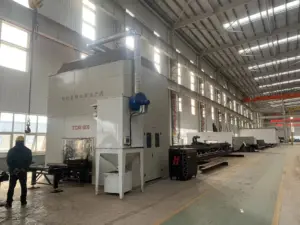
The Dawn of 20kW Fiber Power in Structural Steel Fabrication
As a fiber laser expert, I have witnessed the rapid escalation of wattage over the last decade, but the jump to 20kW marks a specific turning point for heavy industry. In the context of offshore platform construction—where structural members such as H-beams, I-beams, and U-channels must withstand the relentless forces of the North Sea or the Mediterranean—the 20kW threshold is transformative.
At 20kW, the fiber laser is no longer just a tool for thin sheet metal; it is a high-energy thermal lance capable of piercing and slicing through 40mm to 50mm of carbon steel with surgical precision. For Istanbul-based manufacturers, who sit at the crossroads of European engineering standards and Middle Eastern energy demands, this power level allows for the processing of S355 and S460 structural steels at speeds that make plasma or oxy-fuel cutting look archaic. The high power density results in a narrower kerf and a significantly smaller Heat Affected Zone (HAZ), which is critical for maintaining the metallurgical properties of the steel in high-stress offshore environments.
The Infinite Rotation 3D Head: Redefining Geometry
The “Infinite Rotation” 3D head is the centerpiece of this technological marvel. Traditional laser heads are often limited by cable management, requiring “unwinding” after a certain degree of rotation. An infinite rotation (N x 360°) head utilizes advanced slip-ring technology or specialized fiber routing to allow the cutting nozzle to rotate indefinitely around the C-axis and tilt significantly on the B-axis.
In offshore platform fabrication, components rarely meet at 90-degree angles. Bracing members, jacket legs, and deck supports require complex intersections and precise beveling for weld preparation. The 3D head allows the 20kW beam to follow the contours of a channel or beam, cutting V, X, Y, and K-shaped bevels in a single pass. This capability is essential because offshore structures rely on full-penetration welds to ensure the safety of the crew and the environment. By automating the beveling process directly on the laser cutter, Istanbul’s shipyards can bypass the labor-intensive secondary process of manual grinding or milling, moving parts directly from the laser bed to the welding station.
Istanbul: A Strategic Hub for Offshore Engineering
Istanbul has emerged as a global center for maritime and offshore engineering, particularly within the Tuzla and Yalova corridors. The city’s proximity to major shipping lanes and the burgeoning gas fields in the Black Sea makes it a logical site for the deployment of 20kW CNC laser technology.
By housing these massive 3D beam cutters in Istanbul, Turkish engineering firms are positioning themselves to compete with the highest-tier fabricators in Singapore and South Korea. The ability to handle large-format beams—some reaching lengths of 12 meters or more—with a machine that can switch between a standard H-beam and a complex U-channel without manual reconfiguration is a massive competitive advantage. Furthermore, the local availability of technical expertise in Istanbul ensures that these high-tech machines are maintained and optimized for the specific alloys used in the regional maritime industry.
Optimizing Beam and Channel Processing for Heavy Industry
The structural requirements of offshore platforms necessitate the use of heavy-duty channels and beams that can support the weight of topside modules, drilling rigs, and helidecks. Cutting these profiles involves more than just power; it requires sophisticated sensing and software.
The 20kW CNC systems used in these applications are equipped with advanced “touch-sensing” and “auto-centering” algorithms. Because long structural beams are rarely perfectly straight from the mill, the laser system must map the actual physical orientation of the workpiece in real-time. The 3D head compensates for any bow or twist in the beam, ensuring that the holes, notches, and bevels are placed with sub-millimeter accuracy relative to the beam’s actual geometry. This precision is vital for modular offshore construction, where components fabricated in Istanbul may be shipped thousands of miles to be bolted or welded into a larger assembly; there is zero margin for error in fit-up.
The Impact of 20kW on Weld Preparation and Structural Integrity
In the offshore sector, a weld failure can be catastrophic. Therefore, the quality of the cut surface is paramount. The 20kW fiber laser produces a surface finish that is significantly smoother than plasma cutting. This smoothness reduces the risk of hydrogen cracking and ensures better fusion during the welding process.
Moreover, the “infinite rotation” capability allows for “variable beveling.” As the laser moves along the curved intersection of a pipe-to-beam joint (a common occurrence in offshore jackets), the angle of the bevel may need to change constantly to maintain the correct “dihedral angle” for the weld. A 5-axis 3D head, driven by sophisticated CAM software, can adjust this angle on the fly. This ensures that the welder (or welding robot) is presented with a consistent gap and land, resulting in a weld that meets the stringent DNV or API standards required for offshore certification.
Efficiency and Sustainability in the Istanbul Shipyard Ecosystem
The move toward 20kW laser cutting is also a move toward more sustainable manufacturing. While 20kW sounds like a high energy requirement, the efficiency of fiber lasers is roughly 30-40% compared to the 10% efficiency of older CO2 technology. Furthermore, the speed of 20kW cutting means the machine is active for a shorter duration per part.
For Istanbul’s industrial zones, this technology reduces waste. The precision of the CNC laser allows for tighter “nesting” of parts on a beam or channel, minimizing the “drop” or scrap material. In an era where the price of high-grade structural steel is volatile, the ability to squeeze more components out of every ton of steel significantly impacts the bottom line of a project. Additionally, because the laser eliminates the need for coolant-heavy mechanical machining or the messy dross of oxy-fuel, the shop floor environment remains cleaner and safer for operators.
Future-Proofing Offshore Fabrication with 3D Laser Technology
As the energy sector evolves toward offshore wind and hydrogen production, the demand for structural steel fabrication will only increase. Offshore wind turbine foundations (monopiles and jackets) require even more specialized cutting than traditional oil and gas platforms. The 20kW CNC Beam and Channel Laser Cutter is perfectly suited for this transition.
The flexibility of the 3D head means that as designs change—becoming lighter or more complex to accommodate deeper waters—the laser system can adapt via software updates rather than expensive hardware overhauls. Istanbul, with its growing focus on renewable energy infrastructure, is the ideal theater for this technological evolution. The integration of AI-driven nesting and real-time monitoring of the 20kW beam will further refine the process, making the Turkish offshore fabrication sector a global leader in high-precision, heavy-duty manufacturing.
Conclusion: The Cutting Edge of the Bosphorus
The deployment of a 20kW CNC Beam and Channel Laser Cutter with an Infinite Rotation 3D Head in Istanbul is more than just an equipment upgrade; it is a strategic repositioning of the region’s industrial capability. By solving the most difficult challenges in offshore fabrication—thick material penetration, complex beveling, and geometric precision—this technology ensures that the platforms of tomorrow are built more safely, quickly, and efficiently. As a fiber laser expert, I see this as the definitive future of structural steel: where the raw power of the 20kW beam meets the infinite agility of 3D motion, creating the backbone of the world’s most resilient offshore structures.