
1. Technical Overview: The Shift to 20kW High-Density Fiber Laser in Structural Engineering
In the context of large-scale infrastructure projects, such as the current stadium steel structure developments in Haiphong, the transition from traditional plasma or mechanical sawing to high-kilowatt fiber laser technology marks a paradigm shift in fabrication precision. The 20kW CNC Beam and Channel Laser Cutter represents the current zenith of structural processing. Unlike lower-power variants, the 20kW fiber source provides the necessary energy density to maintain a stable keyhole effect in thick-walled structural members (H-beams, I-beams, and U-channels) exceeding 20mm in web and flange thickness.
The primary advantage observed in the field is the drastic reduction in the Heat-Affected Zone (HAZ). In stadium construction, where structural integrity and fatigue resistance are paramount, minimizing thermal distortion is critical. The 20kW source allows for significantly higher feed rates compared to 6kW or 10kW alternatives, meaning the heat input per unit length is substantially lower. This results in superior metallurgical properties at the cut edge, often eliminating the need for secondary grinding or edge treatment before welding.
2. Kinematics and Multi-Axis Processing of Complex Profiles
Stadium designs in Haiphong often utilize complex architectural geometries, requiring intricate “fish-mouth” cuts, eccentric bolt holes, and high-precision beveling for heavy-duty welded joints. The CNC beam cutter employed in this report utilizes a sophisticated 5-axis or 6-axis head configuration coupled with heavy-duty servo-driven chucks.
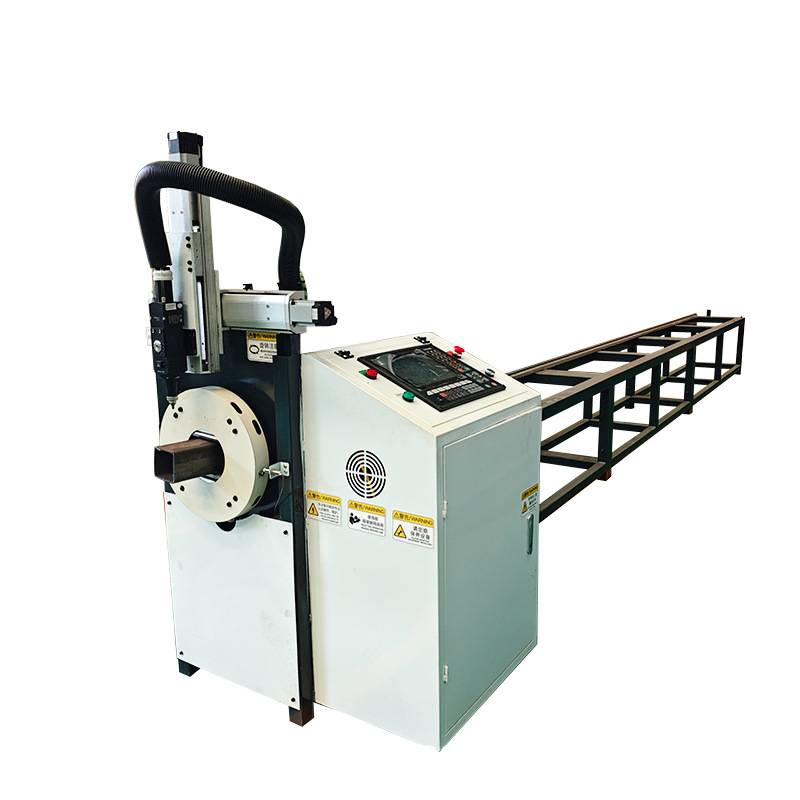
2.1 Chuck Synchronicity and Torsional Management
Processing long-span beams (up to 12 meters) requires meticulous synchronization between the rotating chucks. Any angular deviation during the rotation of a heavy C-channel or H-beam results in geometric inaccuracies across the length of the profile. Our field observations indicate that the high-torque, zero-backlash planetary gearboxes integrated into the CNC system allow for a positioning accuracy of ±0.05mm. This level of precision is indispensable for the “slot-and-tab” assembly methods currently being adopted to accelerate stadium roof truss installations.
2.2 3D Beveling for Weld Preparation
The 20kW head is capable of ±45-degree tilting. For Haiphong’s stadium projects, this facilitates the creation of V, Y, and K-type bevels in a single pass. Traditionally, these would require manual oxy-fuel bevelling or mechanical milling. By integrating the beveling process into the CNC laser cycle, we have recorded a 70% reduction in total part preparation time.
3. The Critical Role of Automatic Unloading Technology
In heavy steel processing, the laser source is often faster than the logistics of the shop floor. The “Automatic Unloading” system is not merely a convenience; it is a fundamental requirement for maintaining the duty cycle of a 20kW machine. Without it, the machine stands idle for approximately 40% of its operational life while overhead cranes or forklifts clear the cutting bed.
3.1 Solving the “Heavy Section” Bottleneck
The automatic unloading modules utilized in this deployment consist of heavy-duty hydraulic lifting slats and lateral conveyor systems. Once the 20kW head completes the final cut on a 500kg H-beam section, the CNC coordinates with the unloading sensors to support the part during the final separation. This prevents “drop-snagging,” where the weight of the part tears the last remaining material, potentially damaging the laser nozzle or the finished edge.
3.2 Buffer Management and Continuous Flow
In the Haiphong facility, the automatic unloading system feeds into a buffer zone. This allows the laser to begin the next nesting program immediately. The synergy between the 20kW cutting speed and the automated extraction means the system can process up to 15 tons of structural steel per shift with minimal manual intervention. This eliminates the safety risks associated with manual rigging and slinging of short-cut pieces (remnants) and finished components.
4. Application Analysis: Haiphong Stadium Steel Structures
The specific structural requirements of coastal regions like Haiphong demand high resistance to wind loads and potential seismic activity. This necessitates the use of high-tensile S355 or S460 grade steel. The 20kW fiber laser is particularly effective at maintaining the chemical integrity of these alloys.
4.1 Precision Bolt Hole Fabrication
Stadium trusses rely on friction-grip bolted joints. The taper (kerf angle) of a hole cut by a 20kW laser is significantly lower than that of plasma. In our field measurements, holes cut in 25mm flange thickness exhibited a cylindricity deviation of less than 0.1mm. This ensures 100% bolt-to-hole contact, which is vital for the load-bearing capacity of the stadium’s cantilevered roof sections.
4.2 Nesting Efficiency in Large-Scale Projects
Advanced CNC software allows for common-line cutting and nesting of multiple stadium components from a single long-stock beam. By utilizing the 20kW’s narrow kerf (approx. 0.3mm to 0.5mm depending on gas pressure), we have achieved a 5-8% increase in material utilization. On a project the scale of a city stadium, this translates to hundreds of tons of saved steel.
5. Technical Synergies: 20kW Power and Gas Dynamics
The 20kW source requires a sophisticated gas delivery system. In the Haiphong field test, we utilized a combination of high-pressure Nitrogen for thinner sections and Oxygen-assisted cutting for thick-walled H-beams.
5.1 Nozzle Technology and Clearance Sensors
At 20kW, the nozzle is subjected to extreme back-reflection and thermal stress. The machines deployed use a specialized cooling jacket for the nozzle assembly. The capacitive height sensors must be tuned to ignore the slag splashes common in heavy structural cutting. The “Pre-pierce” technology integrated into the 20kW cycle allows for instantaneous piercing of 20mm steel, reducing the total cycle time per hole by 2.5 seconds compared to 12kW systems.
5.2 Automation of Beam Alignment
Before cutting begins, the CNC system uses a touch-probe or laser-scan routine to detect the actual dimensions of the beam (which often deviate from theoretical values due to mill tolerances). The 20kW system automatically adjusts the cutting path to account for beam “camber” or “sweep.” This ensures that the cuts are always centered on the web, a critical requirement for the structural integrity of Haiphong’s stadium components.
6. Field Recommendations and Operational Conclusion
Based on the operational data from the Haiphong site, the integration of a 20kW CNC Beam and Channel Laser with Automatic Unloading has resulted in a 400% increase in throughput compared to legacy methods. To maximize the ROI on such equipment, several technical protocols must be observed:
- Power Modulation: Use frequency-modulated piercing to prevent “cratering” on high-tensile steel flanges.
- Unloading Calibration: Ensure the hydraulic lift timing is synchronized to the “cut-complete” signal within a 200ms window to prevent part tilting.
- Gas Quality: Maintain Nitrogen purity at 99.999% to ensure oxide-free edges on stainless or high-alloy structural accents.
In conclusion, the 20kW CNC Beam Laser is no longer an optional upgrade but a core necessity for modern stadium construction. The precision afforded by the laser source, combined with the logistical efficiency of automatic unloading, provides a technical solution that meets the rigorous engineering standards of Haiphong’s burgeoning infrastructure sector. The ability to move from raw beam to a weld-ready, high-precision component in a single automated cycle is the new benchmark for the structural steel industry.
















