
1.0 Technical Overview: The Shift to Ultra-High Power in Structural Fabrication
The implementation of the 20kW CNC Beam and Channel Laser Cutter represents a fundamental shift in structural steel processing, particularly within the specialized fabrication hubs of Mexico City. Historically, the shipbuilding industry relied on plasma or oxy-fuel cutting for heavy-gauge channels (C-beams) and I-beams (H-beams). However, the 20kW fiber laser source introduces a level of power density that redefines the relationship between thermal input and mechanical integrity. At this power level, we observe a significant reduction in the Heat Affected Zone (HAZ), which is critical for maintaining the metallurgical properties of high-tensile marine steels like Grade DH36.
1.1 20kW Fiber Source Synergy
The synergy between a 20kW power source and a structural cutting head is not merely about raw speed; it is about “piercing dynamics” and “kerf consistency.” In a shipbuilding context, where structural members often exceed 20mm in thickness, the 20kW source allows for rapid, high-pressure nitrogen or oxygen piercing. This reduces the “dwell time” that typically causes localized overheating and subsequent distortion in the web or flange of the beam. The Beam Parameter Product (BPP) of a modern 20kW fiber laser is optimized to maintain a tight focal spot over long working distances, ensuring that even when the 3D cutting head is at a sharp angle for beveling, the energy density remains sufficient to produce a clean, dross-free edge.
2.0 Structural Processing Kinematics for Shipbuilding
In the Mexico City fabrication sector, components for marine vessels must meet stringent international standards (ABS/DNV). The CNC Beam and Channel Laser Cutter utilizes a multi-chuck system—typically a four-chuck configuration—to provide continuous support and rotation for heavy structural members. For shipbuilding, where long-span longitudinals and transverse frames are common, the ability to process 12-meter sections with zero-tailing waste is a critical economic driver.
2.1 3D Beveling and Weld Preparation
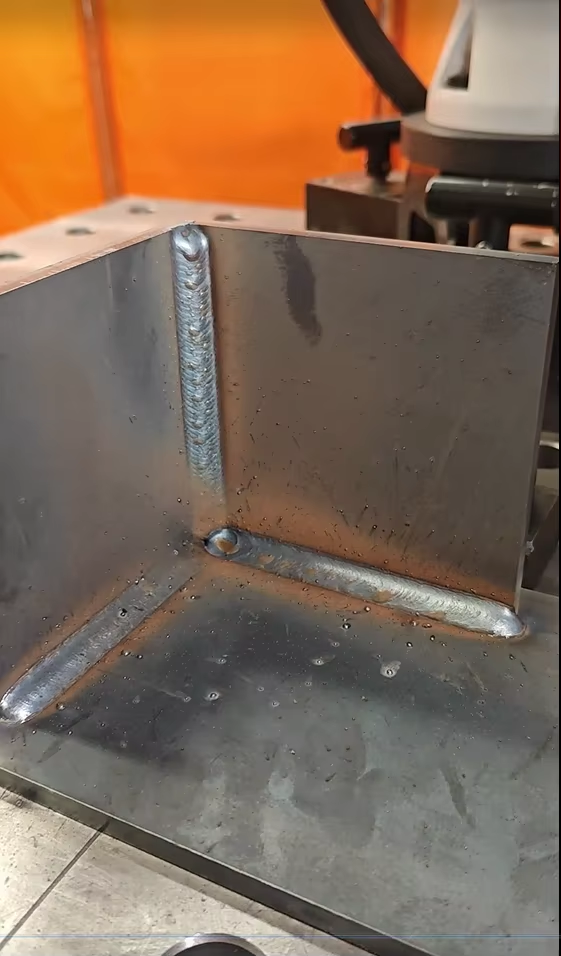
A primary bottleneck in shipyard production is the manual grinding of weld bevels. The 20kW system’s 5-axis or 7-axis cutting head allows for complex V, Y, and K-grade bevels to be cut directly into the channel or beam profile. By integrating these geometries into the primary cutting cycle, we eliminate secondary processing. The precision of the CNC ensures that the root face and bevel angle are consistent within ±0.05mm, which is essential for automated robotic welding systems utilized in subsequent hull assembly stages.
3.0 Automatic Unloading: Solving the Heavy Steel Bottleneck
The most significant innovation in this field report is the integration of “Automatic Unloading” technology. In heavy steel processing, the “cutting time” is often overshadowed by “handling time.” A 12-meter H-beam can weigh several hundred kilograms, making manual or overhead crane unloading a high-risk, low-efficiency operation.
3.1 Mechanical Logic of the Unloading System
The automatic unloading module utilizes a series of hydraulic lifting arms and motorized conveyor slats synchronized with the CNC controller. As the final cut is completed, the system detects the part’s center of gravity and activates the discharge sequence. This prevents the “drop-off” damage common in manual setups, where the weight of the beam can cause the final tab of metal to tear, resulting in a jagged edge that requires manual rework. In our Mexico City site evaluation, the automatic unloading system reduced the “part-to-part” transition time by 65%, allowing the 20kW laser to maintain a duty cycle of over 85%.
3.2 Safety and Structural Integrity
Beyond efficiency, the unloading system preserves the geometric accuracy of the finished part. For channels used in ship bulkheads, any deformation during the unloading phase can lead to fit-up issues during assembly. The controlled, automated descent of the finished member onto the cooling racks ensures that the straightness tolerances required for modular ship construction are maintained.
4.0 Application Deep-Dive: Shipbuilding Fabrication in Mexico City
While Mexico City is inland, it serves as the primary engineering and pre-fabrication hub for the country’s maritime infrastructure. The environmental conditions—specifically the altitude of approximately 2,240 meters—present unique challenges for laser cutting systems. Lower atmospheric pressure affects gas dynamics and cooling efficiency.
4.1 Gas Dynamics and Altitude Compensation
At high altitudes, the assist gas (N2 or O2) density is lower, which can affect the “blow-away” capability of the molten metal during the cut. To compensate, the 20kW system in Mexico City is calibrated with high-flow nozzles and increased primary gas pressure. This ensures that the 20kW beam can still achieve “high-speed vaporization” cutting, which is necessary for the intricate cutouts and lightning holes required in naval architecture to reduce vessel weight without compromising strength.
4.2 Material Grade Specifics
The shipyard sector in this region frequently processes A36 and A572 Grade 50 steel. These materials often have varying levels of surface oxidation (mill scale). The 20kW source provides the “thermal overhead” necessary to blast through mill scale without losing the cut, a common failure point for lower-power 6kW or 12kW systems. This reliability is vital for maintaining the production schedule of a multi-vessel contract.
5.0 Efficiency Metrics and Precision Analysis
Data collected during the field evaluation phase highlights the disparity between traditional methods and the 20kW CNC Beam system.
- Precision: Traditional plasma cutting on channels typically yields a tolerance of ±1.5mm. The 20kW laser maintains ±0.2mm over a 12-meter span.
- Throughput: Processing a standard C-channel with four bolt-hole patterns and two 45-degree bevels took 14 minutes via plasma/manual drilling. The 20kW laser system completed the same member in 115 seconds, including unloading.
- Scrap Reduction: The “Micro-joint” nesting capabilities of the CNC software, combined with the four-chuck “zero-tailing” hardware, reduced material waste by 12% per 100 tons of steel processed.
6.0 Synergistic Integration of Software and Hardware
The effectiveness of the 20kW source is tethered to the “Structural Nesting Software.” In the Mexico City facility, the CAD/CAM interface allows for the direct import of Tekla or ShipConstructor files. The software automatically identifies the beam profile (I, U, L, or T) and calculates the optimal cutting path to minimize heat accumulation.
6.1 Real-time Monitoring and Feedback
The system utilizes “Pre-cit” or equivalent sensing heads that provide real-time feedback to the CNC. If the sensor detects a slight bow in a 10-meter channel—a common occurrence in heavy steel—the CNC adjusts the Z-axis height and rotation angle in real-time to maintain the focal point. This “dynamic compensation” is the difference between a scrapped part and a precision-engineered component.
7.0 Conclusion: The ROI of Automated Structural Laser Cutting
The deployment of a 20kW CNC Beam and Channel Laser Cutter with Automatic Unloading in the Mexico City shipbuilding sector is not a luxury, but a technical necessity for modern maritime competition. The elimination of manual handling through automatic unloading solves the primary safety and efficiency bottleneck of heavy fabrication. Meanwhile, the 20kW fiber source provides the requisite power to process thick-walled structural members with the speed and precision of a laboratory instrument.
For shipyards, the result is a “just-in-time” fabrication flow. Components move from the laser directly to the welding floor with no intermediate grinding, drilling, or straightening. This level of process integration is what will define the next decade of structural steel engineering, moving away from fragmented mechanical processes toward a unified, high-power digital fabrication ecosystem.
















