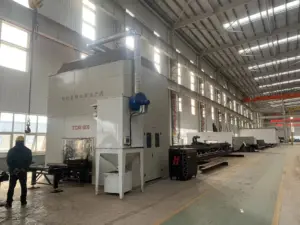
The Dawn of Ultra-High Power: Why 20kW Matters for Offshore Structures
In the realm of fiber laser technology, the leap to 20kW represents a paradigm shift rather than a mere incremental upgrade. For the offshore platform industry—where structural integrity is non-negotiable—the ability to cut through thick carbon steel and stainless steel with surgical precision is paramount. A 20kW fiber laser source provides the photon density required to maintain a stable keyhole during the cutting process, even in materials exceeding 30mm to 50mm in thickness.
For offshore platforms, components like I-beams, H-beams, and C-channels form the skeletal framework that must withstand extreme hydrostatic pressure and corrosive maritime environments. Traditional plasma or oxy-fuel cutting often leaves a wide kerf and a significant heat-affected zone, which can compromise the metallurgical properties of the steel. The 20kW fiber laser, however, concentrates energy so intensely that the material is vaporized almost instantly. This results in a narrow kerf, minimal thermal distortion, and a surface finish that often requires zero post-processing before welding.
Advanced CNC Processing for Beams and Channels
Standard flatbed lasers are insufficient for the complex geometries required in offshore engineering. A 20kW CNC Beam and Channel Laser Cutter utilizes a multi-axis head—often a 5-axis or 6-axis system—combined with a heavy-duty rotary chuck system. This allows the laser to move around the profile of the beam, executing complex miters, notches, bolt holes, and “Cope” cuts in a single pass.
In Riyadh’s fabrication shops, these machines are being used to process “heavy sections.” When a 20kW laser tackles a 400mm I-beam, the CNC software must calculate real-time compensations for material irregularities. The integration of 3D scanning probes ensures that the laser head maintains a constant focal distance, even if the structural steel has slight deviations or “twist” from the mill. This level of precision is critical for offshore jackets and topsides, where thousands of components must fit together with sub-millimeter tolerances to ensure structural load distribution.
The Necessity of Automatic Unloading in Riyadh’s Industrial Hubs
Efficiency in high-power laser cutting is often hindered not by the speed of the light, but by the speed of material handling. A 20kW laser can process structural profiles at speeds that render manual unloading impossible to sustain. This is where the “Automatic Unloading” system becomes the backbone of the operation.
In a typical Riyadh-based facility, these systems utilize heavy-duty hydraulic lifters and chain-driven conveyors. Once the laser completes the intricate cuts on a 12-meter beam, the automated system detects the finished part and transitions it to a cooling and collection zone without operator intervention. This serves two vital purposes:
1. **Safety:** Structural beams for offshore platforms are incredibly heavy. Automatic unloading removes the risk of workplace injuries associated with overhead cranes and manual rigging in the immediate vicinity of the laser cell.
2. **Continuous Cycle:** It allows for “lights-out” manufacturing. While the unloader is clearing the previous workpiece, the loader is already positioning the next beam, maximizing the “beam-on” time of the 20kW source.
Optimizing for Offshore Platforms: Beveling and Weld Preparation
One of the most significant advantages of a 20kW system in the offshore sector is its ability to perform high-speed beveling. Offshore structures require V, Y, X, and K-shaped weld preparations to ensure full penetration welds. Traditionally, this was a secondary process involving manual grinding or mechanical milling.
With the 20kW CNC system, the laser head can tilt up to 45 degrees. Because of the immense power available, the laser can maintain high cutting speeds even when the “effective thickness” increases due to the angle of the cut. This integration of beveling into the primary cutting cycle reduces the production time of offshore structural nodes by as much as 70%. In the competitive landscape of Saudi Arabia’s energy sector, this speed-to-market is a decisive factor for contractors working on Aramco-related projects.
Adapting Fiber Laser Technology to the Riyadh Environment
Operating a 20kW laser in Riyadh presents unique environmental challenges, specifically regarding ambient temperature and airborne particulates. Fiber lasers are sensitive to heat; therefore, the cooling system (chiller) for a 20kW unit must be significantly over-engineered compared to units used in temperate climates.
Expert installations in Riyadh utilize dual-circuit high-capacity chillers with specialized refrigerants to maintain the laser source and the cutting head at a constant 22-25°C, even when outside temperatures soar above 45°C. Furthermore, the “Beam and Channel” cutters are equipped with pressurized optical paths and advanced dust extraction systems. This prevents the fine metallic dust generated during the 20kW cutting process from contaminating the protective windows, ensuring the longevity of the expensive optical components.
The Economic Impact: ROI and Local Content (IKTVA)
The investment in a 20kW CNC laser with automatic unloading aligns perfectly with the In-Kingdom Total Value Add (IKTVA) program. By adopting this technology, Riyadh-based firms reduce their reliance on imported pre-cut steel. They can purchase raw mill-length sections and perform all high-precision fabrication locally.
The Return on Investment (ROI) is driven by three factors:
* **Material Utilization:** Advanced nesting software for beams minimizes “remnants,” saving tons of high-cost marine-grade steel annually.
* **Labor Reduction:** The automatic unloading system allows one operator to manage what would previously have required a team of four.
* **Energy Efficiency:** Despite the high power, modern 20kW fiber lasers have a wall-plug efficiency of over 40%, far exceeding the efficiency of older CO2 lasers or plasma systems.
The Future of Offshore Fabrication in Saudi Arabia
As Saudi Arabia expands its offshore wind potential in the Red Sea and continues to develop its oil and gas fields in the Gulf, the demand for structural steel fabrication will only intensify. The 20kW CNC Beam and Channel Laser Cutter represents the pinnacle of current manufacturing technology.
Looking forward, the integration of AI-driven predictive maintenance will be the next step for Riyadh’s laser hubs. Sensors within the 20kW cutting head can monitor the health of the lens and the consistency of the gas flow, alerting technicians before a failure occurs. This ensures that the massive offshore projects, which are vital to the Kingdom’s economy, stay on schedule.
In conclusion, the deployment of 20kW fiber laser technology in Riyadh is more than a technical upgrade; it is a strategic industrial asset. By combining the raw power of 20,000 watts with the intelligence of CNC 3D processing and the efficiency of automatic unloading, Saudi fabricators are setting a new global standard for how offshore platforms are built—stronger, faster, and with a precision that was once thought impossible.