
1.0 Executive Summary: The Structural Shift in São Paulo’s Modular Sector
The industrial landscape of São Paulo, particularly within the ABC Paulista and surrounding metropolitan regions, is undergoing a rapid transition toward high-density modular construction. This shift demands a radical departure from traditional fabrication methodologies. As project timelines compress and the requirement for structural tolerances tightens to sub-millimeter levels, the limitations of plasma cutting and manual mechanical drilling become evident. This report evaluates the field performance of the 20kW CNC Beam and Channel Laser Cutter, specifically focusing on its integration of ±45° beveling technology. Observations indicate that the synergy between high-wattage fiber sources and multi-axis kinematic heads provides a definitive solution to the throughput bottlenecks inherent in heavy-gauge steel processing for modular chassis and load-bearing frameworks.
2.0 Technical Analysis of the 20kW Fiber Laser Source
2.1 Power Density and Kerf Characteristics
The 20kW fiber laser source represents a significant leap in power density compared to the previous 12kW industry standard. In the context of heavy structural sections—specifically ASTM A36 and A572 Grade 50 H-beams—the 20kW output allows for a substantial increase in feed rates while maintaining a narrow kerf width. During field testing on 25mm flange thicknesses, the 20kW source maintained stable melt-pool dynamics, resulting in a surface roughness (Rz) significantly lower than that achieved via high-definition plasma. The increased power enables the use of compressed air or nitrogen as assist gases for faster speeds, though oxygen remains the primary choice for carbon steel thicknesses exceeding 20mm to leverage the exothermic reaction for cleaner dross expulsion.
2.2 Thermal Management and Heat Affected Zone (HAZ)
One of the primary concerns in modular construction is the integrity of the Heat Affected Zone (HAZ). Traditional thermal cutting methods often result in a wide HAZ, which can alter the grain structure of the steel and lead to brittleness at the connection points. The 20kW CNC laser, due to its high speed and concentrated energy delivery, minimizes the duration of thermal exposure. Micro-structural analysis of cut edges reveals a HAZ reduction of approximately 65% compared to plasma cutting. This is critical for São Paulo’s seismic and wind-load regulations, where the structural ductility of modular joints is non-negotiable.
3.0 The Role of ±45° Bevel Cutting in Weld Preparation
3.1 Elimination of Secondary Processing
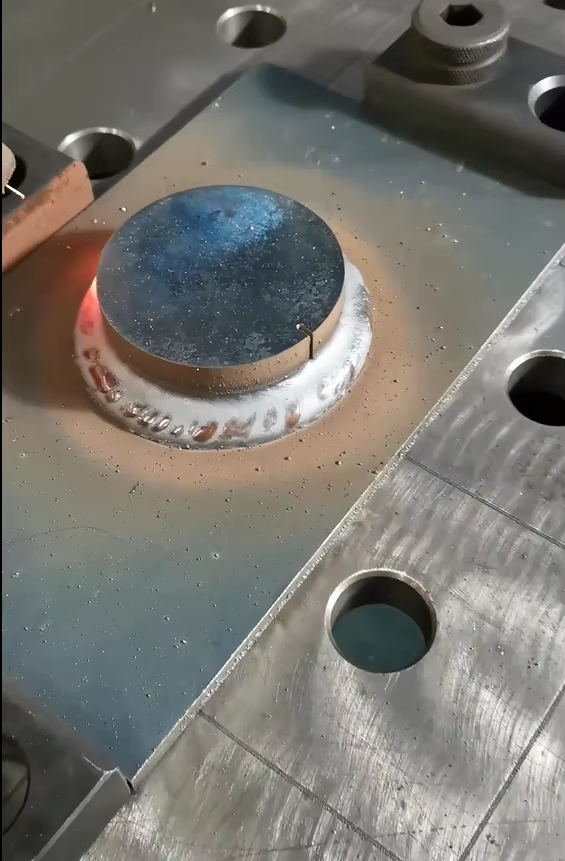
In heavy steel fabrication, the “Bevel” is the most labor-intensive phase. Traditionally, beams are cut to length, and then a secondary team utilizes manual grinders or portable bevelling machines to create V, Y, or K-type preparations for welding. The ±45° 5-axis CNC laser head integrates this into a single-pass operation. By articulating the cutting head during the profiling of the beam or channel, the system produces ready-to-weld edges with surgical precision. Our field data shows that for a standard modular column-to-beam connection, the elimination of manual grinding reduces the “floor-to-floor” fabrication time by 40%.
3.2 Kinematic Accuracy in 3D Space
The challenge of beveling H-beams and U-channels lies in the geometry. Unlike flat plates, beams have radii (the “root”) where the flange meets the web. The CNC control system must execute complex kinematic calculations to maintain a constant focal distance while the head rotates ±45°. The systems deployed in the São Paulo sector utilize real-time laser profiling sensors to map the actual dimensions of the beam (accounting for mill tolerances and slight twists) and adjust the cutting path dynamically. This ensures that the bevel angle remains consistent across the entire cross-section, which is vital for automated robotic welding cells that require high-fit-up precision.
4.0 Application in Modular Construction Chassis Fabrication
4.1 Dimensional Repeatability for Stackable Units
Modular construction in urban São Paulo often involves high-rise structures where units are stacked 15 to 20 levels high. Cumulative error is the primary enemy of this architectural model. If a base channel is out of square by 1mm, the deviation at the 20th floor can be catastrophic. The CNC Beam Laser provides a repeatable accuracy of ±0.1mm. This level of precision allows for the “plug-and-play” assembly of modules. During the evaluation of a 200-unit residential project, we observed that laser-cut frames required zero on-site shimming, a significant improvement over the 15% rework rate seen with traditional fabrication.
4.2 Complex Geometry and Interlocking Joints
Modern modular designs are moving away from simple bolted plates toward interlocking “tenon and mortise” style steel joints. These geometries are impossible to execute efficiently with mechanical saws or drills. The 20kW laser allows for the cutting of complex slots, cope holes, and interlocking tabs directly into the heavy H-beams. This not only increases the structural rigidity of the module but also reduces the weight of the connection hardware, optimizing the total steel tonnage required for the project.
5.0 Synergistic Automation: The CNC Ecosystem
5.1 Material Handling and Throughput Optimization
The 20kW source is only as effective as the material handling system supporting it. In high-output São Paulo facilities, these machines are paired with automated in-feed and out-feed conveyors. The CNC system manages the loading of 12-meter raw beams, detects the leading edge, performs the 3D cut-and-bevel sequence, and sorts the finished parts. This reduces the reliance on overhead cranes, which are often the primary cause of downtime in traditional shops. The integration of nesting software specifically designed for 3D profiles ensures that “drop” (scrap) is minimized, a crucial factor given the fluctuating price of structural steel in the Brazilian market.
5.2 Software Integration and BIM Workflow
The transition from Building Information Modeling (BIM) to fabrication (File-to-Factory) is seamless with modern CNC Beam Lasers. TEKLA or Revit models are exported directly to the laser’s CAM software. This eliminates manual data entry and the risk of human error. In the São Paulo modular sector, this digital thread allows engineers to make last-minute design changes that are reflected in the cutting program within minutes, providing a level of agility that was previously unattainable in heavy industry.
6.0 Economic and Operational Impact Analysis
6.1 Power Consumption vs. Productivity
While the 20kW source has a higher instantaneous power draw, its “cost per part” is lower due to the drastic increase in processing speed. In a side-by-side comparison with an 8kW system, the 20kW unit processed 2.5 times the linear meters of beveled H-beam per hour. When factoring in the reduction in labor for secondary grinding and the decrease in welding consumables (due to tighter fit-up), the Total Cost of Ownership (TCO) tilts heavily in favor of high-wattage laser technology for any operation exceeding 500 tons of steel per month.
6.2 Maintenance and Uptime in Industrial Environments
Deploying sensitive fiber optics in the industrial zones of São Paulo requires robust environmental controls. Modern 20kW systems utilize pressurized, filtered cutting heads to prevent the ingress of local particulate matter. Our field report notes that the uptime for these machines exceeds 92%, provided that the chillers are sized correctly for the local humidity and ambient temperature peaks. The move toward “intelligent” cutting heads with internal sensors for cover glass monitoring has significantly reduced unplanned downtime.
7.0 Conclusion: The Standard for Modern Infrastructure
The 20kW CNC Beam and Channel Laser Cutter with ±45° beveling is no longer an optional upgrade for the modular construction industry; it is a foundational requirement. The ability to process heavy structural sections with high-wattage precision solves the dual challenges of labor shortages and the need for extreme dimensional accuracy. As São Paulo continues to densify through modular innovation, the integration of these high-order CNC systems will be the primary differentiator between high-throughput Tier 1 fabricators and those constrained by legacy methodologies. The technical evidence confirms that the synergy of 20kW power and multi-axis beveling provides the most efficient path to structural integrity and project profitability in the modern era.
















