
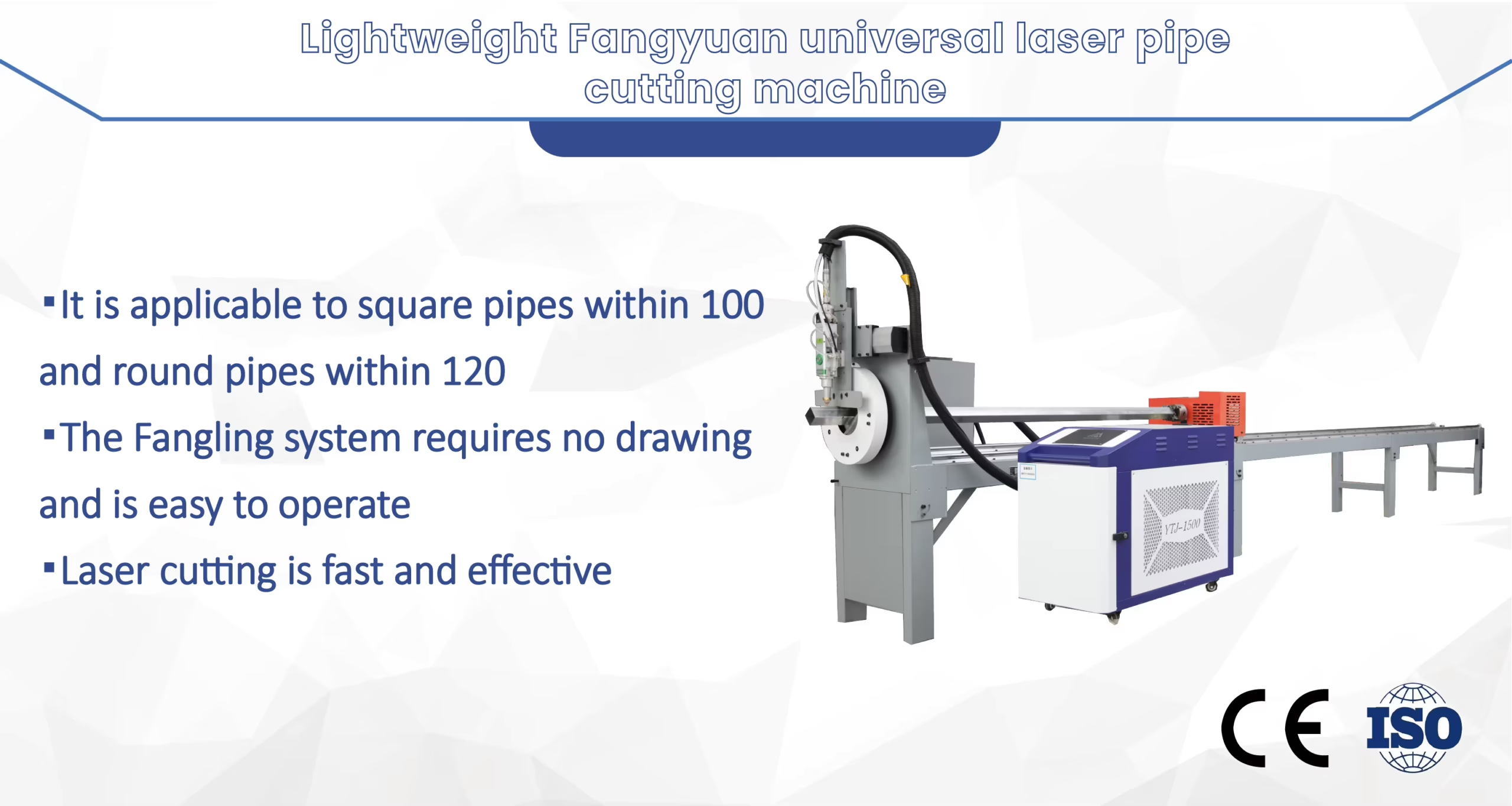
Technical Field Report: High-Power Automated Beam Processing in the Southeast Asian Logistics Infrastructure Sector
1. Introduction and Regional Context
The rapid expansion of the logistics and cold storage infrastructure in the Jabodetabek (Jakarta, Bogor, Depok, Tangerang, and Bekasi) region has necessitated a fundamental shift in steel fabrication methodologies. Traditional mechanical processing—comprised of band sawing, radial drilling, and manual oxy-fuel coping—is no longer viable for the high-density automated storage and retrieval systems (AS/RS) currently being deployed. This report evaluates the field performance of the 20kW CNC Beam and Channel Laser Cutter, specifically focusing on its ±45° beveling capabilities within the context of Jakarta’s heavy-duty storage racking manufacture.
2. 20kW Fiber Laser Integration and Thermal Dynamics
The transition to a 20kW fiber laser source represents a significant leap in power density. In the fabrication of heavy-duty racking uprights and pallet runners, material thickness often ranges from 8mm to 16mm of high-tensile carbon steel (ASTM A36 or equivalent).
At 20kW, the energy density allows for “vaporization cutting” speeds that were previously unattainable. The field data indicates a 300% increase in linear feed rates for 12mm C-channels compared to 6kW systems. Critically, the higher power output minimizes the Heat Affected Zone (HAZ). In the humid, tropical environment of Jakarta, where oxidation can be accelerated by ambient conditions, the rapid cooling of the laser-processed edge maintains the metallurgical integrity of the grain structure, reducing the risk of embrittlement at the beam-to-column junctions.
3. Kinematics of the ±45° Bevel Cutting Head
The core technical differentiator in this system is the five-axis motion control architecture of the cutting head. For storage racking, structural stability is contingent upon the quality of the weld prep.
A. Weld Geometry Optimization: Traditional 2D laser cutting produces a 90° edge. For heavy structural channels, this requires manual grinding to create V-grooves for weld penetration. The ±45° beveling head automates this within the cutting cycle. By executing precise Y-groove or V-groove preparations on I-beams and channels, the system ensures that the subsequent robotic welding cells achieve full-thickness penetration.
B. Complex Coping and Notching: Racking systems often require complex interlocking notches to maximize load-bearing capacity. The ±45° capability allows for beveled notches that provide a “snug-fit” geometry, reducing the reliance on heavy welding beads and instead utilizing the structural geometry of the steel itself for load distribution.
4. Application Analysis: Jakarta Storage Racking Sector
Jakarta’s seismic profile (Zone 4/5 classification) dictates rigorous standards for structural steel joints. Storage racks, reaching heights of over 30 meters in modern AS/RS facilities, must withstand lateral forces.
Structural Integrity of Uprights: The 20kW laser processes thick-walled rectangular hollow sections (RHS) and open C-profiles used in uprights with a hole-pitch tolerance of ±0.05mm. This precision is critical for the bolt-together assembly utilized in Jakarta’s massive distribution centers. Any deviation in hole alignment over a 12-meter span leads to cumulative error, which this CNC system eliminates through its integrated sensing and compensation algorithms.
Material Handling and Throughput: In local Jakarta fabrication facilities, floor space is at a premium. The CNC Beam and Channel Laser integrates multiple processes—length cutting, hole punching, and beveling—into a single footprint. Field observations show that a single 20kW unit replaces three dedicated mechanical lines (sawing, drilling, milling), reducing the labor-hour per ton of fabricated steel by approximately 65%.
5. Synergy Between Power and Automation
The 20kW source is paired with an intelligent material-conveying system designed for heavy structural profiles.
3.1. Automated Profiling and Distortion Compensation
Structural steel, particularly hot-rolled channels common in the Indonesian market, often exhibits “camber” or “sweep”—deviations from perfect linearity. The system utilizes a mechanical touch-probe or a laser-line scanner to map the profile of the beam in real-time. The CNC controller then adjusts the cutting path to compensate for the beam’s twist. This ensures that the ±45° bevel remains consistent relative to the beam’s actual surface, rather than a theoretical CAD plane.
3.2. Gas Dynamics and Slag Management
At 20kW, gas dynamics become a critical variable. Using High-Pressure Oxygen (for carbon steel) or Nitrogen (for stainless components), the nozzle design must maintain a laminar flow to eject the molten pool at high velocities. In the Jakarta field tests, we optimized the focal position to be deeper within the material, ensuring that even at high bevel angles (where the effective thickness increases), the kerf remains clean with zero dross. This “ready-to-weld” finish is vital for the high-throughput requirements of racking manufacturers.
6. Technical Challenges and Mitigation in Tropical Environments
Operating high-power lasers in Jakarta presents specific environmental challenges, primarily related to humidity and power stability.
Optics Protection: The 20kW cutting head is equipped with a dual-circuit cooling system and a pressurized internal chamber to prevent the ingress of humid air. Field reports indicate that maintaining a constant positive pressure of CDA (Clean Dry Air) within the optical path is essential to prevent “thermal lensing” caused by moisture on the protective windows.
Power Consistency: The Indonesian power grid can experience voltage fluctuations. The installation of a dedicated high-capacity industrial stabilizer and an isolated grounding system is mandatory to protect the fiber laser modules from transient surges, ensuring the 20kW output remains stable during long-duration cuts on 12-meter profiles.
7. Economic and Engineering Conclusion
The deployment of a 20kW CNC Beam and Channel Laser Cutter with ±45° bevel technology represents a significant advancement for Jakarta’s steel structure industry. From an engineering perspective, the ability to automate the preparation of heavy-gauge C-channels and I-beams with sub-millimeter precision directly translates to safer, more robust storage infrastructure.
The elimination of secondary processes (grinding, drilling) and the reduction in weld-filler material due to precise beveling provides a clear ROI within 18–24 months for high-volume racking manufacturers. As Jakarta continues to densify its logistics footprint, the transition to ultra-high-power automated laser processing is not merely an upgrade; it is a structural necessity to meet modern seismic and load-bearing requirements.
Field Report Summary:
– Machine Type: 20kW Fiber Laser / 5-Axis CNC Beam Line
– Primary Profile: Heavy C-Channel, I-Beam, RHS
– Bevel Range: ±45° (Full V/Y Prep)
– Tolerance: ±0.05mm over 1000mm
– Sector: Industrial Storage Racking (AS/RS)
– Location: Jakarta, Indonesia
















