The Dawn of Ultra-High Power: Why 20kW Matters for Rail
In the world of structural steel, thickness and throughput are the twin challenges that determine the profitability of a project. For decades, the railway industry relied on plasma cutting, oxy-fuel, or mechanical sawing and drilling. However, the introduction of the 20kW fiber laser has disrupted this status quo.
At 20kW, the energy density at the focal point is immense. For railway infrastructure, which utilizes heavy-walled channels and thick-webbed beams, this power level is not just a luxury; it is a functional necessity. A 20kW source allows for the high-speed sublimation of carbon steel up to 50mm and beyond, while maintaining a heat-affected zone (HAZ) that is significantly narrower than plasma. In railway applications, where fatigue resistance is paramount, minimizing the HAZ is critical to preventing micro-cracks that could lead to structural failure under the constant vibration of passing trains.
The Geometric Revolution: 3D Processing of Beams and Channels
Traditional laser cutters were limited to flat sheets. The 20kW CNC Beam and Channel Cutter, however, utilizes a sophisticated multi-chuck rotary system that allows the laser head to move in 3D space around a stationary or moving profile.
Whether it is an H-beam for a bridge support or a C-channel for a station framework, the machine treats the structural section as a three-dimensional manifold. The CNC system compensates for the inherent deviations in hot-rolled steel—such as “camber” or “sweep”—using touch-sensing or laser-scanning probes. This ensures that every bolt hole, slot, and cut-out is placed with sub-millimeter accuracy relative to the actual geometry of the beam, a feat impossible with traditional mechanical templates.
Mastering the ±45° Bevel: The Key to Superior Welding
Perhaps the most transformative feature of this machine is the ±45° bevel cutting head. In railway construction, beams are rarely joined with simple butt welds. Complex structural nodes require V-type, Y-type, X-type, or K-type weld preparations to ensure full penetration and structural rigidity.
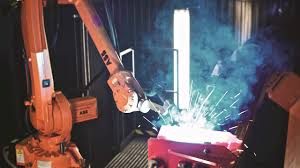
Traditionally, beveling was a secondary process performed by manual grinders or specialized milling machines. This was labor-intensive, prone to human error, and environmentally hazardous due to dust and noise. The 20kW fiber laser integrates beveling into the primary cutting cycle. By tilting the cutting head up to 45 degrees, the machine can create precise chamfers and complex edges in a single pass. For Dubai’s railway projects, this means that components arriving at the construction site are “weld-ready.” The fit-up precision is so high that robotic welding systems can be deployed more effectively, further accelerating the construction timeline.
Strategic Implementation in Dubai’s Railway Infrastructure
Dubai serves as the nerve center for the UAE’s infrastructure ambitions. With the Etihad Rail connecting the country’s major ports and industrial hubs, the demand for high-strength structural steel has skyrocketed.
The 20kW laser is uniquely suited for the Dubai market for several reasons:
1. **Speed to Market:** Projects in Dubai are known for their aggressive timelines. The ability to process a 12-meter H-beam with complex cut-outs and bevels in a fraction of the time required by traditional methods is a massive competitive advantage.
2. **Resource Efficiency:** In a region where skilled labor can be a bottleneck, automating the most difficult aspects of steel fabrication reduces the reliance on manual intervention.
3. **Material Optimization:** Advanced nesting software for beam cutters minimizes “tailing” (waste material at the end of a beam), which is vital given the volatility of global steel prices.
Addressing the Environmental Challenges of the Middle East
Operating a 20kW fiber laser in Dubai’s climate requires specialized engineering. The intense heat and high humidity can affect the stability of the laser resonator and the precision of the mechanical components.
Modern 20kW systems designed for this region feature “Dual-Circuit” high-capacity industrial chillers. These units maintain the laser source and the cutting head at a constant, optimal temperature, even when the ambient warehouse temperature exceeds 45°C. Furthermore, the machines are equipped with pressurized, IP65-rated electrical cabinets to prevent the ingress of fine desert sand and dust, which can wreak havoc on sensitive optical and electronic components.
The Synergy of Software and Hardware: CAD/CAM Integration
A 20kW laser is only as smart as the software driving it. For railway infrastructure, the integration of Building Information Modeling (BIM) data is essential. The CNC systems of these cutters can import Tekla or Autodesk Revit files directly.
This digital workflow ensures that the “Digital Twin” of the railway station or bridge matches the physical component perfectly. The software automatically calculates the complex kinematics required for the ±45° beveling, accounting for the beam’s thickness and the required weld gap. This “one-click” transformation from architectural drawing to finished steel component is the backbone of Industry 4.0 in Dubai’s construction sector.
Safety and Structural Integrity in Rail Applications
Railway infrastructure is subject to some of the most stringent safety standards in the world (such as EN 1090 for structural steel execution). The precision of the 20kW laser contributes directly to these standards.
When a hole is drilled mechanically, it can introduce stress concentrations. When cut with a high-power laser, the hole is perfectly circular with a smooth internal finish, reducing the risk of stress-corrosion cracking. Additionally, the ability to laser-mark part numbers and QR codes directly onto the beams during the cutting process ensures 100% traceability—a requirement for modern infrastructure projects where every beam’s origin and batch must be documented for the life of the structure.
ROI and Economic Impact for Dubai Fabricators
While the initial investment in a 20kW CNC laser is higher than plasma or lower-power alternatives, the Return on Investment (ROI) is realized through volume and versatility.
One 20kW beam cutter can typically replace three separate machines (a band saw, a drill line, and a manual beveling station). This consolidation reduces the floor space required—a premium in Dubai’s industrial zones like JAFZA or DIC. Moreover, the reduction in secondary processing means that the cost-per-part drops significantly as the project scale increases. For a fabricator working on a multi-kilometer rail bridge project, the savings in labor and consumables (like drill bits and grinding discs) can amount to millions of dirhams over the project lifecycle.
Future-Proofing Dubai’s Industrial Landscape
As Dubai looks toward the 2030 goals of increased industrial self-sufficiency, the adoption of ultra-high-power fiber lasers is a move toward high-tech manufacturing. These machines are not just tools; they are platforms for innovation. They allow architects and engineers to design more daring railway structures—using lighter, stronger, and more complex geometries—knowing that the technology exists to fabricate them accurately.
The 20kW CNC Beam and Channel Laser Cutter is more than a machine; it is a catalyst for the next generation of Dubai’s infrastructure. By mastering the ±45° bevel and providing the raw power to slice through the toughest alloys, this technology ensures that the railways of the UAE are built to the highest standards of precision and durability, ready to carry the nation into a connected future.