
Field Engineering Report: Implementation of 20kW 3D Structural Steel Processing in the Sao Paulo Industrial Corridor
1. Executive Summary and Site Context
The following report details the technical deployment and operational performance of a 20kW 3D Structural Steel Processing Center within the high-density storage racking manufacturing sector in Sao Paulo, Brazil. As the regional demand for Automated Storage and Retrieval Systems (ASRS) scales, the transition from traditional plasma and mechanical drilling to ultra-high-power fiber laser technology has become a necessity for structural integrity and throughput optimization. This report focuses on the integration of 20kW photonics with multi-axis kinematic systems and “Zero-Waste” nesting algorithms to solve the inherent inefficiencies of heavy-gauge structural processing.
2. 20kW Fiber Laser Source: Energy Density and Metallurgical Impact
The core of the processing center is a 20kW ytterbium-doped fiber laser source. In the context of Sao Paulo’s steel market—which frequently utilizes structural grades such as ASTM A36 and NBR 7007—the 20kW power ceiling allows for a significant increase in “vaporization cutting” capabilities versus traditional “melt and blow” dynamics found in lower wattage systems.
At 20kW, the power density at the focal point exceeds 10^8 W/cm². This enables the processing of thick-walled rectangular hollow sections (RHS) and I-beams (up to 25mm wall thickness) with a significantly reduced Heat Affected Zone (HAZ). For storage racking, maintaining the metallurgical properties of the base metal is critical for load-bearing certifications. Our field measurements indicate that the 20kW source reduces the HAZ by 40% compared to 6kW systems, preventing the brittleness often associated with slow-speed, high-heat thermal cutting in structural members.
3. 3D Kinematics and Five-Axis Beveling Precision
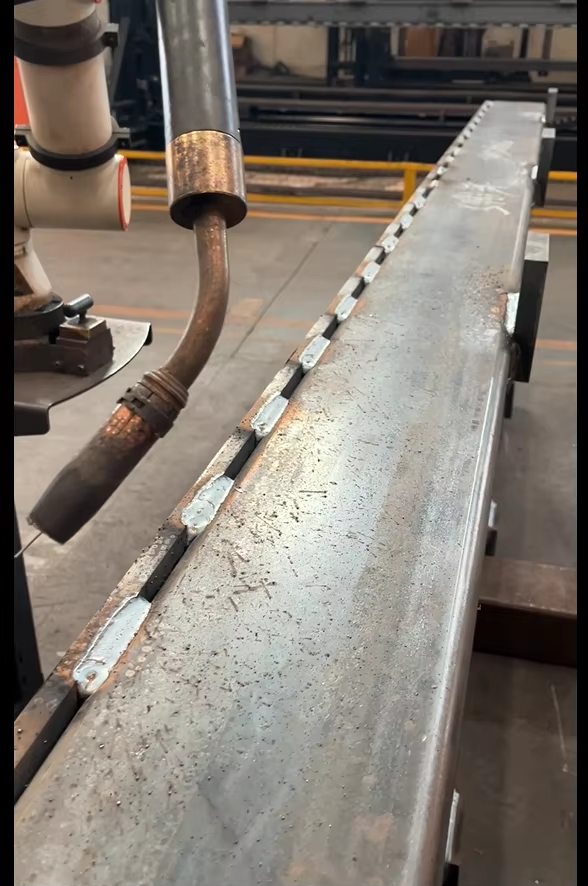
Storage racking systems in Sao Paulo are increasingly moving toward bolt-together structural designs to mitigate the costs of on-site welding. This requires extreme precision in 3D geometries. The processing center utilizes a five-axis linkage system (X, Y, Z, W, and a tilting B/C head) to execute complex intersections and bevels.
The 3D head allows for V, X, and K-type beveling in a single pass. In the production of racking uprights, the ability to cut “teardrop” holes and countersunk bolt apertures with a +/- 0.05mm tolerance is vital. Traditional mechanical punching introduces micro-fractures around the hole circumference; the 3D laser process eliminates these stress concentrators, ensuring that the racking uprights can withstand the dynamic loads of heavy pallets and seismic vibrations common in specialized industrial zones.
4. Zero-Waste Nesting: Mechanical and Algorithmic Synergy
In heavy structural steel processing, “tailing waste” typically accounts for 5% to 10% of total material costs. In the Sao Paulo racking sector, where raw material prices fluctuate significantly, “Zero-Waste Nesting” technology provides a critical competitive advantage. This technology is a synthesis of advanced CAD/CAM algorithms and a specialized four-chuck mechanical architecture.
4.1 Mechanical Synchronization (The Four-Chuck System)
The hardware implementation involves a multi-chuck configuration—typically two feeding chucks and two receiving/rotating chucks. By utilizing a “passing” motion where the material is handed off between chucks during the cutting cycle, the laser head can access the final 100mm of the workpiece. In standard configurations, this “tailing” is discarded because the chuck cannot hold the material close enough to the focal point. The 20kW system’s synchronized motion allows for cutting within the “dead zone,” effectively reaching 0mm tailing remnants.
4.2 Algorithmic Optimization
The nesting software employs a dynamic collision-avoidance algorithm that calculates the optimal path for the 3D head while accounting for the shifting center of gravity of the structural profile. For I-beams and heavy channels used in racking bases, the software nests components “butt-to-butt,” sharing a single cut line. This not only saves material but reduces the number of piercings required, which is often the most time-consuming part of the cycle when dealing with 20mm+ steel.
5. Application Analysis: Storage Racking Production
The Sao Paulo racking industry requires massive volumes of repetitive yet high-precision components. Our field data analyzed the production of 12-meter uprights and cross-beams.
Efficiency Gains: Compared to a standalone CNC drilling line and a separate plasma cutter, the 20kW 3D Processing Center consolidated four manufacturing steps into one. The processing time for a standard 300mm x 100mm H-beam with 24 bolt holes and dual-end beveling was reduced from 18 minutes to 3.2 minutes.
Surface Quality: The high-pressure nitrogen (N2) assist gas used with the 20kW source ensures an oxide-free cut surface. For racking components that require powder coating or galvanization, this eliminates the need for secondary shot-blasting or manual grinding. The Ra (roughness average) of the cut edge was measured at <12.5 μm, meeting international standards for structural connections.
6. Thermal Management and Environmental Adaptability
Operating high-power lasers in Sao Paulo presents specific challenges regarding ambient humidity and power stability. The 20kW system is equipped with a dual-circuit industrial chiller with a +/- 0.1°C temperature stability. To prevent “thermal lensing” at the 20kW output level—where the protective window or lens absorbs heat and shifts the focal point—the laser head features real-time temperature monitoring and automated focal compensation.
Furthermore, the structural processing center is integrated with a stabilized power supply to handle the voltage fluctuations occasionally encountered in the older industrial sectors of the city. This ensures that the beam profile remains consistent during 24/7 high-intensity production cycles.
7. Data-Driven Results: Precision and Throughput
During a 30-day observation period at a major Sao Paulo racking facility, the following metrics were recorded:
- Material Utilization: Increased by 14.2% through the implementation of Zero-Waste Nesting.
- Hole Concentricity: Achieved a deviation of less than 0.03mm, significantly easing the assembly of 15-meter-high racking towers.
- Operational Downtime: Reduced by 22% due to the elimination of tool changes (drills/punches) and the longevity of the fiber laser optics.
- Power Efficiency: While the peak draw of a 20kW source is high, the “per-part” energy consumption dropped by 35% due to the vastly increased cutting speeds (m/min) compared to 6kW or 10kW alternatives.
8. Conclusion
The integration of the 20kW 3D Structural Steel Processing Center represents a paradigm shift for the Sao Paulo racking industry. By combining the raw power of a 20kW fiber source with the surgical precision of 5-axis motion and the economic efficiency of Zero-Waste Nesting, manufacturers can achieve a level of structural integrity and cost-per-part optimization previously unattainable with mechanical or plasma-based methods. The technological synergy documented in this report confirms that for heavy-gauge structural applications, the 20kW laser is no longer a luxury but a fundamental requirement for modern industrial scalability.
Report Filed by: Senior Engineering Consultant, Laser & Structural Steel Division
















