The Dawn of Ultra-High Power: Why 20kW Matters for Shipbuilding
In the world of fiber lasers, the jump to 20kW is not merely a linear increase in power; it is a fundamental shift in capability. For a shipbuilding yard, where structural integrity and material thickness are non-negotiable, a 20kW source provides the “thermal punch” necessary to slice through carbon steel up to 50mm or 60mm with surgical precision. Unlike traditional plasma or oxy-fuel cutting, which have long been the stalwarts of the maritime industry, the 20kW fiber laser offers a significantly smaller Heat Affected Zone (HAZ).
For shipbuilders in Saudi Arabia, this reduction in HAZ is critical. Marine-grade steels are engineered for specific tensile strengths and corrosion resistance. Excessive heat from traditional cutting methods can alter the grain structure of the metal, leading to brittleness or premature rusting at the edges. The 20kW fiber laser, moving at high velocities, minimizes the time the beam spends on any single point, preserving the metallurgical properties of the steel. This ensures that every rib, bulkhead, and hull plate meets the stringent standards of international maritime classifications like DNV or ABS.
3D Structural Processing: Beyond Flat Sheet Cutting
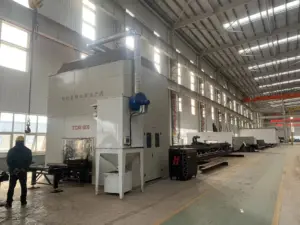
Shipbuilding is rarely a two-dimensional endeavor. The complexity of a vessel’s internal skeleton—comprised of I-beams, H-beams, C-channels, and bulb flats—requires a processing center that can maneuver in 3D space. The 3D Structural Steel Processing Center in Riyadh utilizes a specialized 5-axis cutting head or a robotic arm integration that allows for beveled cuts, countersinking, and complex intersections on curved profiles.
One of the most time-consuming aspects of traditional ship fabrication is weld preparation. Welders typically spend hours grinding manual bevels into thick steel beams to ensure proper penetration. The 3D 20kW laser automates this process entirely. It can cut a “V,” “Y,” or “K” bevel directly onto the structural member during the initial cutting phase. Because the laser is guided by high-precision CNC software, the fit-up during assembly is perfect. In a shipbuilding yard, “perfect fit-up” translates to thousands of hours saved in manual labor and a significant reduction in the amount of filler wire required for welding.
Zero-Waste Nesting: Economics of the Modern Shipyard
Steel is the largest variable cost in shipbuilding. Traditionally, when cutting irregular shapes for hull plating or structural gussets, a significant portion of the raw material ends up as scrap. “Zero-Waste Nesting” is a proprietary software-driven approach that revolutionizes how Riyadh-based fabricators manage their inventory. By utilizing advanced algorithms, the system can “nest” parts so closely that they share common cutting lines.
In a 20kW environment, where the kerf (the width of the cut) is incredibly narrow, the software can arrange hundreds of different components on a single large-format sheet or beam with millimetric gaps. Furthermore, the system employs “skeleton-free” nesting techniques, where parts are nested in a way that the remaining lattice of steel is minimized or used for smaller brackets and clips. For a Saudi shipyard, reducing material waste by even 5-8% can result in millions of Riyals in annual savings, making the 20kW laser not just a tool for quality, but a cornerstone of economic sustainability.
Riyadh as a Strategic Hub for Maritime Fabrication
While the actual shipyards may be located on the coasts—in Dammam or the Western Province—the establishment of a high-tech processing center in Riyadh is a strategic masterstroke. Riyadh serves as the logistical and industrial heart of the Kingdom, with direct access to the raw material pipelines and the specialized engineering talent graduating from the nation’s top technical universities.
Processing structural steel in Riyadh allows for a centralized “Pre-Fab” model. Instead of transporting raw, un-cut steel to the coast, the Riyadh center processes the steel into “ready-to-assemble” kits. These kits, featuring 3D-cut beams and zero-waste nested plates, are then shipped to the shipyard for modular assembly. This decentralization reduces the burden on coastal infrastructure and leverages Riyadh’s advanced industrial zones to provide a “Just-In-Time” delivery model for massive maritime projects. It aligns perfectly with the National Industrial Development and Logistics Program (NIDLP), fostering a domestic supply chain that is resilient and technologically superior.
Overcoming Environmental Challenges: The Riyadh Climate
Operating a 20kW fiber laser in the arid climate of Riyadh presents unique engineering challenges, specifically regarding thermal management and dust filtration. A 20kW laser generates immense internal heat within the resonator and the cutting head. The processing center is equipped with high-capacity, dual-circuit industrial chillers specifically rated for ambient temperatures that can exceed 50°C. These chillers ensure that the laser source remains at a constant operating temperature, preventing “mode instability” and maintaining beam quality.
Moreover, the desert environment necessitates advanced dust collection and air filtration systems. The 3D processing center is fully enclosed, utilizing high-pressure “pulse-jet” filtration to remove the fine metallic dust generated during the 20kW cutting process. This not only protects the sensitive optics of the laser but also ensures a clean working environment for operators, adhering to the Kingdom’s increasingly strict occupational health and safety standards.
The Impact on Local Workforce and Technical Expertise
The introduction of 20kW 3D laser technology is a catalyst for high-value job creation. This is not a “plug-and-play” machine; it requires a new generation of Saudi engineers, CAD/CAM specialists, and laser technicians. Operating a 5-axis 3D system requires a deep understanding of spatial geometry and robotic programming. By hosting this center in Riyadh, the industry is creating a localized ecosystem of experts who can troubleshoot, program, and optimize laser parameters for various marine alloys.
The “Zero-Waste” aspect also introduces the concept of “Digital Twin” manufacturing to the local workforce. Before a single spark is flown, the entire cutting process is simulated in a virtual environment. This reduces errors, prevents expensive collisions of the 3D head, and allows engineers to calculate the exact cost of a part before production begins. This level of digitalization is exactly what Vision 2030 aims to achieve across all industrial sectors.
Future Outlook: Towards 30kW and Beyond
As we look toward the future of shipbuilding in Saudi Arabia, the 20kW 3D Structural Steel Processing Center is only the beginning. We are already seeing the emergence of 30kW and 40kW sources, which will further increase cutting speeds on ultra-thick plates. However, the 20kW threshold remains the “sweet spot” for structural efficiency, offering the best balance between energy consumption, cutting speed, and edge quality.
The integration of AI into the nesting software will soon allow the Riyadh center to predict material needs months in advance, automatically ordering steel based on upcoming shipyard schedules. The 3D laser will also likely be paired with automated robotic welding stations, creating a seamless “cut-to-weld” pipeline that requires minimal human intervention. For the Saudi shipbuilding yard, this means faster build times for tankers, offshore platforms, and naval vessels, positioning the Kingdom as a dominant force in the global maritime industry.
In conclusion, the 20kW 3D Structural Steel Processing Center is more than just a piece of machinery; it is a statement of industrial intent. By locating this technology in Riyadh and focusing on zero-waste, high-precision fabrication, Saudi Arabia is not just building ships—it is building a future-proof manufacturing philosophy that will resonate across the global maritime stage for decades to come.