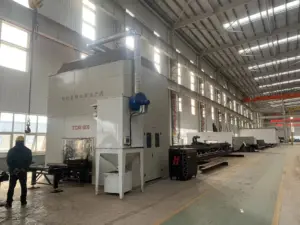
The Dawn of Ultra-High Power: Why 20kW is the New Standard for Structural Steel
In the realm of fiber laser technology, the leap from 12kW to 20kW is not merely an incremental upgrade in speed; it is a fundamental shift in the capability to process structural steel. For decades, structural fabrication relied on mechanical saws and plasma cutters, which often left rough edges and heat-affected zones (HAZ) that required secondary grinding. The 20kW fiber laser source provides a power density capable of vaporizing thick-walled structural steel almost instantaneously.
In Riyadh’s airport construction projects, where massive steel spans are required to support sprawling terminal roofs, the 20kW source allows for the clean cutting of carbon steel up to 50mm in thickness and beyond. The increased power translates to higher “bright surface” cutting speeds, where the kerf is so narrow and the gas pressure so efficient that the resulting edge is ready for immediate welding. This eliminates days of lead time across the fabrication cycle, moving components from the delivery bay to the assembly site at a pace previously thought impossible.
3D Processing Capabilities: Mastering Complex Geometries
Traditional laser cutting is a 2D affair, limited to flat sheets. However, airport architecture—characterized by its fluid lines and complex load-bearing geometries—demands a 3D approach. The 20kW Structural Steel Processing Center utilizes a multi-axis head (typically 5 or 6 axes) that can navigate around H-beams, U-channels, and circular hollow sections (CHS).
The 3D head is capable of performing precision beveling (A, V, X, and K-shaped cuts) in a single pass. For the structural supports of a major airport terminal, these bevels are critical for deep-penetration welding. By automating this process, the 20kW system ensures that every joint is mathematically perfect. The 3D capability also allows for the “fish-mouth” cutting of intersecting pipes, a necessity for the intricate space-frame structures often seen in modern airport concourses. In Riyadh’s desert heat, where thermal expansion must be accounted for in engineering designs, the micron-level precision of a 3D laser ensures that large-scale assemblies fit together perfectly on-site, reducing the need for forced fitting or field modifications.
The Logic of Zero-Waste Nesting in Structural Fabrication
One of the most significant cost drivers in structural steel is material waste. Standard fabrication often leaves “tails” or unusable offcuts at the end of every beam or pipe. The “Zero-Waste” Nesting system integrated into this processing center utilizes advanced CAD/CAM algorithms specifically designed for 3D profiles.
Zero-waste nesting works on several levels:
1. **Common-Line Cutting:** The software identifies instances where the end-cut of one component can serve as the start-cut for the next. This eliminates the “gap” or kerf waste between parts.
2. **Micro-Joint Optimization:** By using intelligent micro-joints, the system can nest small parts inside the cut-outs of larger structural members (such as base plates being cut from the web of a massive H-beam), maximizing the utility of every square centimeter of steel.
3. **Remnant Management:** The software tracks the “tail” of every beam. If a 12-meter beam is used to cut 11 meters of parts, the remaining 1-meter section is logged into a digital library. The next time a small bracket or connector is needed, the system automatically prompts the operator to load the remnant.
In the context of the Riyadh airport project, where thousands of tons of steel are processed monthly, a 5% to 10% reduction in waste translates to millions of Riyals in savings and a significant reduction in the project’s overall carbon footprint.
Riyadh’s Environmental Challenges: Engineering for the Desert
Operating a 20kW fiber laser in Riyadh presents unique environmental challenges, specifically regarding ambient temperature and airborne particulates. A laser source of this magnitude generates immense internal heat. The processing center is equipped with a dual-circuit, high-capacity industrial chilling system designed to maintain the laser source and the cutting head at a constant 22°C, even when outside temperatures in the industrial zones of Riyadh climb toward 50°C.
Furthermore, the “Zero-Waste” facility includes a high-efficiency dust extraction and filtration system. Laser cutting structural steel produces fine metallic dust and oxides. To maintain a clean room environment for the sensitive optics, the system utilizes positive-pressure enclosures and multi-stage HEPA filtration. This not only protects the machine’s longevity but also ensures that the air quality within the fabrication hub meets the stringent environmental standards required by modern Saudi labor laws and international building certifications (LEED).
Integration with BIM and Digital Twin Technology
The airport construction project in Riyadh is not just a physical build; it is a digital one. The 20kW Processing Center is fully integrated into the Building Information Modeling (BIM) workflow. Engineers at the design office can send Tekla or Revit files directly to the machine’s controller.
The “Zero-Waste” software interprets these 3D models, applies the nesting logic, and generates the G-code without manual intervention. This “File-to-Fiber” workflow ensures that the “Digital Twin” of the airport matches the physical reality exactly. If a design change is made to a terminal gate’s structural support in the morning, the updated components can be nested and cut by the afternoon, providing an unprecedented level of agility in large-scale infrastructure management.
The Economic Impact on Airport Construction Timelines
The primary bottleneck in airport construction is often the “Steel Phase”—the period between the completion of foundations and the enclosure of the building envelope. By deploying a 20kW 3D processing center, the fabrication timeline is compressed by an estimated 40-60%.
Consider a single complex node in the airport’s roof structure. Traditionally, this would require:
1. Sawing the main beam.
2. Moving it to a drilling station for bolt holes.
3. Moving it to a manual station for beveling.
4. Welding on stiffener plates that were cut elsewhere.
The 20kW laser performs the cut, the holes, and the beveling in one continuous operation on one machine. The speed of the 20kW laser is such that it can often outpace three or four traditional mechanical lines. For the Riyadh project, this means the building envelope can be closed sooner, allowing interior trades (HVAC, electrical, finishing) to begin their work months ahead of schedule, significantly mitigating the risks of liquidated damages and project overruns.
Conclusion: A New Benchmark for GCC Infrastructure
The deployment of a 20kW 3D Structural Steel Processing Center with Zero-Waste Nesting in Riyadh is more than a purchase of industrial equipment; it is a strategic investment in the future of Saudi Arabian infrastructure. As the King Salman International Airport takes shape, it will stand as a testament to what is possible when ultra-high-power fiber laser technology meets intelligent automation.
By solving the dual challenges of extreme precision and material efficiency, this technology aligns perfectly with the sustainability and localization goals of Saudi Vision 2030. As a fiber laser expert, I see this as the beginning of a new era where the “Heavy” in heavy industry no longer means “Slow.” Through the lens of a 20kW laser, the future of structural fabrication is fast, precise, and remarkably sustainable.