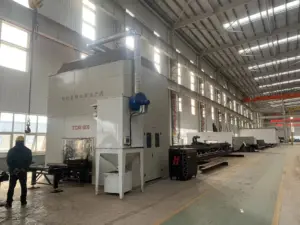
The Industrial Evolution of Dammam: Embracing 20kW Fiber Technology
Dammam has long been the heartbeat of Saudi Arabia’s industrial sector, serving as a gateway for the oil, gas, and logistics industries. As the Kingdom pivots toward localizing manufacturing through Saudi Vision 2030, the demand for sophisticated storage infrastructure has skyrocketed. Modern warehouses—ranging from cold storage facilities in the 1st Industrial City to massive distribution hubs near King Abdulaziz Port—require racking systems that are stronger, more complex, and faster to assemble.
The introduction of the 20kW 3D Structural Steel Processing Center is the technological answer to this demand. While 3kW or 6kW lasers were once the standard, the 20kW fiber source allows for unprecedented piercing speeds and the ability to cut through thick structural steel (up to 25mm and beyond) with a “clean cut” finish that requires zero post-processing. In a city where humidity and heat can accelerate oxidation, the high-speed nitrogen-assisted cutting provided by a 20kW source minimizes the Heat Affected Zone (HAZ), preserving the metallurgical properties of the steel and ensuring long-term rust resistance when coated.
The Power of 20kW: Speed, Precision, and Thickness
The “20kW” designation is not merely a number; it is a capability threshold. In the context of storage racking—specifically the uprights and heavy-duty beams used in pallet racking—the material thickness often fluctuates between 6mm and 16mm of high-tensile carbon steel.
A 20kW fiber laser processes these thicknesses at speeds that are 300% to 500% faster than traditional 6kW units. For a Dammam-based manufacturer, this means the throughput of a single machine can match the output of an entire workshop of older plasma cutters or mechanical drills. The “3D” component refers to the five-axis or six-axis cutting head capable of tilting and rotating. This allows for beveling (for weld preparations) and the intricate cutting of holes on the side-walls of C-channels or I-beams without having to flip the workpiece manually.
Advanced 3D Processing for Complex Racking Geometries
Storage racking is no longer a simple matter of bolting beams together. Modern systems, such as “Drive-In” racking, “Radio Shuttle” systems, and “Automated Storage and Retrieval Systems” (ASRS), require complex interlocking notches and precise bolt-hole patterns to ensure stability at heights exceeding 30 meters.
The 3D structural steel laser center utilizes advanced CNC algorithms to handle various profiles, including:
- I-Beams and H-Beams: Perfect for the primary structural supports of mezzanine floors.
- Square and Rectangular Tubing: Used for uprights where torsional rigidity is key.
- C-Channels and U-Channels: Common in shelf beams and bracing.
With the 3D head, the laser can perform “miter cuts” and “saddle cuts,” allowing beams to fit together like a jigsaw puzzle. This level of precision eliminates the gaps often found in manual fabrication, significantly increasing the load-bearing capacity of the final racking structure.
The Game Changer: Automatic Unloading and Material Handling
In a high-output environment like Dammam’s industrial zones, the bottleneck is rarely the laser itself; it is the loading and unloading of heavy, 12-meter structural beams. A 20kW laser cuts so fast that manual unloading cannot keep pace, leading to machine idle time.
The Automatic Unloading System integrated into these centers solves this logistics challenge. Once the 3D head completes its sequence, a series of hydraulic lifters or robotic grippers take the finished profile and move it to a designated sorting area.
1. **Safety:** Handling 12-meter steel beams is inherently dangerous. Automation removes human operators from the “splash zone” of sparks and the physical strain of heavy lifting.
2. **Continuous Flow:** The machine can transition to the next beam immediately, maintaining a “Lights-Out” manufacturing capability where the machine can run with minimal supervision during night shifts.
3. **Damage Prevention:** Finished components for racking often require a specific surface finish for powder coating. Automatic unloading ensures that the beams are placed gently, preventing the scratches and dents common with forklift handling.
Optimizing for the Saudi Climate: Cooling and Filtration
Operating a 20kW fiber laser in Dammam presents unique environmental challenges. The ambient temperature can exceed 50°C in the summer, and the air often carries fine sand and high humidity.
A professional-grade 3D processing center for this region must be equipped with:
- Dual-Circuit High-Capacity Chillers: One circuit cools the fiber laser source, while the other cools the 3D cutting head and optics. These chillers are oversized to handle the delta-T requirements of the Eastern Province.
- Positive Pressure Enclosures: The electrical cabinets and the laser source are housed in air-conditioned, dust-proof environments to prevent the ingress of conductive dust or sand, which could cause catastrophic short circuits.
- High-Efficiency Dust Extraction: Cutting structural steel produces significant particulate matter. A robust filtration system is essential not only for the machine’s longevity but for the health of the operators and compliance with Saudi environmental regulations.
Economic Impact and ROI for Racking Manufacturers
For a racking supplier in Dammam, the return on investment (ROI) for a 20kW 3D laser system is driven by three factors: material utilization, labor reduction, and market expansion.
Material Utilization: The nesting software for 3D lasers is incredibly sophisticated. It can “nest” different parts on a single 12-meter beam, reducing scrap by up to 15%. With the price of high-grade steel being a volatile commodity, these savings go directly to the bottom line.
Labor Reduction: A traditional racking production line might require operators for a saw, a drill press, a punching machine, and a manual grinding station. The 3D laser center consolidates these four stations into one, requiring only one technician to oversee the CNC interface.
Market Expansion: With 20kW of power, a manufacturer is no longer limited to standard racking. They can bid on complex structural steel projects for the oil and gas sector, such as pipe racks or skid frames, diversifying their revenue streams beyond simple storage solutions.
The Synergy with Saudi Vision 2030
The Saudi government’s “National Industrial Development and Logistics Program” (NIDLP) aims to transform the Kingdom into a global logistics hub. This requires a massive expansion of warehouse capacity. By adopting 20kW 3D fiber laser technology, Dammam-based companies are positioning themselves as preferred vendors for the Public Investment Fund (PIF) projects, such as NEOM, The Red Sea Project, and King Salman Maritime Industries Complex.
These projects demand international standards of quality and speed. The precision of a fiber laser ensures that every racking component produced in Dammam meets ISO and Eurocode standards, making Saudi-made racking a competitive export product for the entire GCC region.
Conclusion: The Future is Photonic
The 20kW 3D Structural Steel Processing Center with Automatic Unloading is more than just a tool; it is a statement of industrial maturity. For the storage racking industry in Dammam, it marks the end of “good enough” fabrication and the beginning of “perfect” engineering. As fiber laser technology continues to evolve, the integration of AI-driven nesting and real-time monitoring will further enhance these machines, ensuring that the Eastern Province remains at the forefront of the global industrial landscape. For manufacturers ready to bridge the gap between traditional steelwork and the fourth industrial revolution, the 20kW 3D laser is the ultimate bridge.