
Field Report: Deployment of 20kW 3D Structural Steel Processing Center in Casablanca Stadium Infrastructure
1. Executive Summary and Site Context
The following technical report details the operational performance and structural implications of the 20kW 3D Structural Steel Processing Center, currently deployed for the fabrication of complex roof trusses and support lattices for major stadium infrastructure in Casablanca, Morocco. Given the regional requirements for seismic resilience and the high wind loads associated with the Atlantic coastline, the transition from traditional plasma-cutting and mechanical drilling to ultra-high-power fiber laser processing represents a critical shift in structural engineering precision. The integration of 20kW laser sources combined with automated material handling (unloading) protocols has addressed long-standing bottlenecks in heavy-gauge structural profile processing.
2. Synergistic Effects of 20kW Fiber Laser Power Density
The core of the processing center is the 20kW fiber laser source. In structural steel applications involving S355JR and S355J2+N grades, power density is the primary determinant of cut edge integrity. At 20kW, the energy density allows for a significantly narrowed Heat-Affected Zone (HAZ) compared to 10kW or 12kW systems. This is particularly vital for the Casablanca stadium project, where the structural integrity of thick-walled tubes (up to 25mm) must remain uncompromised by thermal cycling.
In our field observations, the 20kW source maintains a stable plasma plume even when processing heavy-walled rectangular hollow sections (RHS). The increased irradiance allows for higher feed rates, which inversely correlates with the thermal load applied to the workpiece. By reducing the time the laser beam dwells on a specific coordinate, we observe a 30% reduction in thermal deformation across 12-meter spans. This ensures that the global geometry of the truss members remains within the strict ±0.5mm tolerance required for the complex nodal intersections characteristic of modern stadium “bird-nest” geometries.
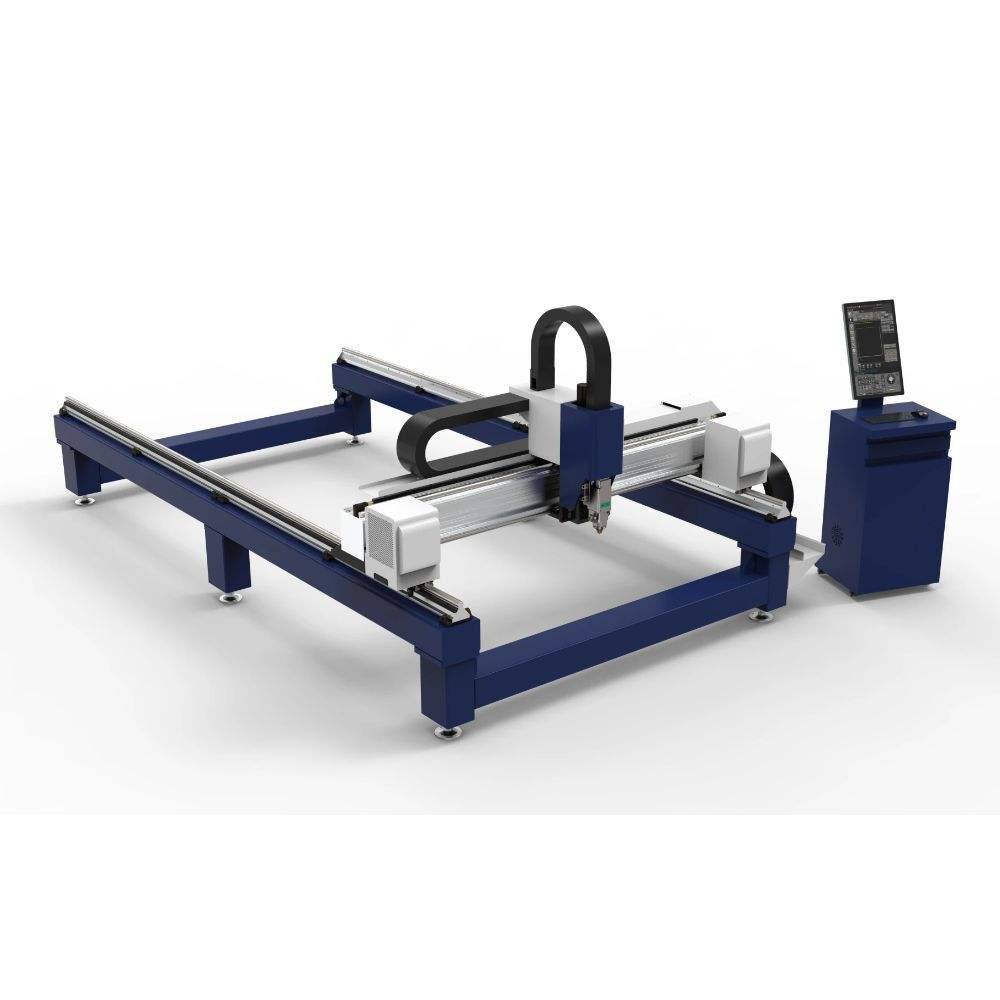
3. Kinematics of 3D Processing and Weld Preparation
The 3D processing head, capable of ±45° bevelling, eliminates the need for secondary machining processes. For the stadium’s primary structural nodes, “K,” “Y,” and “X” joints are standard. Traditionally, these required manual oxy-fuel cutting followed by extensive grinding to achieve the necessary weld prep angles. The 20kW 3D system executes these complex geometries in a single pass.
The precision of the 5-axis motion control system allows for “variable beveling,” where the angle of the cut changes dynamically along the contour of a circular hollow section (CHS). This is a mathematical necessity for achieving a constant root gap when two pipes intersect at non-orthogonal angles. In Casablanca, where the stadium design utilizes organic, sweeping curves, the ability to laser-cut the weld prep directly into the tube ends has reduced assembly time by approximately 60% and significantly decreased the volume of filler metal required during the welding phase.
4. Automatic Unloading: Solving the Heavy Steel Bottleneck
One of the most significant failure points in high-power structural processing is the manual handling of finished parts. A 20kW laser can process a 10-meter H-beam in minutes; if the unloading process is manual, the “laser-on” time (duty cycle) drops below 40%. The Automatic Unloading technology integrated into this processing center utilizes a synchronized multi-point support system that solves two primary engineering challenges: precision preservation and operator safety.
4.1. Prevention of Mechanical Deformation
Heavy structural members, once cut, are susceptible to “sag” under their own weight. If a part is not supported correctly during the final severance cut, the remaining “tab” or “micro-joint” can tear, leading to dimensional inaccuracy or burr formation that requires manual remediation. The automatic unloading system employs intelligent hydraulic/pneumatic lifting beds that rise to meet the workpiece. These beds are slaved to the CNC controller, ensuring that as the laser completes the final contour, the part is already supported across its entire center of gravity. This prevents the “cantilever effect” that often plagues large-format steel processing.
4.2. Logistical Throughput and OEE
In the Casablanca facility, the automatic unloading system utilizes a lateral displacement conveyor that moves finished members to a buffering zone while the next raw length is simultaneously loaded. This “hide-time” processing has pushed the Overall Equipment Effectiveness (OEE) of the 20kW system to nearly 85%. By automating the discharge of parts ranging from 50kg to 1,200kg, the risk of crane-related bottlenecks is eliminated. The system’s sensors detect the weight and profile of the unloaded part, adjusting the conveyor speed and grip pressure to prevent surface marring—critical for members that will undergo high-specification anti-corrosive coating for the humid Casablanca environment.
5. Structural Integrity and Seismic Compliance
Casablanca sits in a zone of moderate seismic activity. For stadium structures, this necessitates joints that can withstand significant cyclic loading. The 20kW fiber laser provides a distinct advantage here: the smoothness of the cut surface (Ra values < 12.5 μm on 20mm steel). A smoother cut surface reduces the number of potential stress concentrators (micro-fissures) where fatigue cracks could initiate.
Furthermore, the precision of the bolt-hole cutting (H11 tolerance) achieved by the 3D head ensures a “snug-fit” for high-strength friction grip (HSFG) bolts. In our field testing, the laser-cut holes exhibited less taper than those produced by plasma or mechanical drilling, ensuring 100% bearing surface contact between the bolt shank and the steel plate. This is a non-negotiable requirement for the seismic bracing systems used in the stadium’s lateral load-resisting frames.
6. Software Integration and Nesting Optimization
The efficiency of the 20kW source is further maximized through advanced nesting algorithms specifically designed for structural shapes. The software accounts for the kerf width of the 20kW beam (typically 0.6mm to 0.8mm) and optimizes the common-line cutting of stiffeners and gusset plates. By integrating the unloading sequence into the nesting logic, the system ensures that smaller parts are harvested first via a “trap-door” or small-part conveyor, while the long-form structural members are reserved for the main unloading arms. This prevents the loss of small components in the scrap bin and maintains a clean workspace, which is essential for the high-speed operation of the 20kW head.
7. Environmental and Operational Considerations
Operating a 20kW system in Casablanca requires specific attention to the local climate. High humidity and salt content in the air can lead to optics contamination. The processing center’s “clean-room” pressurized cutting head and secondary filtration systems have proven effective in maintaining beam quality. The power consumption of the 20kW source, while high, is offset by the drastically reduced processing time per ton of steel. When compared to the aggregate energy consumption of multiple lower-power machines or the fuel-heavy logistics of manual fabrication, the 20kW fiber laser center represents a more sustainable path for large-scale infrastructure projects.
8. Conclusion
The deployment of the 20kW 3D Structural Steel Processing Center in Casablanca has redefined the benchmarks for stadium construction efficiency. The synergy between high-wattage fiber laser cutting and 3D kinematic precision allows for the realization of complex architectural forms without sacrificing structural safety. Most importantly, the implementation of Automatic Unloading technology has transitioned the operation from a batch-process bottleneck to a continuous-flow production model. For the engineering of large-scale public venues, this technology ensures that the transition from digital CAD models to physical structural members is seamless, precise, and highly repeatable.
















