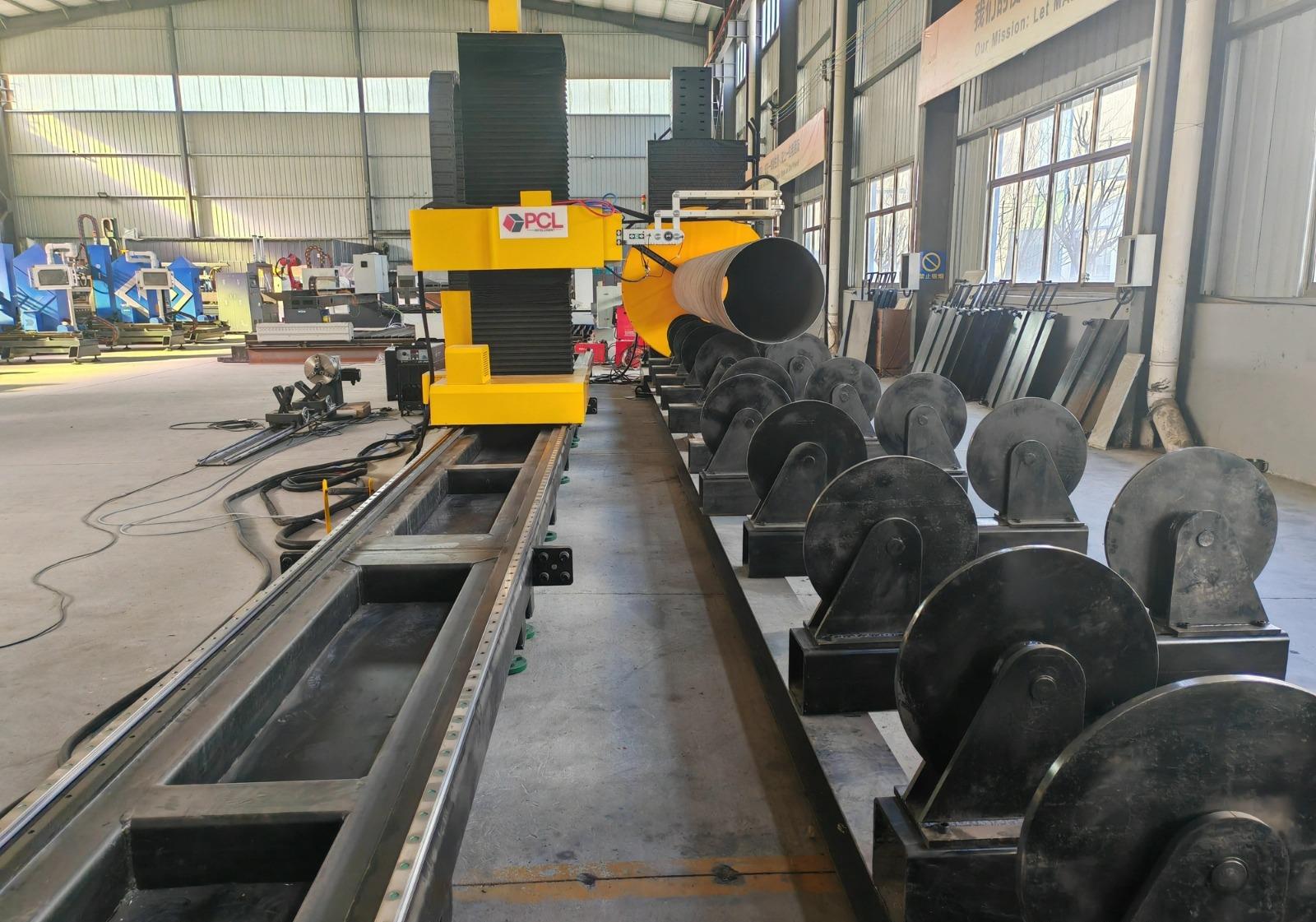
The Industrial Evolution of Sao Paulo’s Construction Sector
Sao Paulo stands as the economic engine of Latin America, a megalopolis defined by its constant state of vertical and horizontal expansion. However, the traditional methods of structural steel fabrication—relying on manual layout, mechanical drilling, and plasma cutting—have long struggled to keep pace with the demands of modern modular construction. The introduction of the 20kW 3D Structural Steel Processing Center with Automatic Unloading marks a technological “Great Leap Forward.”
Modular construction requires a level of precision that traditional methods simply cannot guarantee. When building components are manufactured off-site to be bolted together hundreds of kilometers away, a three-millimeter error in a beam’s bolt-hole alignment can halt an entire project. The 20kW fiber laser eliminates these discrepancies, providing the Sao Paulo market with a manufacturing capability that merges the scale of heavy industry with the precision of aerospace engineering.
The Power of 20kW: Why Intensity Matters
As a fiber laser expert, I often encounter the question: “Why 20kW?” In the realm of structural steel, power is synonymous with both speed and the ability to process thick-walled materials without compromising edge quality. A 20kW fiber laser source delivers an extraordinary energy density that can vaporize carbon steel and stainless steel with ease.
At this power level, the laser doesn’t just cut; it dominates the material. For structural components like H-beams, I-beams, and thick-walled square tubing (RHS), the 20kW source allows for high-speed “fly-cutting” through web thicknesses that would slow a 6kW or 12kW laser to a crawl. Furthermore, the high wattage minimizes the Heat Affected Zone (HAZ). By moving faster, the laser imparts less total heat into the surrounding metal, preventing the warping and metallurgical changes that can compromise the structural integrity of the steel—a critical factor for high-rise modular frames.
3D Kinematics and 5-Axis Versatility
Traditional 2D lasers are limited to flat sheets. However, structural steel is a three-dimensional world. The 3D processing center utilizes a sophisticated 5-axis cutting head capable of tilting and rotating around the workpiece. This allows for complex beveling, which is essential for weld preparations.
In the modular construction workflow, pieces often need V-type, X-type, or K-type bevels to ensure full-penetration welds during assembly. Previously, these bevels were ground manually or cut with slower oxy-fuel torches. The 3D laser head performs these cuts in a single pass, synchronized with the movement of the beam through the chucks. Whether it is a “bird’s mouth” cut for interlocking tubes or precision-mitered corners for architectural trusses, the 3D capability ensures that the components fit together perfectly the first time, eliminating on-site “re-work” which is the bane of construction budgets in Brazil.
The Logistics of Efficiency: Automatic Unloading
A 20kW laser is so fast that the bottleneck often shifts from the cutting process to the material handling. This is where the “Automatic Unloading” system becomes the unsung hero of the Sao Paulo facility. In a high-volume modular construction plant, you cannot afford to have a 20kW laser sitting idle while a crane operator struggles to clear a finished 12-meter beam.
The automated unloading system utilizes synchronized conveyors and hydraulic lifters that detect the completion of a part and transition it to a sorting area without human intervention. This allows for “lights-out” manufacturing. In the context of Sao Paulo’s high labor costs and the need for strict safety protocols, reducing the manual handling of heavy steel members significantly lowers the risk of workplace accidents and ensures that the machine’s “beam-on” time is maximized. The system can sort parts by project phase or assembly sequence, effectively acting as a pre-sorting hub for the modular assembly line.
Driving Modular Construction in the Brazilian Market
Modular construction is gaining massive traction in Brazil due to the need for affordable housing, modern hospitals, and rapid-build data centers. The 20kW 3D laser center is the heart of this movement. By utilizing a “Design for Manufacturing and Assembly” (DfMA) approach, engineers in Sao Paulo can send CAD files directly to the laser center.
The precision of the laser allows for the implementation of interlocking joints and tabs—features that were once too expensive to produce. These “jig-less” assemblies mean that parts can be snapped together and tacked in place without the need for complex measuring tools on the shop floor. This democratization of high-end fabrication allows smaller modular firms in the Sao Paulo region to compete with international giants, fostering a more robust and innovative local ecosystem.
Advanced Beam Shaping and Gas Dynamics
From a technical standpoint, the success of a 20kW system in thick structural steel relies heavily on beam shaping technology. Modern 20kW lasers allow us to manipulate the “mode” of the beam—altering the energy distribution from a tight, high-intensity spot for thin cutting to a wider, “ring-shaped” profile for thick plate piercing.
When cutting through 25mm or 30mm structural plates, the gas dynamics—typically using oxygen or high-pressure air—must be perfectly balanced with the laser’s power. The processing center in Sao Paulo utilizes intelligent nozzles that monitor the cut in real-time, adjusting the gas flow to prevent slag buildup (dross). The result is a silver-bright cut surface that requires zero secondary finishing. For modular contractors, this means the steel can go straight from the laser to the paint line or the welding station, further compressing the production schedule.
Economic Impact and Sustainability
Investing in a 20kW 3D structural steel center is a significant capital expenditure, but the Return on Investment (ROI) in the Sao Paulo context is compelling. Beyond the raw speed, there is the factor of material utilization. The nesting software used by these machines optimizes the layout of parts on a beam or tube, significantly reducing scrap compared to manual methods.
Furthermore, the fiber laser is a “green” technology compared to older CO2 lasers or plasma cutters. It consumes significantly less electricity per meter of cut and eliminates the need for the consumable electrodes and hazardous gases associated with plasma. In an era where “ESG” (Environmental, Social, and Governance) criteria are becoming mandatory for large-scale Brazilian infrastructure projects, the laser’s efficiency and low waste profile provide a distinct competitive advantage.
The Future: Integration with Digital Twins
Looking forward, the 20kW processing center in Sao Paulo is not an isolated island of automation; it is a node in a digital network. By integrating the laser center with Building Information Modeling (BIM) software, every beam produced can be etched with a unique QR code. This code tracks the part through the modular assembly process, onto the truck, and into its final position in the building.
This level of traceability is vital for the quality assurance required in modular high-rises. As a fiber laser expert, I see the Sao Paulo facility as a blueprint for the future of global construction. We are no longer just “cutting steel”; we are manufacturing data-rich components that enable a faster, safer, and more predictable way to build the cities of tomorrow.
Conclusion
The deployment of a 20kW 3D Structural Steel Processing Center with Automatic Unloading in Sao Paulo represents the pinnacle of current fabrication technology. It solves the “iron triangle” of construction: it is faster, higher quality, and—when analyzed over the lifecycle of a project—more cost-effective. For the modular construction industry in Brazil, this isn’t just a new machine; it is the foundation of a new era of industrialization, ensuring that the skyline of Sao Paulo continues to rise with unprecedented precision and efficiency.