The Dawn of High-Power Fiber Lasers in Edmonton’s Heavy Industry
Edmonton has long been the heartbeat of Canada’s industrial fabrication, serving as the gateway to the north and the primary staging ground for oil sands infrastructure. In this environment, crane manufacturing is not merely a service; it is a critical engineering feat. The introduction of the 20kW fiber laser into this ecosystem represents the next evolutionary step.
For decades, structural steel processing relied on a combination of mechanical sawing, drilling, and plasma cutting. While effective, these methods often necessitated significant secondary operations, such as manual grinding for weld preparation. The 20kW fiber laser changes the calculus. At this power level, the laser transition from a tool for thin-gauge sheet metal to a powerhouse capable of slicing through the heavy-walled sections required for crane gantries, pedestals, and telescopic booms.
The Significance of 20kW Power Density
In the realm of fiber lasers, “power is king,” but not just for the sake of speed. A 20kW source provides a photon density that allows for the efficient processing of carbon steels up to 50mm and beyond, which are common in heavy-duty crane components. More importantly, at the 12mm to 25mm range—the “sweet spot” for many structural members—a 20kW laser operates at speeds that leave traditional plasma systems behind.
The high power allows for a narrower kerf and a significantly reduced Heat-Affected Zone (HAZ). In crane manufacturing, where fatigue resistance and structural grain integrity are paramount, minimizing the thermal input during the cutting process is a massive advantage. This ensures that the base metal retains its engineered properties, reducing the risk of micro-fractures in high-stress areas of the crane’s structure.
Mastering the Third Dimension: 3D Structural Processing
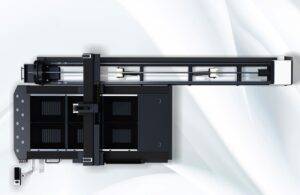
Traditional laser systems are limited to X and Y axes, essentially “printing” shapes on flat plates. However, crane manufacturing is a three-dimensional challenge. The 3D Structural Steel Processing Center is designed to handle “longs”—I-beams, H-sections, channels, and hollow structural sections (HSS).
Equipped with a sophisticated 5-axis cutting head and a chuck-based material handling system, the machine can rotate and position massive steel profiles with sub-millimeter precision. This allows for the cutting of bolt holes, cope joints, and complex notches in a single pass. For an Edmonton manufacturer building a gantry crane, this means an I-beam can be loaded into the machine and emerge fully processed, with all connection points and structural cutouts completed without the beam ever leaving the conveyor system.
The ±45° Bevel: Revolutionizing Weld Preparation
The most transformative feature for crane fabrication is the ±45° bevel cutting capability. Crane components are subject to immense dynamic loads, requiring full-penetration welds to ensure safety and longevity. Traditionally, creating a V, Y, or K-shaped bevel on a thick steel section required a secondary process: either a manual oxy-fuel torch or a CNC milling machine.
With the 3D laser’s ability to tilt the cutting head up to 45 degrees, the machine can create these complex weld preparations during the primary cutting cycle. The 20kW power ensures that even when cutting at an angle (which increases the effective thickness of the material), the laser maintains a clean, slag-free edge. This “weld-ready” output means that parts can go directly from the laser center to the welding robot or manual welding station. In a high-output Edmonton facility, this can shave hundreds of hours off the annual production schedule, directly impacting the bottom line.
Enhancing Structural Integrity in Crane Booms and Gantries
Crane booms, whether they are lattice or telescopic, require a perfect balance between weight and strength. The use of high-strength, low-alloy (HSLA) steels is common in these applications. Fiber lasers are exceptionally well-suited for these materials.
The precision of the 20kW laser allows for tighter tolerances in the fit-up of parts. In structural engineering, the “fit-up” is the gap between two pieces of metal before welding. A tighter, more consistent fit-up results in stronger welds with less filler material and less distortion. For Edmonton’s crane manufacturers, this translates to booms that are straighter and gantries that are more rigid. Furthermore, the ability to cut complex geometries into HSS (Hollow Structural Sections) allows for more innovative lattice designs that can lift more weight while using less raw steel.
Solving the Edmonton Labor and Climate Challenge
The industrial landscape in Edmonton faces two perennial challenges: a shortage of highly skilled manual fitters/grinders and a climate that demands high-performance equipment. The 20kW 3D Structural Steel Processing Center addresses both.
By automating the most labor-intensive parts of the fabrication process—layout, cutting, and beveling—manufacturers can reallocate their skilled labor to more complex assembly and high-level welding tasks. The machine doesn’t get tired, and it delivers the same ±0.1mm accuracy on a -30°C January morning as it does in the height of summer. This consistency is vital for maintaining delivery schedules for major infrastructure projects in the North.
Integration with Industry 4.0 and Nesting Software
Modern crane manufacturing is as much about data as it is about steel. The 3D processing center integrates seamlessly with CAD/CAM software specific to structural steel (such as Tekla or SDS/2). This allows engineers in an Edmonton office to design a crane component and send the file directly to the laser center.
The software optimizes the “nesting” of parts on a beam or tube to minimize scrap, which is a significant cost-saving measure given the current price of high-grade steel. Additionally, the system provides real-time tracking of production metrics, allowing plant managers to see exactly how many tons of steel are being processed per hour, further refining the efficiency of the Edmonton manufacturing hub.
Safety Standards and Compliance
In Canada, crane manufacturing is governed by strict CSA and AWS standards. Every cut and every weld must be traceable and of the highest quality. The 20kW fiber laser provides a level of repeatability that manual processes cannot match. By utilizing CNC-controlled beveling, the geometry of the weld joint is guaranteed to be consistent across the entire length of the component. This simplifies the non-destructive testing (NDT) process, as the ultrasonic or radiographic inspectors find fewer defects associated with poor fit-up or improper edge preparation.
Conclusion: The Future of Alberta Fabrication
The investment in a 20kW 3D Structural Steel Processing Center with ±45° beveling is a statement of intent. It signals that Edmonton’s manufacturing sector is not just surviving but leading the way in adopting global technological standards. For the crane industry, it means faster lead times, higher structural reliability, and the ability to compete on a global scale.
As the demands of the energy and construction sectors evolve, the ability to process heavy structural steel with the precision of a surgeon and the power of a locomotive will be the defining characteristic of successful fabricators. The 20kW fiber laser is not just a machine; it is the foundation of the next generation of Alberta-made heavy machinery.