The Strategic Shift to 12kW Fiber Lasers in Dammam
Dammam has long been the epicenter of Saudi Arabia’s industrial and logistics expansion. As the region scales up its infrastructure, the demand for heavy-duty lifting equipment—ranging from overhead bridge cranes to massive gantry systems at the King Abdulaziz Port—has reached an all-time high. Historically, crane manufacturing relied on plasma or oxy-fuel cutting combined with manual grinding for weld preparation. However, these methods introduce significant heat-affected zones (HAZ) and require extensive secondary processing.
The introduction of the 12kW Fiber Laser System changes the calculus entirely. At 12,000 watts of power, the laser density is sufficient to pierce and cut through thick-walled structural steel with a narrow kerf width and minimal thermal distortion. For a crane manufacturer in Dammam’s Second Industrial City, this means the ability to process 20mm to 40mm carbon steel plates and profiles at speeds that were previously unthinkable, while maintaining a edge quality that requires zero post-processing.
Universal Profile Processing: Beyond Flat Plate
While flat-bed lasers are common, a “Universal Profile” system is a different beast entirely. Crane manufacturing is rarely about flat sheets alone; it is about the structural “bones” of the machine—the I-beams, H-channels, and square tubing that form the long-span girders and support columns.
A 12kW Universal system utilizes a sophisticated rotary axis and multi-dimensional chuck system to handle these three-dimensional profiles. In the context of crane fabrication, this allows for the automated cutting of bolt holes, utility pass-throughs, and interlocking notches directly into large-scale beams. The “Universal” aspect refers to the machine’s ability to switch between flat plate fabrication (for end-carriages and trolley frames) and profile processing (for main girders) without requiring two separate installations. This consolidation of workflow is vital in Dammam’s high-rent industrial zones, where floor space optimization is key to operational efficiency.
The Power of ±45° Bevel Cutting
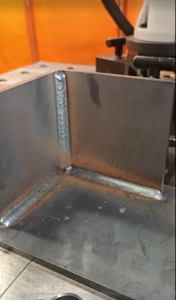
In crane manufacturing, the weld is the most critical point of potential failure. To ensure deep penetration and structural resonance, steel edges must be beveled—essentially angled—to create V, Y, or K-shaped grooves for the welding robot or technician to fill.
Traditional laser systems only cut at a 90° perpendicular angle. The 12kW system’s ±45° bevel head utilizes a specialized 5-axis kinematic torch. This allows the laser to tilt dynamically as it moves along the contour of the steel.
1. **Elimination of Secondary Grinding:** Manual beveling is labor-intensive and inconsistent. The fiber laser delivers a precise 30° or 45° edge that is “weld-ready” immediately after cutting.
2. **Complex Geometries:** Crane components often involve intersecting beams at non-standard angles. The beveling head can compensate for these angles, ensuring that every joint fits perfectly with zero gap, which is essential for the high-fatigue environments cranes operate in.
3. **Material Savings:** Precision beveling reduces the amount of weld filler material needed by creating optimized groove profiles, leading to significant cost savings over the course of a large-scale project.
12kW: The “Sweet Spot” for Heavy Steel
As an expert in the field, I often get asked why 12kW is the preferred power level for this application. While 20kW or 30kW systems exist, the 12kW source provides the most stable “cost-to-performance” ratio for the typical thicknesses used in Dammam’s crane industry.
At 12kW, the laser achieves a “bright surface” cut on thick carbon steel, meaning the oxygen-assisted cutting process leaves a smooth, mirror-like finish. This is critical for crane girders where surface micro-cracks can lead to stress fractures over years of lifting cycles. Furthermore, the 12kW power source is robust enough to handle the slight inconsistencies often found in industrial-grade structural steel (such as surface rust or mill scale) without losing beam stability, a common challenge in the humid and dusty environment of the Eastern Province.
Addressing the Dammam Climate: Cooling and Filtration
Operating a high-power fiber laser in Dammam presents unique environmental challenges. The ambient temperature can exceed 45°C, and the air is often laden with fine sand and saline moisture from the Arabian Gulf. A 12kW system in this region must be equipped with specialized “Tropicalized” configurations.
– **Dual-Circuit Chilling:** The laser source and the cutting head require precise temperature control. In Dammam, we implement high-capacity industrial chillers with oversized condensers to ensure the laser medium stays within the tight 22°C-25°C window, even when the factory floor is sweltering.
– **Pressurized Optical Cabins:** To prevent dust ingress, the entire beam delivery path is pressurized with clean, dry nitrogen or filtered air. This prevents the “lens burn” that occurs when even a single speck of Dammam sand lands on the protective window of a 12kW head.
– **Advanced Dust Extraction:** Cutting heavy profiles generates significant fumes. High-volume, self-cleaning dust collectors are mandatory to maintain air quality and prevent the accumulation of metallic dust on the precision rack-and-pinion drives.
Impact on Crane Structural Integrity and Safety
Cranes are governed by strict international standards such as FEM (Federation Europeenne de la Manutention) or CMAA (Crane Manufacturers Association of America). These standards dictate the tolerances for girder straightness and weld quality.
The 12kW laser system provides a level of repeatability (±0.05mm) that is simply impossible with manual layouts. When cutting the web and flange plates for a 30-meter box girder, the laser ensures that every hole and edge aligns perfectly. This precision reduces the internal stresses introduced during assembly. In Dammam’s crane factories, this means fewer “fit-up” issues and a much faster assembly cycle, allowing local manufacturers to compete with international firms on both lead time and quality.
The Economic Value for Saudi Vision 2030
The deployment of such a system in Dammam is more than a technical upgrade; it is a strategic economic move. By localizing the production of complex, beveled structural steel, Saudi crane manufacturers can reduce their reliance on imported pre-cut components from Europe or China.
This technology supports the “Made in Saudi” initiative. It enables local firms to bid on massive petrochemical expansion projects in nearby Jubail or new logistics hubs in Neom, knowing they can produce world-class structural components locally. The high speed of the 12kW laser also means that a single machine can replace three or four older plasma tables, drastically reducing the energy consumption per ton of steel processed—a key metric as the Kingdom moves toward more sustainable industrial practices.
Conclusion: The Future of Metal Fabrication in the Eastern Province
The 12kW Universal Profile Steel Laser System with ±45° Bevel Cutting is the ultimate tool for the modern crane manufacturer. In the competitive landscape of Dammam, it provides the “unfair advantage” needed to produce safer, stronger, and more cost-effective lifting solutions. As fiber laser technology continues to evolve, the ability to process profiles and plates on a single, high-power platform will become the standard. For now, the early adopters in Dammam are setting the pace, turning raw Saudi steel into the backbone of the Kingdom’s future, one precision-beveled cut at a time.