
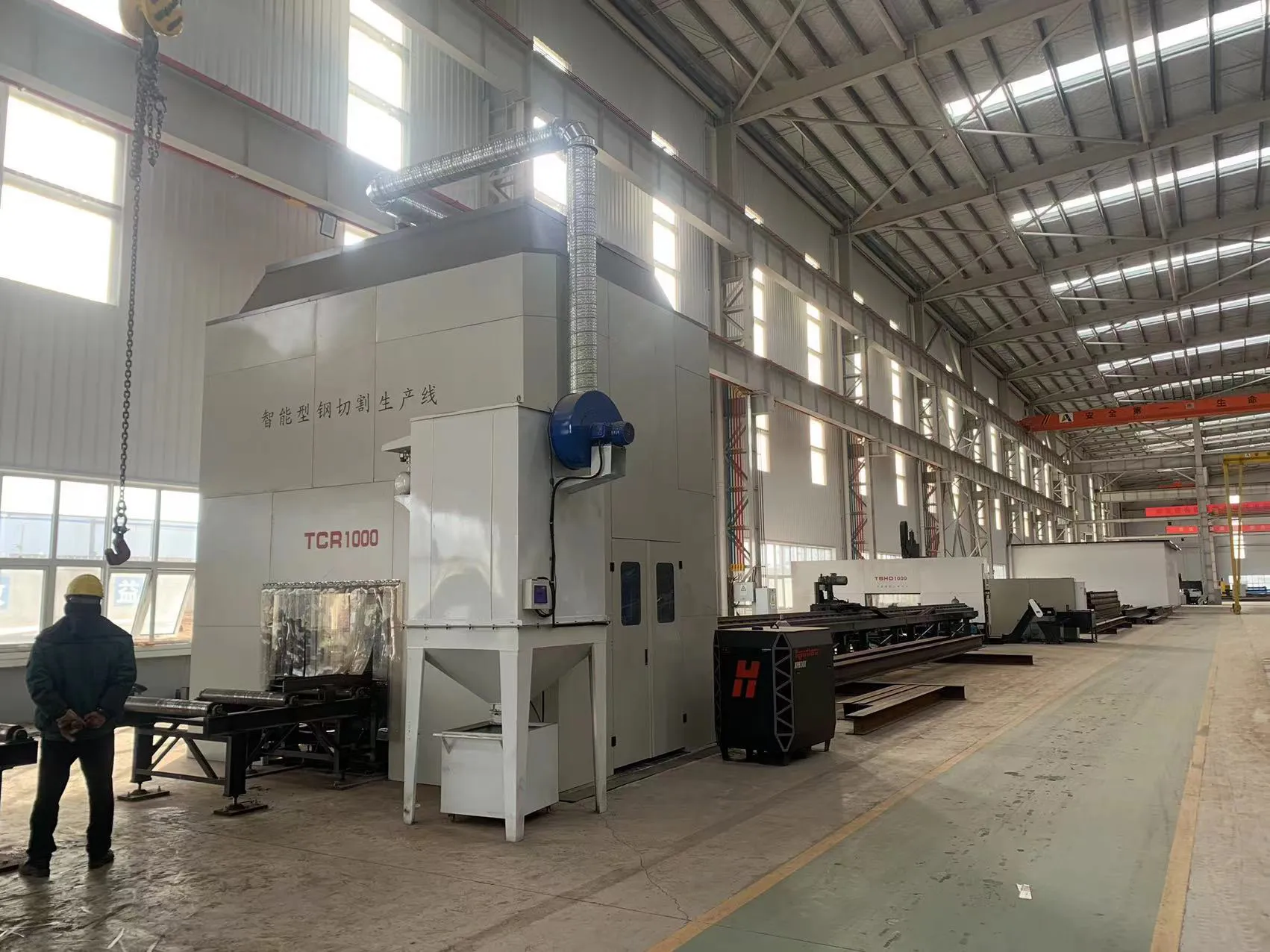
Technical Field Report: Implementation of 12kW Universal Profile Laser Systems in Jakarta’s Power Infrastructure Sector
1. Project Scope and Operational Context
This report evaluates the deployment of a 12kW Universal Profile Steel Laser System within the high-demand fabrication environment of Jakarta, Indonesia. The primary focus is the production of lattice structures for high-voltage power transmission towers. Given Jakarta’s rapid urban expansion and the Indonesian government’s commitment to grid reliability, the fabrication sector is shifting from traditional mechanical punching and sawing toward high-radiance fiber laser oscillation.
The 12kW system was integrated to process heavy-gauge angle steel (L-profiles), channels (C-profiles), and H-beams. In the context of Jakarta, thermal management and atmospheric humidity present specific challenges to laser stability, necessitating a robust cooling and filtration infrastructure to maintain beam quality over long-duty cycles.
2. 12kW Fiber Source Dynamics and Beam Delivery
The transition to a 12kW fiber laser source represents a significant leap in power density compared to the previous 6kW industry standard for structural steel. At 12kW, the system achieves a superior “bright surface” cut on carbon steels up to 25mm, which is critical for the structural integrity of power tower gusset plates and main leg members.
Key Technical Parameters:
- Wavelength: 1.07μm, optimized for high absorption in structural carbon steel.
- Power Density: Enhanced piercing speed by 40% compared to 8kW systems, reducing the thermal load on the material and minimizing the Heat Affected Zone (HAZ).
- Beam Quality (BPP): Maintained at ≤4 mm·mrad to ensure consistent kerf width across the entire 12-meter profile length.
In Jakarta’s tropical environment, the 12kW source requires a dual-circuit industrial chiller with a precision of ±0.5°C. Field observations indicate that maintaining the dew point within the laser enclosure is vital to prevent condensation on the protective windows of the 3D cutting head.
3. Universal Profile Processing: Kinematics and 3D Cutting
Unlike flat-sheet lasers, the Universal Profile System utilizes a multi-axis 3D cutting head coupled with a synchronized chuck system (typically 3 or 4 chucks). For power tower fabrication, the ability to process angle steel (e.g., 200mm x 200mm x 20mm) with high-precision bolt-hole placement is paramount.
The system employs a “non-contact” capacitive height sensing mechanism that compensates for the inherent deviations in hot-rolled steel profiles. Structural steel produced in local mills often exhibits slight longitudinal twisting or flange inconsistency. The laser system’s real-time sensing allows the 3D head to adjust the focal position dynamically, ensuring the nozzle-to-workpiece distance remains constant, which is a prerequisite for achieving the ±0.1mm tolerance required for tower assembly.
4. Zero-Waste Nesting Technology: Algorithmic Optimization
One of the most critical advancements evaluated in this report is the “Zero-Waste Nesting” technology. Traditional profile cutting often results in “tailings” or “remnants” ranging from 300mm to 800mm per raw length due to the mechanical limitations of the chucks holding the material.
Mechanical Execution of Zero-Waste:
The system utilizes a multi-chuck synchronized movement strategy. As the laser processes the final section of a profile, the “master” chuck passes the workpiece to the “sub” chucks, allowing the cutting head to operate between the clamping zones. This enables “tailing-free” cutting, where the final remnant is reduced to virtually zero (<50mm).
Nesting Logic for Power Towers:
Power towers consist of hundreds of varying lengths of angle steel. The nesting software utilizes a 1D/3D hybrid algorithm to calculate the optimal sequence.
1. Common Line Cutting: Two adjacent parts share a single cut line, reducing gas consumption and processing time by 15-20%.
2. Micro-joint Management: Precise placement of micro-joints ensures that even small components remain stable within the profile during high-speed traverses, preventing collisions with the cutting head.
3. Dynamic Remnant Tracking: The software logs the exact dimensions of any unusable material, though the “Zero-Waste” mechanical configuration ensures that nearly 99% of the raw stock is converted into finished parts.
5. Impact on Power Tower Fabrication in the Jakarta Sector
The power sector in Indonesia requires galvanization for almost all structural steel. laser cutting provides a distinct advantage here over mechanical shearing: the absence of micro-cracking at the edges.
Observations on Edge Quality:
In Jakarta’s high-salinity coastal air, any micro-fissure in the steel can lead to accelerated sub-surface oxidation under the galvanizing layer. The 12kW laser produces a finish with a surface roughness (Ra) of less than 12.5μm. This smoothness ensures superior zinc adhesion during the hot-dip galvanizing process, extending the field life of the transmission towers.
Production Efficiency:
In a 10-hour shift, the 12kW system outperformed a traditional CNC drilling and sawing line by a factor of 3.5. Specifically, the integration of holes, slots, and bevels in a single pass eliminates the need for secondary handling, which is a major bottleneck in Jakarta’s labor-intensive fabrication shops.
6. Structural Integrity and Metallurgical Analysis
Critics of laser cutting in structural steel often cite the Heat Affected Zone (HAZ). Our field analysis of S355JR grade steel (common in Indonesian infrastructure) processed with the 12kW system showed a HAZ depth of only 0.3mm to 0.5mm.
The high feed rate enabled by the 12kW source means the heat input per millimeter is lower than that of lower-power lasers. Hardness testing across the cut edge showed a negligible increase in Vickers hardness (HV), well within the tolerances for structural bolting applications defined by SNI (Standard Nasional Indonesia) and international Eurocode 3 standards.
7. Environmental and Operational Constraints in Jakarta
The deployment of high-power lasers in Jakarta necessitates specific infrastructural considerations:
- Power Quality: Fluctuations in the local grid require the installation of high-capacity voltage stabilizers and UPS systems to protect the fiber laser diodes.
- Gas Purity: For high-speed cutting, Oxygen (O2) purity must be ≥99.95%. For “clean-cut” stainless or thin-gauge galvanized components, Nitrogen (N2) at 20-25 bar is required. Local gas supply chains must be vetted for moisture content.
- Dust Extraction: Processing heavy profiles generates significant particulate matter. A 12,000 m³/h extraction system with a pulse-jet cleaning filter is mandatory to comply with Jakarta’s environmental regulations and to protect the machine’s linear guides.
8. Conclusion and Recommendation
The 12kW Universal Profile Steel Laser System, equipped with Zero-Waste Nesting, represents the current pinnacle of efficiency for structural steel fabrication. For Jakarta’s power tower manufacturers, the transition to this technology facilitates a move away from “manual-heavy” workflows toward a “digital-twin” integrated manufacturing environment.
The reduction in material waste, combined with the elimination of secondary processing (drilling/grinding), provides a projected ROI (Return on Investment) within 14 to 18 months, depending on throughput volume. It is my technical recommendation that for profiles exceeding 12mm thickness, the 12kW source be considered the baseline to ensure both edge quality and operational speed.
Final Assessment: The system is verified as fully capable of meeting the rigorous demands of Indonesia’s national grid infrastructure projects, providing a localized solution to global engineering standards.
















