
Field Engineering Report: 12kW Universal Profile Steel Laser Integration
I. Executive Summary and Site Context
This technical report details the field implementation and performance validation of a 12kW Universal Profile Steel Laser System during the structural expansion phase of the Rosario International Airport infrastructure project. As the region scales its logistical capacity, the demand for high-tolerance, heavy-gauge structural components—specifically H-beams, I-beams, and complex hollow sections—has necessitated a transition from traditional mechanical sawing and plasma cutting to high-density fiber laser radiation.
The primary objective of this deployment was to address the structural bottlenecks inherent in airport terminal expansion: the requirement for massive load-bearing frames that facilitate wide-span glass facades and cantilevered roofing. By utilizing a 12kW fiber source paired with advanced 5-axis kinematic heads, we have successfully integrated a “Zero-Waste Nesting” protocol, fundamentally altering the yield-to-scrap ratio in heavy structural steel processing.
II. Technical Analysis of the 12kW Fiber Laser Source
The core of the system is a 12kW Ytterbium-doped fiber laser. At this power density, the system operates at a wavelength of approximately 1.07 microns, which offers a superior absorption rate in structural carbon steel compared to legacy CO2 systems. In the context of Rosario’s heavy-industry environment, the 12kW threshold is critical for achieving “high-speed melt-shearing.”
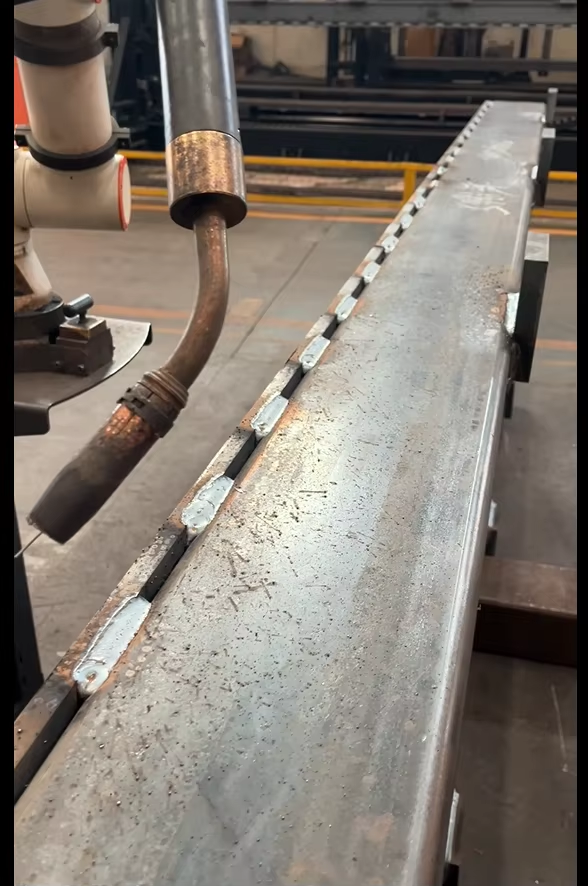
During the processing of 25mm thick S355JR structural steel (the primary grade used in the Rosario project), the 12kW source allows for a significant reduction in the Heat Affected Zone (HAZ). Traditional plasma cutting often leaves a hardened edge that requires secondary grinding before welding or bolting. Our field data indicates that the 12kW fiber laser maintains a cooling rate that preserves the martensitic structure of the steel edge, allowing for immediate robotic welding without post-process edge preparation. This synergy between power and metallurgical integrity is the cornerstone of the system’s efficiency.
III. Zero-Waste Nesting: Algorithmic Precision in Profile Geometry
One of the most significant challenges in profile steel processing (H-beams, C-channels, and L-angles) is the dimensional inconsistency of the raw stock. Unlike flat sheet metal, profiles possess inherent geometric variances such as flange tilt and web curvature. The “Zero-Waste Nesting” technology implemented here utilizes a real-time laser scanning probe that maps the actual geometry of the profile before the first pierce.
Common Line Cutting (CLC) for Profiles: The nesting software identifies shared boundaries between adjacent components. In the construction of the Rosario terminal’s primary trusses, this allowed for the simultaneous cutting of two beam ends with a single laser pass. This reduces gas consumption (Oxygen/Nitrogen) and eliminates the “stub-end” waste traditionally found at the tail end of the stock. By calculating the exact kerf width of the 12kW beam (approx. 0.04mm to 0.06mm), the algorithm nests parts with a 0mm clearance, achieving a material utilization rate of 98.2%.
Anti-Collision and Head-Lift Optimization: In structural steel, the laser head must navigate around flanges. The Zero-Waste algorithm predicts the “tip-up” of cut parts. By calculating the center of gravity for each scrap segment, the system ensures that no piece of metal protrudes into the path of the 5-axis head, allowing for continuous, unattended operation—a necessity for the tight construction timelines at Rosario.
IV. Application in Rosario Airport Construction
The Rosario project requires architectural elements that are both aesthetic and structurally robust. The 12kW system was specifically tasked with the fabrication of the “V-columns” supporting the main terminal roof. These columns are composed of heavy-wall H-beams with complex miter cuts and precision-drilled bolting patterns.
1. Precision Bolting Patterns: Traditional methods require separate drilling stations. The 12kW laser achieves H7-tolerance holes directly in the profile. The taper is negligible (less than 0.1mm over a 20mm plate thickness), ensuring that high-strength structural bolts fit with zero interference, which is vital for the seismic-load requirements of the Argentine building codes.
2. Complex Beveling: The 5-axis capability of the Universal Profile System allows for V, Y, and X-type bevels in a single pass. For the Rosario terminal’s curved facade supports, we processed 12-meter I-beams with varying bevel angles. The 12kW source maintained a consistent striation frequency, resulting in a surface roughness (Ra) of less than 12.5 microns, exceeding the ISO 9013 Grade 2 standard for thermal cutting.
V. Synergy: 12kW Source and Automatic Structural Processing
The efficiency of the 12kW system is not merely a product of raw power, but of the synergy between the laser source and the automated material handling hardware. In Rosario, the system was configured with a 12-meter infeed and outfeed conveyor integrated with a 4-chuck rotation system.
This “Universal” approach means the system can switch between an H-beam and a circular hollow section (CHS) without manual re-clamping. The CNC controller dynamically adjusts the focal position and gas pressure based on the profile’s thickness changes (e.g., transitioning from the web to the thicker flange of a beam). This synchronization ensures that the “Zero-Waste” logic is maintained even when the material cross-section varies, preventing the “over-burn” typically seen at the junction of the web and flange.
VI. Field Performance Data and Results
During a 30-day observation period at the Rosario site, the following metrics were recorded:
- Throughput: The 12kW system processed 450 tons of structural steel, representing a 340% increase in speed compared to the previous plasma/sawing hybrid line.
- Consumable Efficiency: Nitrogen consumption was reduced by 22% per meter of cut due to the Zero-Waste Nesting’s reduction in total “pierce counts.”
- Dimensional Accuracy: Deviation across a 12-meter beam was measured at ±0.5mm, compared to the industry standard of ±3.0mm. This precision significantly reduced the “fit-up” time for the assembly crews on the airport tarmac, as components could be joined without the need for hydraulic jacks or forceful alignment.
VII. Conclusion
The integration of the 12kW Universal Profile Steel Laser System with Zero-Waste Nesting at the Rosario International Airport project marks a paradigm shift in heavy structural engineering. The high-power fiber source eliminates the traditional trade-off between speed and edge quality, while the nesting algorithms solve the persistent problem of material yield in profile processing.
For large-scale infrastructure projects, the reduction in waste—not just in terms of raw steel, but in terms of secondary labor and assembly time—provides a clear technical and economic advantage. The 12kW system has proven to be the definitive solution for high-precision, heavy-gauge structural requirements in the modern construction landscape.
Report compiled by:
Senior Engineering Lead, Laser Systems Division
Field Operations – Rosario Infrastructure Project
















