
Field Report: Deployment of 12kW Universal Profile Steel Laser System – Houston Heavy Fabrication Hub
1. Executive Summary and Site Overview
This report details the technical commissioning and operational integration of a 12kW Universal Profile Steel Laser System within a high-output structural steel facility in Houston, Texas. As the industry shifts toward higher automation to combat skilled labor shortages, the synergy between advanced Laser Technology and traditional Steel welding has become the focal point of our structural integrity strategy. This Houston site, primarily serving the petrochemical and offshore sectors, requires high-precision processing of heavy-walled I-beams, H-sections, and rectangular hollow sections (RHS).
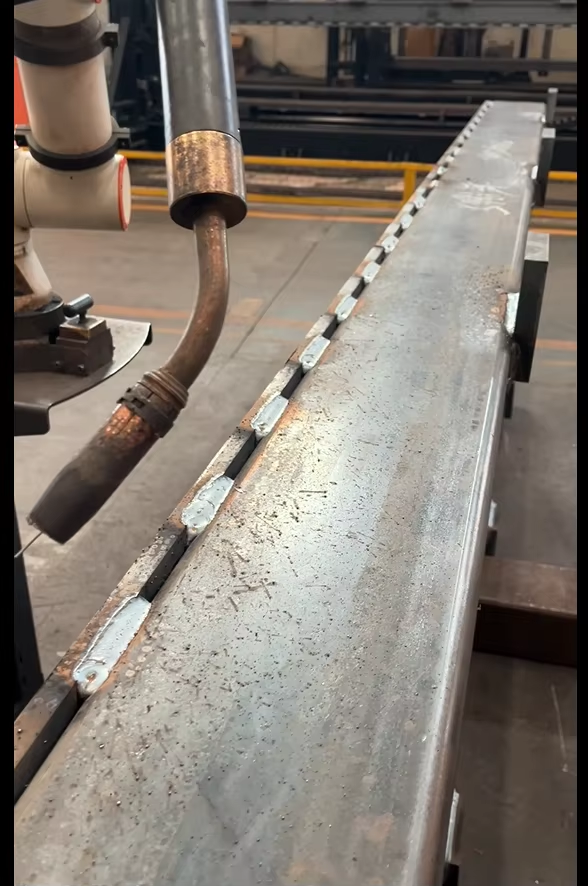
The implementation of the 12kW fiber source marks a significant departure from traditional plasma or mechanical saw-and-drill lines. The primary objective was to reduce the “fit-up” time—the period between raw material arrival and the commencement of steel welding—by leveraging the superior tolerances of the Universal Profile Steel Laser System.
2. Technical Analysis: The Universal Profile Steel Laser System
2.1 Multi-Axis Flexibility and Profile Handling
The term “Universal” in this system refers to the 5-axis or 6-axis head capability designed to wrap around complex structural geometries. Unlike flatbed lasers, the Universal Profile Steel Laser System utilizes a chuck-and-carrier mechanism that rotates the profile while the laser head maneuvers to maintain a perpendicular or beveled focal point. In the Houston facility, we tested this on 24-inch wide-flange beams. The laser’s ability to execute “bird-mouth” cuts and complex cope geometries in a single pass has eliminated two intermediate handling steps.
2.2 The 12kW Laser Technology Threshold
Why 12kW? In the context of Laser Technology, power is not merely about speed; it is about the quality of the Heat Affected Zone (HAZ). At 12kW, we achieve high-speed sublimation in carbon steel up to 25mm thickness. This power level allows for the use of nitrogen as a shielding gas on thinner sections to prevent oxidation, or oxygen for thick-plate piercing, ensuring that the resulting edge is pristine for subsequent steel welding. In our field tests, the 12kW source maintained a kerf width of less than 0.5mm, a precision level that plasma systems cannot replicate.
3. Synergy Between Laser Technology and Steel Welding
3.1 Precision Beveling for Weld Preparation
The most significant bottleneck in Houston’s structural shops has historically been the manual grinding of bevels for Full Penetration (CJP) welds. The Universal Profile Steel Laser System integrates the beveling process directly into the cutting program. By utilizing the 12kW Laser Technology to create V, Y, and K-preps on the fly, we have observed a 40% reduction in weld volume requirements. Because the fit-up is tighter (gaps reduced to near-zero), the amount of filler metal required in the steel welding process is significantly minimized, reducing both material costs and thermal distortion of the workpiece.
3.2 Surface Chemistry and Weld Integrity
A critical lesson learned during the Houston deployment involves the surface chemistry of the cut edge. Standard oxy-fuel or plasma cutting leaves behind a heavy oxide layer that must be mechanically removed before steel welding to prevent porosity. The 12kW Laser Technology, when tuned correctly with high-pressure assist gases, produces a surface that is often “weld-ready.” However, we noted that on high-strength A572 Grade 50 steel, the cooling rate of the laser cut can result in localized hardening. We adjusted our welding procedures to include a slight pre-heat to ensure hydrogen cracking is mitigated, particularly in thick-walled profiles.
4. Houston Environmental and Operational Challenges
4.1 Humidity and Thermal Management
Houston’s ambient humidity levels (often exceeding 80%) present a challenge for high-power Laser Technology. The Universal Profile Steel Laser System’s resonator and optics must be kept in a climate-controlled environment to prevent “dew point” condensation on the lenses. During the August commissioning, we had to upgrade the chiller capacity for the 12kW source. A key lesson learned: standard industrial chillers often struggle with the latent heat load in the Gulf Coast climate; oversized, redundant cooling circuits are mandatory for 24/7 operation.
4.2 Power Grid Stability
The 12kW system pulls a significant, fluctuating load. In the Houston industrial corridor, voltage sags can be common. We implemented a dedicated power conditioner for the Universal Profile Steel Laser System to prevent “beam flicker,” which can cause micro-interruptions in the cut. For a senior engineer, the takeaway is clear: the infrastructure supporting the laser is as critical as the laser itself.
5. Lessons Learned and Field Observations
5.1 Material Grade Variability
Not all steel is created equal for Laser Technology. We discovered that “A36” steel from different mills reacted differently to the 12kW beam. Variations in silicon and phosphorus content affected the dross adhesion. We have now implemented a “Laser-Grade” procurement specification for all profiles destined for the Universal Profile Steel Laser System to ensure consistent cut quality and to maximize the speed of subsequent steel welding operations.
5.2 Programming and Nested Logic
The transition from 2D drawings to 3D TEKLA or SDS/2 models is non-negotiable. The Universal Profile Steel Laser System thrives on direct CAD-to-CAM translation. Manual entry at the HMI (Human Machine Interface) is a recipe for error. Our Houston team had to pivot to a fully digital workflow, where the “digital twin” of the beam includes all bolt holes, copes, and weld preps before the steel even hits the conveyor.
6. The Economic Impact on Steel Welding Production
The data from the first quarter of operation shows a transformative shift in labor allocation. Previously, the shop required a 3:1 ratio of fitters to welders. With the Universal Profile Steel Laser System producing parts with “Lego-like” precision, the ratio has shifted to 1:2. The fitters are no longer measuring and grinding; they are simply tacking components together. The steel welding phase is now the primary driver of throughput, rather than the bottleneck. Furthermore, the accuracy of the laser-cut bolt holes (tolerance ±0.1mm) has virtually eliminated the need for field reaming during erection in the Houston shipyards.
7. Conclusion and Technical Outlook
The integration of a 12kW Universal Profile Steel Laser System in the Houston market represents the current “Gold Standard” for structural steel fabrication. By leveraging Laser Technology not just for cutting, but as a sophisticated tool for weld preparation, we have bridged the gap between raw metallurgy and high-tolerance engineering.
For future deployments, I recommend a heavy focus on the “upstream” digital data and “downstream” welding metallurgy. The laser is a catalyst that exposes inefficiencies in both. If your steel welding process isn’t ready for the precision of a 12kW laser, you aren’t gaining the full ROI. In Houston, we have proven that when these technologies are synchronized, the result is a safer, faster, and more profitable structural build.
Final Engineering Notes:
- Maintenance: Monitor cover slide cleanliness every 4 hours in the Houston humid environment.
- Safety: Ensure Class 4 laser enclosures are strictly maintained; the 12kW back-reflection from galvanized profiles is a significant hazard.
- Quality: Conduct periodic macro-etch tests on the laser-cut edge to monitor the HAZ depth for AWS D1.1 compliance.
















