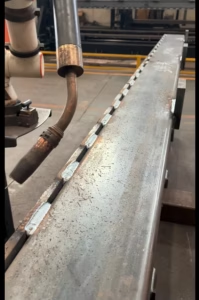
1.0 Executive Summary: Strategic Implementation in the Queretaro Industrial Corridor
This technical field report evaluates the operational integration of a 12kW Universal Profile Steel Laser System, equipped with high-capacity Automatic Unloading technology, within the context of large-scale stadium steel structure fabrication in Queretaro, Mexico. The regional demand for seismic-resistant, architecturally complex sports infrastructure has necessitated a shift from conventional plasma cutting and mechanical drilling toward high-kilowatt fiber laser processing. This report focuses on the mechanical synergy between the 12kW power density and the automated material handling systems required to maintain tight geometric tolerances in heavy-section structural steel.
2.0 12kW Fiber Laser Dynamics in Heavy Profile Processing
2.1 Power Density and Kerf Characteristics
The transition to a 12kW fiber source represents a critical threshold for universal profile processing (H-beams, I-beams, C-channels, and RHS). At 12kW, the power density allows for high-speed sublimation and fusion cutting of carbon steel sections exceeding 25mm in thickness. Unlike lower-wattage systems, the 12kW source maintains a stable plasma plume, resulting in a reduced Heat-Affected Zone (HAZ). This is paramount for stadium structures in Queretaro, where the fatigue life of structural nodes is scrutinized under rigorous civil engineering standards.
2.2 Gas Dynamics and Edge Quality
To leverage the 12kW output, the system utilizes high-pressure nitrogen or oxygen-assisted cutting. In heavy profile sections, gas flow laminarization is achieved through specialized nozzle geometries. This ensures that the dross adhesion is minimized on the internal radii of H-beams. For the complex bevelling required in stadium “tree” columns, the 12kW source enables high-speed 45-degree cuts with a surface roughness (Ra) significantly lower than thermal oxy-fuel methods, eliminating the need for secondary grinding prior to welding.

3.0 Kinematics of the Universal Profile System
3.1 Multi-Axis Synchronization
The “Universal” designation refers to the system’s ability to manipulate diverse cross-sections via a multi-chuck rotation mechanism. Processing stadium trusses requires the simultaneous control of the X-axis (longitudinal feed), Y-axis (transverse head movement), Z-axis (height sensing), and A/B axes (profile rotation and head tilt). The 12kW system in this field study utilizes a four-chuck configuration to minimize “dead zones” and provide continuous support for profiles up to 12 meters in length.
3.2 Material Deviation Compensation
Structural steel profiles, particularly those sourced for large-scale Queretaro projects, often exhibit inherent longitudinal bowing and cross-sectional torsion. The system employs laser-based profiling sensors to map the actual geometry of the beam in real-time. The CNC control algorithm then adjusts the cutting path dynamically to ensure that bolt holes and interlocking notches are placed relative to the actual center-of-gravity of the profile, rather than the theoretical CAD model.
4.0 Automatic Unloading: Solving the Bottleneck of Heavy Fabrication
4.1 Mechanical Architecture of the Unloading System
The processing of heavy profile steel (often exceeding 150kg/m) creates a significant logistical bottleneck at the discharge phase. The Automatic Unloading technology discussed herein utilizes a series of servo-controlled hydraulic lift-and-transfer arms. As the 12kW laser completes the final cut-off, the unloading system synchronizes with the chuck release to support the workpiece across its entire length. This prevents “tip-down” deformation, which frequently occurs in manual or gravity-fed unloading scenarios.
4.2 Precision and Surface Integrity
In stadium construction, the aesthetic and structural integrity of the steel members is non-negotiable. Manual unloading using overhead cranes often results in surface scoring or impact damage to the precision-cut edges. The automated system uses polymer-coated rollers and synchronous lateral transfers to move the processed members to a collection buffer. This ensures that the high-precision bevels produced by the 12kW laser are preserved for fit-up. Data from the Queretaro site indicates a 40% reduction in rework due to handling-related damage since the implementation of the automated unloading module.
5.0 Application Case: Stadium Steel Structures in Queretaro
5.1 Structural Node Complexity
Queretaro’s recent stadium expansions involve complex “star” nodes where multiple tubular and H-section members converge. These nodes require complex intersection cuts (fish-mouth and miter). The 12kW system processes these intersections in a single pass. The precision of the automated unloading allows for “kit-based” production, where all components for a specific node are cut and grouped together, significantly reducing the sorting time in the assembly hall.
5.2 Throughput Metrics
In a comparative analysis against traditional mechanical sawing and drilling lines, the 12kW laser system with automatic unloading demonstrated a 300% increase in throughput. Specifically, for a 400mm H-beam with twelve 22mm bolt holes and a double-bevel end cut, the total cycle time was reduced from 18 minutes (mechanical) to 2.4 minutes (12kW laser). The automation of the unloading phase accounted for a 15% improvement in “green-light time” (actual cutting time) by eliminating the wait for crane availability.
6.0 Technical Synergy: Power and Automation
6.1 Thermal Management
High-power laser processing of thick-walled profiles generates significant thermal energy. The system’s integration of a high-capacity chiller and a ventilated unloading bed ensures that the material temperature is stabilized before it reaches the buffer zone. This thermal management is critical for maintaining the dimensional stability of long-span stadium rafters, which can exceed 15 meters.
6.2 Software Integration (BIM to CNC)
The synergy is further enhanced by the software pipeline. Structural models from Tekla or Revit are converted into machine-specific G-code that accounts for the unloading sequence. The system identifies the center of mass for each cut part to determine the optimal placement of the unloading arms, ensuring that even asymmetrical parts are handled without loss of calibration.
7.0 Engineering Challenges and Mitigation
7.1 Material Consistency
Variations in the carbon content and mill scale of structural steel can affect the 12kW beam absorption. The field team implemented an adaptive frequency modulation (AFM) strategy, where the laser pulses are adjusted based on real-time back-reflection monitoring. This prevents damage to the 12kW optics when processing highly reflective or contaminated surfaces common in heavy industrial steel.
7.2 Unloading Synchronization
The primary challenge in automatic unloading for profiles is the “catch” mechanism for short scrap pieces versus long finished parts. The Queretaro system utilizes a dual-path discharge: a vibrating conveyor for small scrap and the aforementioned hydraulic arms for structural members. This prevents scrap interference with the precision sensors of the unloading bed.
8.0 Conclusion
The implementation of a 12kW Universal Profile Steel Laser System with Automatic Unloading represents a paradigm shift for the steel structure sector in Queretaro. By synthesizing high-power fiber laser dynamics with automated material handling, fabricators can achieve the extreme precision required for stadium infrastructure while significantly reducing labor-intensive bottlenecks. The data suggests that the integration of automatic unloading is not merely an auxiliary convenience but a structural necessity to maintain the tolerances and throughput demanded by modern civil engineering projects. As stadium designs continue to push the boundaries of geometry and span, the reliability of the 12kW automated platform will remain the benchmark for heavy-section processing.