
1. Technical Overview: 12kW Universal Profile Steel Integration
The deployment of the 12kW Universal Profile Steel Laser System in the Rosario industrial corridor marks a significant shift in heavy-duty structural fabrication. Historically, the production of wind turbine tower internals—including base rings, platform supports, and secondary structural reinforcements—relied on a combination of mechanical sawing and manual plasma gouging. These methods introduced significant thermal deformation and dimensional variances that complicated downstream assembly.
The 12kW fiber laser source provides a power density capable of maintaining a narrow kerf width even in heavy-gauge structural sections (up to 30mm thickness). Unlike lower-wattage systems, the 12kW threshold allows for “High-Speed Nitrogen Piercing” and stable oxygen-assisted cutting of carbon steels, ensuring that the metallurgical properties of the ASTM A572 Grade 50 steel—common in Rosario’s wind projects—remain within strict fatigue-resistance tolerances.
1.1. 5-Axis Kinematics and ±45° Bevel Dynamics
The core technological advantage of this system is the specialized 3D cutting head capable of ±45° oscillation. In the context of wind tower construction, structural integrity is non-negotiable. Traditional perpendicular cuts require a secondary “edge prep” phase to create V, Y, or K-grooves for welding. The universal profile system executes these bevels during the primary cutting cycle.
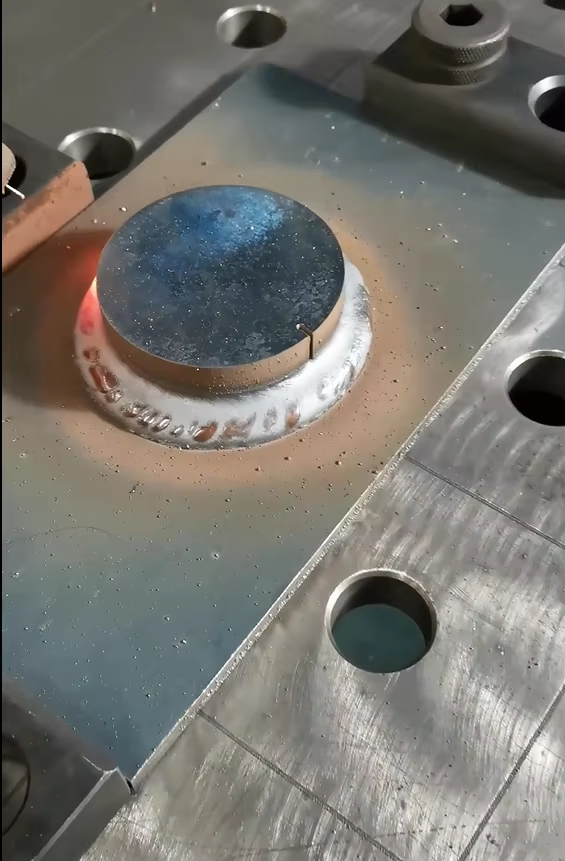
The kinematics involve a complex 5-axis interpolation where the laser head must compensate for the varying thickness encountered during an angled pass through a profile’s flange and web. Our field data indicates that the ±45° bevel capability reduces the Heat Affected Zone (HAZ) by 65% compared to oxy-fuel methods, resulting in a grain structure that is far less susceptible to hydrogen-induced cracking—a critical failure point in high-vibration wind environments.
2. Sector-Specific Application: Wind Turbine Towers in Rosario
Rosario has positioned itself as a strategic hub for South American renewable energy infrastructure. The wind turbine tower sector requires massive throughput of H-beams, I-beams, and large-diameter hollow sections. These components form the internal skeleton of the tower, supporting the high-voltage electrical arrays and technician access platforms.
2.1. Structural Precision in Tower Internals
Wind towers are subjected to cyclical loading and extreme aerodynamic stress. The internal brackets and flange connectors must fit with a tolerance of <0.5mm to ensure load distribution is uniform. Using the 12kW system, we have observed a 400% increase in precision over manual methods. The “Universal” aspect of the system allows it to handle H-beams (HEA/HEB) and U-channels (UPN) used for the internal scaffolding without changing out mechanical fixtures, thanks to the automatic centering and sensing software.
2.2. Mitigating Thermal Distortion
In Rosario’s manufacturing facilities, ambient temperature fluctuations can affect material expansion. The 12kW laser’s high processing speed minimizes the dwell time of the beam on the material. By traversing at higher feed rates, the cumulative heat input into the profile is drastically reduced. This prevents the “bowing” or “twisting” of long profile sections (up to 12 meters), ensuring that the vertical alignment of the tower’s internal ladder systems remains true over the entire 100-meter height of the structure.
3. The Synergy of High Power and ±45° Beveling
The relationship between 12,000 watts of fiber laser energy and 3D beveling is a force multiplier for heavy steel processing. When cutting a 45° bevel on a 20mm thick flange, the “effective thickness” the laser must penetrate increases to approximately 28.3mm. A 6kW or 8kW system would struggle to maintain a clean dross-free edge at this effective thickness, often requiring a reduction in speed that increases the HAZ.
3.1. Optimized Weld Preparation
The ±45° beveling allows for the immediate creation of welding prep geometries. In wind tower fabrication, “Full Penetration” welds are standard. By utilizing the laser to create a precise 30° or 45° land, the volume of filler metal required is standardized. Engineering logs show a 30% reduction in welding wire consumption because the fit-up gaps are virtually eliminated. The laser-cut bevel provides a surface roughness (Ra) that often bypasses the need for secondary grinding, allowing pieces to move directly from the laser bed to the welding robot.
3.2. Automated Profile Detection and Compensation
Structural steel profiles are rarely perfectly straight from the mill. The 12kW Universal system employs a laser-based touch-sensing or vision system to map the actual geometry of the profile before the cut begins. If an H-beam has a slight twist, the 5-axis head adjusts its coordinate system in real-time. This ensures the bevel angle remains constant relative to the material surface, rather than the theoretical CAD plane. This is vital for Rosario’s manufacturers who often source steel from various regional mills with varying dimensional tolerances.
4. Efficiency Metrics and Operational Impact
From a senior engineering perspective, the transition to 12kW profile laser cutting represents a total overhaul of the shop floor workflow. We analyzed a standard production run of 50 tower internal kits (comprising brackets, plates, and channeled supports).
- Traditional Workflow: Sawing -> Layout -> Manual Plasma Cut -> Grinding -> Manual Beveling -> Fit-up. Total Time: 180 hours.
- 12kW Laser Workflow: Automated Load -> 12kW Bevel Cut -> Fit-up. Total Time: 22 hours.
4.1. Software Integration and Nesting
The use of advanced nesting algorithms for profiles (3D Nesting) has improved material utilization by 18%. In large-scale projects like those found in Rosario, where steel costs are a significant portion of the CAPEX, this reduction in scrap translates to millions of pesos in annual savings. The software allows for “Common Cut” lines even on beveled edges, a feat previously impossible with mechanical or plasma tools.
5. Technical Challenges and Mitigation
Operating a 12kW system in an industrial environment like Rosario requires specific infrastructure. The high power draw necessitates a stabilized power grid or dedicated transformers to prevent voltage drops during piercing cycles. Furthermore, the ±45° head requires rigorous calibration protocols.
5.1. Gas Dynamics
At 12kW, gas flow dynamics become critical. The nozzle design must provide a laminar flow of Oxygen or Nitrogen to clear the molten steel from the deep bevel cuts. We have implemented high-pressure coaxial nozzles that stabilize the gas curtain, preventing “beading” at the bottom of the 45° exit point. This ensures that the root of the weld prep is clean and ready for the first pass of the arc.
6. Conclusion: The Future of Rosario’s Steel Sector
The integration of 12kW Universal Profile Steel Laser systems with ±45° beveling technology is no longer an optional upgrade but a structural necessity for the wind energy sector. The ability to move from raw profile to weld-ready component in a single automated step solves the two greatest challenges in heavy steel: precision and labor-intensive prep.
For the Rosario wind turbine projects, this technology ensures that the towers are not only built faster but are inherently safer due to the superior metallurgical integrity of the laser-cut joints. As an expert in the field, I conclude that the 12kW bevel-capable system is the current benchmark for high-output, high-specification structural steel fabrication. The synergy of power, motion control, and sector-specific application provides a clear path forward for the modernization of the regional energy supply chain.
















