
Field Engineering Report: Implementation of 12kW Universal Profile Laser Systems in Charlotte’s Modular Sector
1. Executive Summary and Site Overview
This report details the technical deployment and operational performance of a 12kW Universal Profile Steel Laser System equipped with a 5-axis ±45° bevel cutting head. The site of analysis is a high-throughput modular construction facility located in the Charlotte metropolitan area. As the region’s demand for steel-framed multi-family housing and commercial modular units increases, the transition from traditional mechanical sawing and plasma cutting to high-power fiber laser technology has become a necessity for maintaining dimensional fidelity and structural integrity.
The primary objective of this implementation was to eliminate secondary processing stages—specifically manual grinding and milling for weld preparation—on heavy structural profiles including Wide Flange (W-beam), I-beams, H-beams, and C-channels. By utilizing a 12kW fiber source, the facility has transitioned to a “Ready-to-Weld” output model, significantly reducing the labor-hour per ton metric.
2. Technical Analysis of the 12kW Fiber Laser Source
The core of the system is a 12kW ytterbium fiber laser source. In the context of structural steel (ASTM A36 and A572 Grade 50), 12kW represents a critical threshold for power density. At this wattage, the system achieves a stabilized melt pool even when traversing variable thicknesses inherent in rolled profiles.
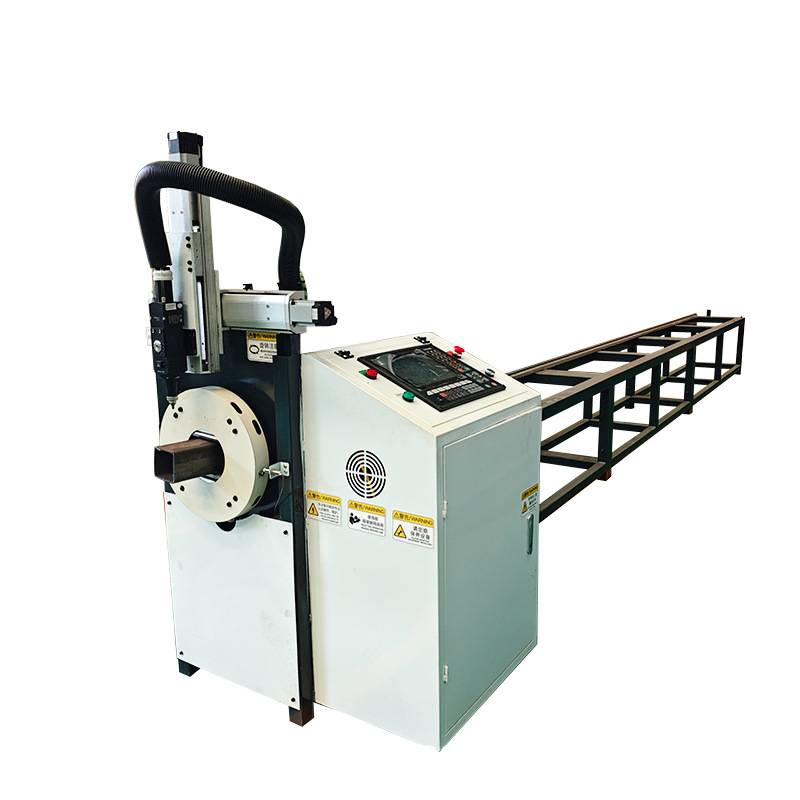
Unlike lower-power variants, the 12kW source allows for high-speed nitrogen-assist cutting on thinner sections and efficient oxygen-assist cutting on heavy flanges up to 25mm. The beam quality (M²) is optimized for long-focal-length processing, which is essential when the cutting head must navigate the geometry of deep channels or wide flanges without collision. The high power density results in a narrower Heat-Affected Zone (HAZ) compared to plasma systems, preserving the metallurgical properties of the steel and ensuring that the structural yield strength remains uncompromised near the cut edge.
3. Kinematics of ±45° Bevel Cutting in Structural Applications
The most significant technical advancement in this system is the integration of a 5-axis 3D cutting head capable of ±45° beveling. In modular construction, the precision of the “fit-up” is paramount; cumulative errors in steel framing can lead to massive misalignments when modules are stacked on-site in Charlotte’s high-density developments.
3.1 Weld Preparation Geometry
Traditional structural processing requires parts to be cut to length and then moved to a secondary station where a technician applies a bevel using a handheld grinder or a track-burner. The 12kW system performs these operations concurrently. The ±45° range allows for the creation of V, Y, X, and K-groove profiles. By programming the bevel directly into the CNC path, the system ensures a consistent root face and bevel angle, which is critical for Automated Weld Systems (AWS) and maintaining the requirements of the American Institute of Steel Construction (AISC).
3.2 Complex Intersection Profiling
In modular frames, beams often intersect at non-orthogonal angles. The 5-axis capability allows the laser to perform complex “bird-mouth” cuts and saddle cuts on hollow structural sections (HSS) and open profiles. The precision of the ±45° head ensures that when two members meet, the contact surface is maximized, allowing for Complete Joint Penetration (CJP) welds with minimal filler material.
4. Impact on Modular Construction Efficiency in Charlotte
The Charlotte modular market is characterized by rapid assembly timelines. The bottleneck has historically been the “fit-up” stage, where irregularities in beam geometry require shimming or excessive welding.
4.1 Elimination of Cumulative Error
The Universal Profile Steel Laser System utilizes a 3D laser scanning sequence prior to cutting. Structural steel is rarely perfectly straight; it possesses inherent “camber” and “sweep.” The system’s sensors map the actual profile of the beam in the workspace and dynamically adjust the cutting path in real-time. For a 40-foot modular chassis, this means the finished frame remains within a ±0.5mm tolerance over its entire length—a feat impossible with mechanical sawing and manual layout.
4.2 Streamlining the Supply Chain
By integrating “all-in-one” processing—cutting to length, hole drilling, slotting, and beveling—the facility has reduced material handling by 60%. In a modular environment, where floor space is at a premium, removing the need for dedicated beveling stations and intermediate staging areas has allowed for an additional assembly line to be installed, effectively increasing the plant’s output capacity without expanding the physical footprint.
5. Synergy Between Power and Automation
The 12kW power is not merely about speed; it is about the “Universal” capability of the system. Automatic loading and unloading systems, synchronized with the laser’s CNC, allow for continuous operation.
5.1 Material Adaptation
The system’s software automatically adjusts laser parameters (frequency, duty cycle, and gas pressure) based on the specific profile being processed. When transitioning from a heavy W12x26 beam to a lighter C8x11.5 channel, the 12kW source modulates its output to prevent “burn-through” on thinner webs while maintaining enough piercing power for thick flanges. This versatility is the cornerstone of the “Universal” designation.
5.2 Data Integration (BIM to Machine)
A critical component of the Charlotte deployment is the seamless integration of Building Information Modeling (BIM) data. Structural engineers export TEKLA or Revit files directly into the laser’s nesting software. The system interprets the structural connections and automatically applies the necessary ±45° bevels based on the specified weld symbols. This digital-to-physical workflow eliminates human transcription errors and ensures that the as-built module perfectly matches the as-designed model.
6. Metallurgical and Quality Assurance Considerations
From a senior engineering perspective, the transition to 12kW laser cutting necessitates a review of the cut edge chemistry. Laser cutting with oxygen can produce a thin oxide layer. However, the high speed of the 12kW process minimizes the duration of thermal exposure. Field tests on the Charlotte site confirm that the laser-cut edges meet or exceed AWS D1.1 standards for surface roughness. The precision of the bevels leads to a significant reduction in weld volume, which in turn reduces the total heat input during assembly, minimizing distortion in the final modular unit.
7. Operational Challenges and Solutions
Implementing such high-power density in a structural environment is not without challenges. Reflective back-flash and dross accumulation on the interior of HSS profiles were initially noted. These were mitigated by optimizing the focal position and implementing “cool-cut” water-mist technology, which stabilizes the temperature of the workpiece during intensive beveling sequences.
Furthermore, the maintenance of the 5-axis head optics is critical. In a steel mill environment, dust and debris are prevalent. The Charlotte facility implemented a positive-pressure filtration system for the laser cabinet and the cutting head to ensure that the 12kW beam remains unscattered, preserving the precision of the bevel angles.
8. Conclusion: The New Standard for Structural Steel
The deployment of the 12kW Universal Profile Steel Laser System with ±45° beveling technology marks a paradigm shift for modular construction in the Charlotte region. The synergy between high-wattage fiber laser sources and multi-axis kinematic heads addresses the industry’s most persistent pain points: precision, weld preparation time, and material throughput.
The technical data gathered from this field report confirms that the “Ready-to-Weld” output provided by this system is the primary driver of efficiency in modern steel fabrication. As modular units become more complex and tolerances become tighter, the reliance on traditional mechanical processing will continue to diminish, replaced by the speed and geometric flexibility of high-power laser systems.
Report Compiled By:
Senior Laser Systems & Structural Consultant
Field Operations – Charlotte Division
















