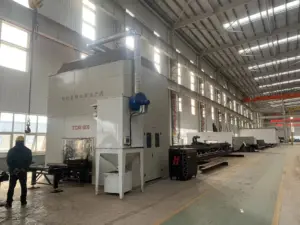
The Strategic Integration of 12kW Fiber Lasers in Rayong’s Industrial Hub
Rayong has long been the heartbeat of Thailand’s heavy industry, serving as a critical node for the Eastern Economic Corridor (EEC). As the global demand for mineral resources surges, the pressure on mining machinery manufacturers to produce more durable, precise, and cost-effective equipment has reached an all-time high. Enter the 12kW Universal Profile Steel Laser System.
For years, the mining sector relied on plasma or oxy-fuel cutting for thick-section structural steel. While effective, these methods often necessitated extensive post-processing, including grinding and secondary beveling. The introduction of 12kW fiber laser power to the Rayong manufacturing cluster changes the calculus. At this power level, the laser doesn’t just cut; it vaporizes high-tensile steel with a narrow heat-affected zone (HAZ), ensuring that the structural integrity of the mining equipment—often subjected to extreme vibrations and loads—remains uncompromised.
The Mechanics of Power: Why 12kW is the Sweet Spot for Mining
In the realm of fiber lasers, wattage translates directly to “cutting thickness” and “processing speed.” For mining machinery—which involves heavy-duty hopper liners, excavator chassis, and conveyor frameworks—materials typically range from 12mm to 30mm of carbon steel or specialized wear-resistant alloys like Hardox.
A 12kW source provides the necessary energy density to maintain a stable “keyhole” during the cutting process in these thick sections. Compared to a 6kW system, a 12kW laser can process 20mm carbon steel up to three times faster, significantly increasing the throughput of a Rayong-based facility. Furthermore, the 12kW power allows for the use of compressed air or nitrogen as an assist gas in mid-range thicknesses, reducing the operational cost per part compared to high-purity oxygen.
Redefining Geometry: The ±45° Bevel Cutting Advantage
The true “game-changer” for mining machinery fabrication is the ±45° 3D beveling head. In traditional fabrication, a part is cut to shape, then moved to a separate station where a technician uses a hand-held torch or a milling machine to create a bevel for welding. This secondary process is a hotbed for human error and lost time.
The 12kW Universal Profile system integrates this into the primary cutting cycle. The laser head, mounted on a high-precision 5-axis gantry, can tilt up to 45 degrees in any direction. This allows for the immediate creation of V, X, Y, and K-shaped joints. For the massive structural components of a mining crusher or a continuous miner, these precision bevels ensure deep weld penetration and superior joint strength. In a high-stakes environment like a subterranean mine, the quality of these welds, facilitated by laser-perfect bevels, is a critical safety requirement.
Universal Profile Processing: Beyond Flat Sheets
Mining equipment is rarely made of flat plates alone. It is a complex assembly of H-beams, I-beams, C-channels, and large-diameter square tubing. Traditional laser systems are often limited to either flat sheets or simple tubes. The “Universal Profile” designation of this 12kW system implies a transformative versatility.
Equipped with advanced chucking systems and a multi-axis kinematic model, the system can rotate and position heavy structural profiles under the laser head. Whether it is cutting a circular mounting hole through a 400mm H-beam or contouring the end of a heavy-wall pipe to fit a curved manifold, the system handles it with micron-level repeatability. For manufacturers in Rayong, this means one machine can replace a suite of saws, drills, and manual cutting stations, drastically reducing the factory footprint and the complexity of the material handling logic.
Addressing the Challenges of Wear-Resistant Steels
Mining machinery lives and dies by its ability to resist abrasion. Consequently, fabrics make heavy use of high-carbon, quenched, and tempered steels. These materials are notoriously difficult to cut using traditional thermal methods because the high heat input can soften the edges, defeating the purpose of the wear-resistant material.
The 12kW fiber laser’s high power density allows for extremely fast travel speeds. This high speed minimizes the “dwell time” of the heat on the edge of the cut. As a result, the hardness of the material at the cut edge is preserved far better than with plasma or oxy-fuel. In Rayong, where local suppliers provide specialized alloys for the regional mining market, the ability to maintain material properties while achieving a ±45° bevel is a significant competitive advantage.
Software Integration and Industry 4.0 in the EEC
The hardware is only half the story. To manage the complexity of a ±45° bevel on a universal profile, the system utilizes sophisticated CAD/CAM nesting software. This software automatically calculates the “tilt-and-turn” logic required to maintain the focal point of the 12kW beam on the surface of the steel, even as the geometry shifts.
For the Rayong industrialist, this represents an entry point into Industry 4.0. The system can be integrated into the factory’s ERP (Enterprise Resource Planning) system, providing real-time data on gas consumption, electricity usage, and cutting time per part. This level of transparency is vital for calculating the ROI of large-scale mining projects where margins are often tight and deadlines are non-negotiable.
Localized Maintenance and the Rayong Ecosystem
Investing in a 12kW system is a significant capital expenditure. The success of such an installation in Rayong depends heavily on the local support ecosystem. The proximity to major logistics hubs allows for rapid delivery of consumables—such as protective windows, nozzles, and ceramic rings—and specialized assist gases.
Furthermore, as a fiber laser expert, I must emphasize that a 12kW system requires a stable environment. Rayong’s tropical climate necessitates high-efficiency industrial chillers and dust extraction systems to handle the particulate matter generated during the laser-material interaction. The modern universal profile systems are designed with fully enclosed cabins and sophisticated filtration, ensuring that the machine operates reliably despite the ambient humidity and heat of the Gulf of Thailand.
Economic Impact: ROI and the Future of Thai Fabrication
The transition to a 12kW Universal Profile Steel Laser System with beveling capabilities provides a multi-fold Return on Investment (ROI). First is the reduction in labor costs; a single operator can now perform the work of a five-man cutting and grinding crew. Second is the material savings; the precision of the laser allows for “common-line cutting” and tighter nesting of parts, reducing the scrap rate of expensive alloys.
Third, and perhaps most importantly for the Rayong region, is the increase in global competitiveness. By producing mining components that are “weld-ready” with higher precision than international competitors, Thai fabricators can move up the value chain—transitioning from simple component suppliers to high-end original equipment manufacturing (OEM) partners for global mining giants.
Conclusion: The New Standard for Mining Machinery
The 12kW Universal Profile Steel Laser System is more than just a cutting tool; it is a comprehensive manufacturing platform. For the mining machinery sector in Rayong, it represents the end of the “rough cut” era. By combining high-wattage fiber laser power with the mechanical agility of ±45° beveling, manufacturers can achieve a level of geometric complexity and structural integrity that was previously impossible.
As we look toward the future of heavy industry in Thailand, the adoption of such advanced photonic solutions will be the defining factor in who leads the market. In the rugged, unforgiving world of mining, precision is the ultimate form of durability—and the 12kW fiber laser is the ultimate instrument of that precision.