Introduction to 12kW Tube laser cutting in Mexico City
The industrial landscape of Mexico City (CDMX) and the surrounding Valley of Mexico is undergoing a significant technological transformation. As nearshoring continues to drive global manufacturing toward North America, the demand for precision metal fabrication has reached an all-time high. Among the most critical advancements in this sector is the implementation of high-power fiber laser technology. Specifically, the 12kW tube laser cutter has emerged as a cornerstone for industries ranging from automotive manufacturing to aerospace and structural engineering.
Operating a 12kW system offers a unique set of advantages, particularly when processing non-ferrous metals like aluminum alloy. However, the high-altitude environment of Mexico City—situated at over 2,240 meters above sea level—presents specific engineering challenges that must be addressed to maintain optimal efficiency. This guide explores the technical nuances of utilizing a 12kW fiber laser for aluminum tube fabrication, focusing on the intersection of high-power optics and the unique atmospheric conditions of the Mexican capital.
 laser cutting machine” style=”width: 100%; max-width: 800px; height: auto; margin: 20px 0;”>
The Technical Superiority of 12kW Power for Aluminum Alloys
Aluminum alloys, such as the 6061-T6 and 5052 series commonly used in Mexican industrial sectors, are notoriously difficult to process using traditional thermal methods. Their high thermal conductivity and high reflectivity mean that a significant portion of laser energy can be wasted or reflected back into the cutting head if the power density is insufficient. A 12kW fiber laser overcomes these hurdles by providing an immense energy concentration at the focal point.
Overcoming Reflectivity and Thermal Dissipation
At lower power levels (under 4kW), aluminum acts like a mirror to fiber laser wavelengths (typically around 1.06 microns). This “back-reflection” can damage sensitive optical components. However, at 12kW, the energy density is so high that it instantaneously transitions the material into a molten state, significantly increasing the absorption rate. This allows for faster “piercing” and more stable laser cutting speeds, reducing the heat-affected zone (HAZ) and preventing the deformation of thin-walled tubes.
Increased Processing Speeds
In a high-output environment like Mexico City’s industrial corridors (such as Vallejo or Tlalnepantla), throughput is the primary metric for success. A 12kW system can process aluminum tubes with wall thicknesses of up to 12mm-15mm at speeds that were previously impossible. For thinner sections (3mm-5mm), the 12kW source allows for high-speed nitrogen-assisted cutting, which results in a burr-free, “mirror” finish that requires no secondary post-processing.
Environmental Considerations: Operating in Mexico City
Operating precision machinery in Mexico City requires an understanding of how altitude and climate affect physics. The reduced atmospheric pressure at 2,240 meters impacts both the cooling systems and the dynamics of the assist gases used during the laser cutting process.
Assist Gas Dynamics at High Altitude
The density of air in Mexico City is approximately 20-25% lower than at sea level. When using high-pressure nitrogen for aluminum alloy cutting, the flow dynamics through the nozzle change. Engineers must often calibrate the gas pressure slightly higher than the manufacturer’s standard sea-level specifications to achieve the same kinetic energy required to eject molten aluminum from the kerf. Failure to adjust for this can lead to dross accumulation on the underside of the tube.
Cooling and Thermal Management
The 12kW laser source generates significant heat. In CDMX, the lower air density reduces the efficiency of air-cooled heat exchangers. It is imperative to use a high-capacity industrial chiller with a specialized refrigerant cycle designed for high-altitude operation. Maintaining the laser source and the cutting head at a constant temperature is vital for preventing “thermal drift,” which can cause the focal point to shift during long production runs.
Optimizing the Laser Cutting Process for Aluminum Tubes
To achieve the highest quality when working with aluminum alloys, operators must master the interplay between power, speed, and focal position. Aluminum’s fluidity when molten means that even small deviations in parameters can result in poor edge quality.
Focal Position and Beam Profile
For thick aluminum tubes, a “negative” focus (where the focal point is positioned inside the material) is often preferred. This widens the kerf slightly, allowing the assist gas to more effectively blow out the molten metal. With 12kW of power, the beam profile can be shaped to optimize the energy distribution, ensuring that the top and bottom of the cut remain consistent, even on curved tube surfaces.
Nozzle Selection and Centering
The use of double-layer nozzles is standard for nitrogen-assisted laser cutting of aluminum. In a 12kW system, the nozzle diameter must be precisely matched to the material thickness. In the fast-paced workshops of Mexico City, operators must perform frequent centering checks. Even a 0.1mm misalignment can cause the gas flow to become turbulent, leading to an asymmetrical cut or “burning” on one side of the tube.
Material Handling and Tube Geometry
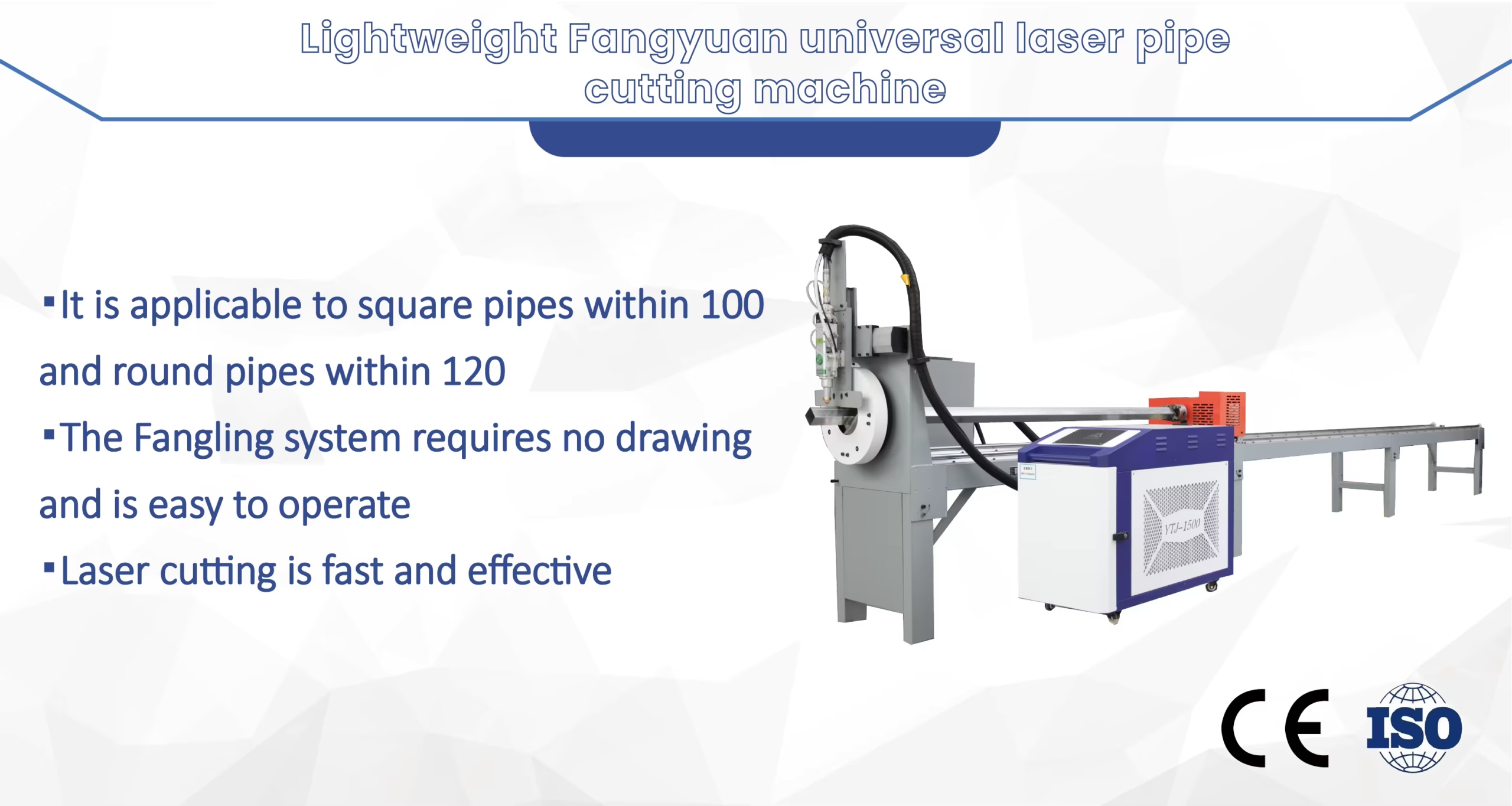
Aluminum tubes come in various shapes: round, square, rectangular, and oval. The 12kW tube laser cutter utilizes advanced chuck systems (pneumatic or hydraulic) to secure the material. Because aluminum is softer than steel, it is prone to surface scratching. High-end machines used in the Mexican market often feature specialized nylon rollers and protective loading systems to preserve the aesthetic quality of the alloy.
Automated Loading and Unloading
To maximize the 12kW source’s potential, automated bundle loaders are essential. In high-volume sectors like the Mexican automotive industry, these systems allow for continuous operation. The software calculates the most efficient nesting patterns, minimizing “remnant” waste—a critical factor given the fluctuating price of aluminum in the global market.
Maintenance and Longevity in an Urban Industrial Environment
Mexico City is known for its high particulate matter and dust levels. For a fiber laser cutting system, dust is the enemy of optics. A 12kW machine requires a strictly controlled environment or a highly localized filtration system.
Optic Protection
The protective windows (cover slides) in the cutting head must be inspected daily. At 12kW, even a microscopic dust particle on the lens can absorb enough energy to shatter the glass, leading to costly downtime. Using positive pressure “air curtains” around the cutting head helps repel contaminants during the process.
Electrical Stability
The power grid in some industrial zones of Mexico City can experience fluctuations. A 12kW laser requires a stable, high-voltage supply. Installing a dedicated voltage regulator and a robust grounding system is non-negotiable to protect the sensitive CNC electronics and the laser generator from surges that could compromise the laser cutting precision.
Applications in the Mexican Market
The versatility of the 12kW tube laser has opened new doors for Mexican manufacturers. In the aerospace hub of Querétaro and the automotive clusters of Estado de México, aluminum is replacing steel to reduce weight and improve fuel efficiency.
Automotive Chassis and Frames
Lightweight aluminum extrusions are increasingly used in electric vehicle (EV) frames. The 12kW laser allows for complex “fish-mouth” cuts and interlocking joints that are essential for structural integrity. The precision of the laser cutting process ensures that these components can be robotically welded with minimal fit-up issues.
Architectural and Structural Aluminum
From the modern skyscrapers along Paseo de la Reforma to large-scale infrastructure projects, aluminum is favored for its corrosion resistance. 12kW tube lasers enable architects to design complex geometries in large-diameter tubes that were previously too expensive or difficult to fabricate manually.
Conclusion: The Future of Fabrication in CDMX
The adoption of 12kW tube laser cutting technology represents a significant leap forward for the Mexican manufacturing sector. By understanding the specific requirements of aluminum alloys and the environmental variables of Mexico City, companies can achieve unprecedented levels of productivity and quality. As the industry moves toward “Industry 4.0” integration, these high-power systems will continue to be the engine driving innovation, allowing Mexican firms to compete on a global stage with precision, speed, and reliability.
Investing in 12kW technology is not merely an upgrade in power; it is a commitment to mastering the physics of light and material. For the engineers and fabricators in the heart of Mexico, it is the key to unlocking the full potential of aluminum alloy fabrication in the 21st century.