
The Evolution of 12kW laser cutting in the Toluca Industrial Corridor
Toluca, the capital of the State of Mexico, has solidified its position as one of the most significant manufacturing hubs in North America. With a dense concentration of automotive, aerospace, and heavy machinery industries, the demand for precision metal fabrication is at an all-time high. Within this ecosystem, the introduction of 12kW fiber laser technology has redefined the parameters of productivity, particularly when processing carbon steel. This guide explores the technical nuances, operational strategies, and economic advantages of deploying high-power laser cutting systems in the unique industrial climate of Toluca.
The transition from lower-wattage systems (such as 4kW or 6kW) to the 12kW threshold is not merely an incremental upgrade; it is a fundamental shift in processing capability. For Toluca-based fabricators, this means the ability to handle thicker plates with greater speed and edge quality, meeting the rigorous standards of global Tier 1 and Tier 2 suppliers. As the region continues to attract international investment, mastering the 12kW fiber laser is essential for maintaining a competitive edge in the local and global supply chains.
Technical Specifications of the 12kW Fiber Laser Source
A 12kW fiber laser source delivers a massive power density to the focal point, allowing for the rapid sublimation and melting of carbon steel. Unlike CO2 lasers of the past, fiber technology operates at a wavelength of approximately 1.06 microns, which is more readily absorbed by metals. This high absorption rate, combined with 12,000 watts of power, enables cutting speeds that were previously unthinkable.
In the context of carbon steel, a 12kW system can comfortably process thicknesses ranging from 1mm to 40mm. In the “sweet spot” of 6mm to 20mm—thicknesses frequently used in automotive chassis components and structural brackets—the 12kW laser cutting process is significantly faster than its 6kW counterparts, often doubling or tripling the linear meters cut per hour. This throughput is vital for Toluca’s high-volume production environments where lead times are measured in hours rather than days.
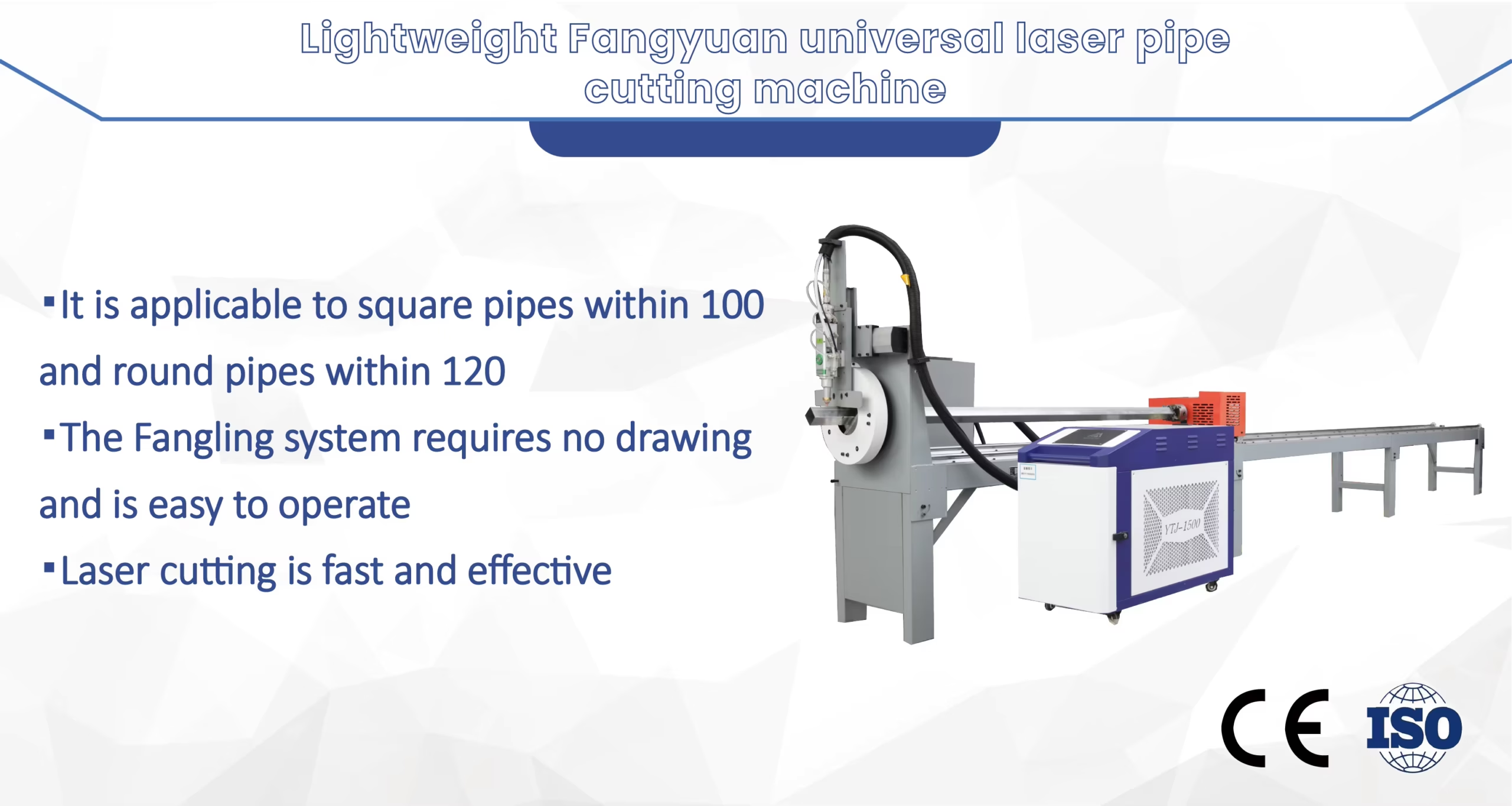 laser cutting machine for Sheet Metal” style=”width: 100%; max-width: 800px; height: auto; margin: 20px 0;”>
Processing Carbon Steel: Metallurgical Considerations
Carbon steel is the backbone of the Toluca manufacturing sector. Whether it is ASTM A36 for structural applications or specialized high-strength low-alloy (HSLA) steels for automotive safety components, the material reacts uniquely to high-power laser cutting. The primary challenge with carbon steel is managing the Heat Affected Zone (HAZ) and ensuring a clean dross-free finish.
With 12kW of power, the “piercing” phase—the most critical part of the cut—is reduced to milliseconds. This rapid piercing prevents excessive heat buildup in the surrounding material, which is crucial for maintaining the structural integrity of the part. Furthermore, the high power allows for the use of “Air Cutting” or “High-Pressure Nitrogen Cutting” on medium-gauge carbon steel (up to 12mm), which produces an oxide-free edge. This is a game-changer for Toluca shops that previously had to spend hours on secondary de-burring and cleaning before welding or painting.
The Impact of Toluca’s Altitude on Laser Operations
Toluca sits at an elevation of approximately 2,660 meters (8,730 feet) above sea level. For engineering teams, this altitude presents specific environmental variables that must be accounted for in the laser cutting process. While the fiber laser source itself is a sealed solid-state system and largely unaffected by air pressure, the auxiliary systems are not.
Lower air density at high altitudes affects the cooling efficiency of the water chillers required to stabilize the 12kW resonator and the cutting head. Engineers in Toluca must ensure that chiller units are appropriately rated for high-altitude operation or “over-specced” to handle the reduced heat exchange capacity. Additionally, the pneumatic systems and gas delivery pressures for Oxygen (O2) and Nitrogen (N2) must be calibrated to compensate for the lower atmospheric pressure to ensure consistent assist-gas dynamics at the nozzle.
Optimizing Assist Gas Strategies for 12kW Systems
The choice of assist gas is the most significant factor in the cost-per-part and edge quality when laser cutting carbon steel. With a 12kW system, the options expand significantly:
- Oxygen (O2) Cutting: Traditionally used for thicker carbon steel. The oxygen reacts exothermically with the iron, adding thermal energy to the cut. With 12kW, oxygen cutting of 25mm+ plate is exceptionally stable, producing a smooth, square edge.
- Nitrogen (N2) Cutting: High-power 12kW lasers allow for Nitrogen cutting of carbon steel up to 10-12mm. This process relies purely on mechanical kinetic energy to blow the molten metal out. The result is a silver, oxide-free edge that is ready for immediate powder coating or welding.
- Compressed Air Cutting: As power increases to 12kW, high-pressure compressed air becomes a viable and highly economical alternative for carbon steel up to 8mm. It offers speeds comparable to Nitrogen but at a fraction of the gas cost, provided the air is ultra-dry and oil-free.

Operational Excellence: Maintenance and Nozzle Technology
Operating a 12kW laser in a 24/7 production environment like those found in Toluca’s industrial parks requires a disciplined maintenance regimen. The sheer power of the beam means that any contamination on the protective window or the internal optics will be instantly fatal to the component. In the dusty environments often found in large-scale metal fabrication shops, maintaining a clean-room standard for the cutting head is paramount.
Nozzle selection is equally critical. For 12kW carbon steel applications, “Cool-Touch” or double-layered nozzles are often employed to manage the reflected heat from the molten pool. Automated nozzle changers and cleaners are no longer luxuries; they are necessities for maintaining the beam alignment and focus required for high-precision laser cutting. In Toluca, where skilled labor can be competitive, these automated features allow a single operator to manage multiple high-power machines effectively.
Integration with Industry 4.0 in the State of Mexico
The 12kW laser cutting machine is a data-rich environment. Modern systems deployed in Toluca are typically integrated into the factory’s ERP and MES systems. Real-time monitoring of gas consumption, power usage, and “beam-on” time allows plant managers to calculate the exact cost of every carbon steel part produced.
Advanced nesting software also plays a vital role. With the speed of 12kW cutting, the bottleneck often shifts from the machine to the loading/unloading process. Implementing automated material handling systems (towers and pallets) ensures that the laser is not sitting idle. For Toluca’s automotive suppliers, this level of automation is critical for meeting “Just-In-Time” (JIT) delivery requirements while minimizing material waste through intelligent nesting of parts on the carbon steel sheets.
Economic Viability and Return on Investment (ROI)
While the initial capital expenditure for a 12kW fiber laser is higher than lower-power models, the ROI for Toluca fabricators is often realized much faster. The primary driver of this ROI is the “cost-per-part.” By increasing cutting speeds by 200% or 300% on common carbon steel thicknesses, the machine’s overhead is spread across a much larger volume of parts.
Furthermore, the ability to cut thicker materials (up to 40mm) allows shops to bring work in-house that was previously outsourced to plasma cutting or waterjet services. Laser cutting provides a superior finish and tighter tolerances (+/- 0.1mm) compared to plasma, reducing the need for secondary machining. In a competitive market like Toluca, offering “laser-quality” edges on heavy plate is a significant market differentiator.
Safety Standards and Environmental Regulations
Operating a Class 4 laser system of this magnitude requires strict adherence to safety protocols. In Mexico, NOM (Normas Oficiales Mexicanas) standards govern industrial safety. For 12kW systems, a fully enclosed housing is mandatory to protect workers from reflected radiation. Additionally, high-power cutting of carbon steel generates significant particulate matter and fumes.
Toluca’s environmental regulations require robust dust extraction and filtration systems. High-efficiency fume extractors with HEPA filtration are necessary to ensure that the air quality within the facility remains safe and that the shop remains compliant with local environmental audits. Investing in a high-quality filtration system also protects the machine’s sensitive motion components from abrasive metal dust.
Conclusion: The Future of Metal Fabrication in Toluca
The adoption of 12kW laser cutting technology represents a milestone in the industrial maturity of Toluca. As the region continues to evolve from a low-cost manufacturing center to a high-tech engineering hub, the tools used on the shop floor must keep pace. For carbon steel fabrication, the 12kW fiber laser offers a perfect balance of power, precision, and profitability.
By understanding the metallurgical requirements of carbon steel, optimizing gas strategies for the local altitude, and embracing the automation capabilities of modern fiber lasers, Toluca-based companies can achieve world-class production standards. The 12kW laser is not just a tool; it is the engine of growth for the next generation of Mexican manufacturing excellence.
















