
The Evolution of 12kW laser cutting in Tijuana’s Industrial Landscape
The manufacturing sector in Tijuana, Baja California, has undergone a radical transformation over the last decade. As a primary hub for the “Maquiladora” industry, the region has shifted from simple assembly to high-tech precision engineering. At the forefront of this shift is the implementation of 12kW precision laser systems. These high-power fiber lasers have redefined the capabilities of local fabricators, particularly when dealing with non-ferrous metals. The 12kW threshold represents a “sweet spot” in industrial laser cutting, providing enough power to maintain high feed rates on thick materials while ensuring the beam quality remains tight enough for intricate geometries.
For engineers and plant managers in Tijuana, the adoption of 12kW technology is not merely an upgrade in speed; it is a strategic move to meet the stringent requirements of the aerospace, medical device, and automotive industries that dominate the border region. The ability to process complex components with minimal post-processing is a competitive necessity in a market that demands just-in-time delivery to the United States and global markets.
 laser cutting machine“>
Material Science: Processing Aluminum Alloys with High-Power Fiber Lasers
Aluminum alloys, such as the 6061-T6 and 7075 series commonly used in Tijuana’s aerospace sector, present unique challenges for thermal processing. Aluminum is characterized by high thermal conductivity and high reflectivity. In lower-power systems, these properties often lead to “back-reflection,” where the laser energy is bounced back into the delivery optics, potentially causing catastrophic damage to the resonator. However, the 12kW precision laser system utilizes advanced optical isolators and a power density that overcomes the initial reflectivity of the material almost instantaneously.
Managing Reflectivity and Thermal Conductivity
When laser cutting aluminum, the 12kW source provides a high-intensity photon flux that creates a stable keyhole in the material. Because aluminum dissipates heat rapidly, a high-power laser is required to maintain the melt pool without allowing heat to soak into the surrounding areas. This minimizes the Heat Affected Zone (HAZ), which is critical for maintaining the structural integrity of the alloy. In precision engineering, preventing the alteration of the material’s temper (T-rating) is often as important as the dimensional accuracy of the cut itself.
Edge Quality and Dross Suppression
One of the primary advantages of the 12kW system is the reduction of “dross” or burr on the bottom edge of the aluminum part. In the past, aluminum required significant deburring after being cut. With the increased wattage, the melt is more fluid, and when combined with high-pressure nitrogen assist gas, the molten material is ejected cleanly from the kerf. This results in a “ready-to-assemble” edge, which significantly reduces labor costs in Tijuana’s high-volume production environments.
Technical Advantages of the 12kW Power Level
The jump from 6kW or 8kW to 12kW is not linear in terms of performance; it is exponential for certain thicknesses. For aluminum alloys between 6mm and 15mm, a 12kW system can increase cutting speeds by over 200% compared to an 8kW system. This throughput increase allows Tijuana-based facilities to take on larger contracts without expanding their physical footprint.
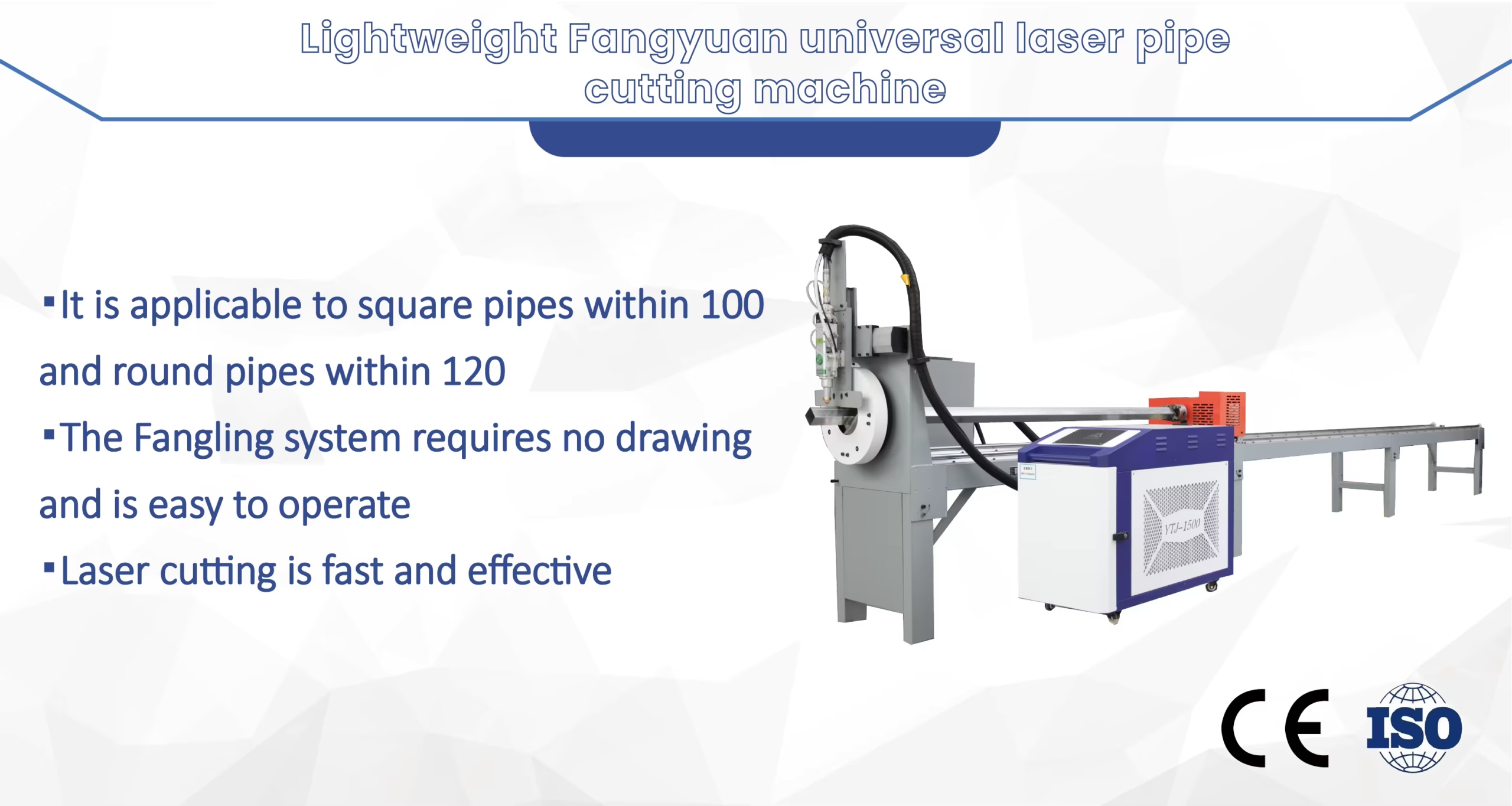
Beam Dynamics and Kerf Control
Precision laser cutting at 12kW relies on sophisticated beam shaping technology. Modern heads can adjust the beam diameter and mode (the energy distribution profile) on the fly. For thinner aluminum sheets, a narrow, high-intensity beam is used to slice through the material at incredible velocities. For thicker plates, the beam is widened to create a slightly larger kerf, allowing the assist gas to effectively clear the heavier melt. This adaptability ensures that a single machine can handle everything from delicate electronics housings to heavy-duty structural brackets.
The Role of Nitrogen Assist Gas
In the Tijuana industrial corridor, the supply chain for industrial gases is robust. For aluminum, Nitrogen is the assist gas of choice. Unlike Oxygen, which can cause oxidation and a rougher finish on aluminum, Nitrogen acts as a shielding agent. It prevents the formation of aluminum oxide on the cut surface, leaving a bright, weldable edge. The 12kW system’s ability to maintain high speeds means Nitrogen consumption per part is actually lower than on less powerful machines, despite the higher flow rates required during the cut.
Integration within the Tijuana Manufacturing Ecosystem
Tijuana’s proximity to San Diego and the wider California market makes it a nexus for high-spec manufacturing. Companies operating in the Otay Mesa and El Florido industrial parks are increasingly integrating their 12kW laser systems into fully automated workflows. This includes the use of CAD/CAM nesting software that optimizes material yield—critical when working with expensive aluminum alloys.
Meeting Aerospace and Automotive Standards
Precision is the hallmark of the 12kW system. With positioning accuracies often within ±0.03mm, these machines meet the rigorous standards of AS9100 and IATF 16949. In the aerospace sector, where aluminum components must meet exacting tolerances for flight safety, the consistency of fiber laser cutting provides a level of repeatability that plasma or waterjet cannot match at the same speed. The 12kW system ensures that the first part of a 10,000-unit run is identical to the last.
Economic Impact and ROI for Local Fabricators
While the capital investment for a 12kW precision laser is higher than lower-wattage alternatives, the Return on Investment (ROI) in the Tijuana market is accelerated by the high demand for precision components. The reduction in secondary operations (grinding, sanding, deburring) and the increase in parts-per-hour mean that most shops see a payback period of less than 24 months. Furthermore, the reliability of modern fiber resonators reduces downtime, a crucial factor in the 24/7 operating cycles of many Maquiladoras.
Operational Best Practices for 12kW Systems
To maximize the lifespan and performance of a 12kW laser system in the unique climate of Tijuana—which can range from humid coastal air to dry, dusty conditions—certain operational protocols must be followed. Precision optics are sensitive to environmental contaminants, making the filtration and cooling systems of the machine paramount.
Cooling and Thermal Stability
A 12kW laser generates significant heat within the resonator and the cutting head. High-efficiency chillers are required to maintain a constant temperature. In Tijuana, where ambient temperatures can fluctuate, using a dual-circuit cooling system—one for the laser source and one for the optics—is standard practice. This prevents thermal expansion of the optical components, which could otherwise lead to “focus shift” and a loss of cut quality during long production runs.
Maintenance of Delivery Optics
The “cover glass” or protective window is the most frequently replaced consumable in a 12kW system. When laser cutting aluminum, the risk of “spatter” is higher due to the material’s low viscosity when molten. Operators must be trained to inspect the cover glass regularly. Even a microscopic speck of dust can absorb 12kW of energy, causing the glass to shatter and potentially damaging the internal lenses. Clean-room standards for lens replacement are becoming the norm in top-tier Tijuana fabrication shops.
Future Outlook: The Frontier of Laser Technology in Baja
As the 12kW precision laser system becomes the standard in Tijuana, we are already seeing the emergence of even higher power levels, such as 20kW and 30kW. However, for the majority of aluminum alloy applications, the 12kW system remains the most efficient balance of power, precision, and operating cost. The ongoing integration of AI-driven monitoring—where the machine can detect a “lost cut” or an impending nozzle clog and self-correct—is the next step for the region’s industry.
The synergy between advanced laser cutting technology and Tijuana’s skilled labor force is creating a powerhouse of manufacturing excellence. By mastering the nuances of 12kW systems, local companies are not just cutting metal; they are carving out a significant place in the global supply chain, proving that precision and power are the keys to industrial longevity in the 21st century.
Conclusion
The 12kW precision laser system is more than just a tool; it is a catalyst for economic and technical growth in Tijuana. By addressing the specific challenges of aluminum alloys—reflectivity, heat dissipation, and edge quality—this technology allows local manufacturers to compete at the highest global levels. As the region continues to attract high-tech investment, the role of high-power laser cutting will only become more central to the success of the Baja California industrial corridor.
















