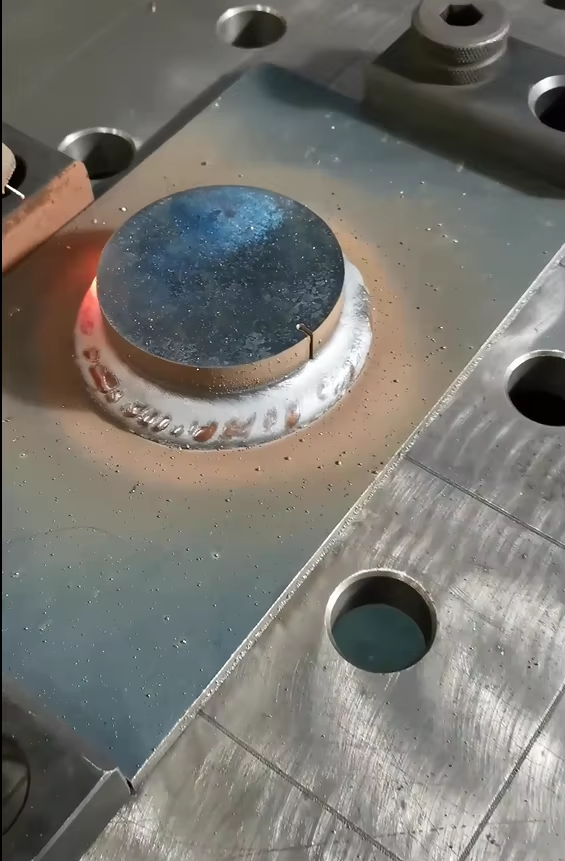
The Dawn of 12kW Fiber Laser Power in Structural Steel
For decades, the structural steel industry relied on the brute force of mechanical saws and the versatility of plasma torches. However, as the demand for modular construction intensifies in industrial hubs like Houston, these legacy methods are reaching their physical limits. Enter the 12kW Fiber Laser. As an expert in fiber optics and laser material processing, I have watched the “power wars” move from 2kW to 6kW, but it is the 12kW threshold that truly unlocks the potential for heavy-duty I-beam profiling.
At 12kW, the power density of a fiber laser allows for “vaporization cutting” on significantly thicker materials. While a 6kW machine might struggle or require slower feed rates for a 1-inch thick web or flange, the 12kW source maintains a high-velocity melt expulsion, resulting in a heat-affected zone (HAZ) that is virtually negligible. This is critical for Houston’s modular builders who must adhere to strict AISC (American Institute of Steel Construction) standards. A smaller HAZ means the structural integrity of the I-beam remains uncompromised, and the edges are weld-ready without the need for secondary grinding.
Precision for the Modular Revolution: Why Millimeters Matter
Modular construction is often described as “Lego at scale.” Unlike traditional on-site stick-built projects where gaps can be filled with shims or field welds, modular units are built in a controlled factory environment and then transported to the site. If the I-beam frame of Module A is off by just 3 millimeters, it may not lock into Module B three stories up.
The 12kW heavy-duty laser profiler solves the “tolerance stacking” nightmare. Traditional beam lines have a tolerance of roughly ±1.5mm to ±3mm. A fiber laser profiler, utilizing high-precision rack-and-pinion drives and laser-based edge detection, brings that tolerance down to ±0.1mm. When processing a 40-foot I-beam, the laser can accurately cut bolt holes, notches, and complex copes in a single pass. This ensures that every beam is a “digital twin” of the CAD model, allowing for rapid assembly in Houston’s modular yards and reducing the “fit-up” time by as much as 70%.
Zero-Waste Nesting: The Economics of Efficiency
In the current economic climate, where the price of structural steel remains volatile, material utilization is the difference between a profitable project and a loss. This is where “Zero-Waste Nesting” algorithms become the silent heroes of the fabrication process.
Traditional nesting often leaves significant “remnants”—short sections of I-beam that are too small to be used for primary structures but too expensive to simply scrap. Modern 12kW laser profilers utilize advanced software that looks across an entire project’s Bill of Materials (BOM). The software performs “common line cutting” and intelligent part-in-part nesting. For example, if a large I-beam requires a significant cope or a section to be removed for a utility pass-through, the laser can often cut smaller gussets or connection plates from that “waste” area of the beam’s web.
Furthermore, these machines utilize sophisticated sensing to minimize the “dead zone” at the ends of the beam. Traditional saws require a certain amount of material for the clamp to hold; the heavy-duty laser profilers used in Houston’s top-tier shops use secondary grippers and “chuck-over-chuck” processing, allowing the laser to cut within inches of the beam’s end. This can improve material yield by 10% to 15%—a massive cost saving when dealing with thousands of tons of steel.
The Houston Advantage: Logistics and Infrastructure
Houston, Texas, is uniquely positioned as a global leader in modular construction, particularly for the oil and gas, data center, and healthcare sectors. The proximity to the Port of Houston allows for the easy import of raw structural steel and the export of finished modular assemblies. However, the labor market in Texas, while robust, faces a shortage of highly skilled manual layout specialists and welders.
By deploying 12kW laser profilers, Houston fabrication shops are automating the most labor-intensive part of the process: the layout and prepping of the steel. In the past, a layout artist would spend hours with a tape measure and soapstone marking hole locations and cope lines. The laser profiler does this automatically, including “etching” part numbers and welding instructions directly onto the steel. This “manless” processing allows the human talent to focus on high-value assembly and specialized welding, effectively increasing the throughput of the entire facility without a linear increase in headcount.
Complex Geometries: Beyond Simple Cuts
The “heavy-duty” designation of these laser profilers refers to their ability to handle large sections, such as W24 or even W36 beams used in heavy industrial modules. These machines are typically equipped with 5-axis or 6-axis robotic cutting heads. This allows for beveling and chamfering in a single operation.
For Houston’s modular builders, this means the laser can prepare a 45-degree bevel for a full-penetration weld while simultaneously cutting a hexagonal “castellated” pattern into the beam to reduce weight without sacrificing strength. This level of geometric complexity was previously too expensive or time-consuming to achieve. With 12kW of fiber laser power, these complex geometries are cut as easily as a straight line. This enables architects and engineers to design more efficient, lighter modular frames, which in turn reduces shipping costs and crane requirements during site installation.
The Environmental Impact: Greening the Skyway
Sustainability is no longer a buzzword; it is a requirement in modern construction. Modular construction is inherently greener than traditional building, but the 12kW laser profiler takes it a step further. Because the laser is highly efficient—converting electricity into light with high “wall-plug efficiency”—it consumes significantly less energy per foot of cut than older CO2 lasers or high-definition plasma systems.
Additionally, the precision of the cuts reduces the amount of welding wire and shielding gas required, as there are no large gaps to fill. When you combine this with the zero-waste nesting that keeps steel out of the scrap bin, the carbon footprint of a modular building fabricated in Houston is significantly lower than one built using traditional methods. The reduction in scrap also means fewer truck trips to recycling centers, further lowering the project’s overall emissions.
Future-Proofing Houston’s Construction Industry
As we look toward the future, the integration of Artificial Intelligence (AI) with 12kW laser profiling is the next frontier. We are already seeing “smart” machines that can sense variations in the thickness of the steel and adjust the laser’s focal point in real-time to maintain a perfect cut. In the context of Houston’s modular construction, this means that even if a batch of steel has slight metallurgical inconsistencies, the laser will compensate, ensuring that every piece of the modular puzzle fits perfectly.
The investment in a 12kW Heavy-Duty I-Beam Laser Profiler is an investment in the future of the built environment. It represents a move away from the “measure twice, cut once” manual era toward a “model once, print in steel” digital era. For Houston, a city defined by its ability to build big and build fast, this technology is not just an upgrade—it is the backbone of the next generation of structural engineering. By embracing the speed of fiber lasers and the intelligence of zero-waste nesting, the modular construction industry is setting a new global standard for quality, speed, and sustainability.