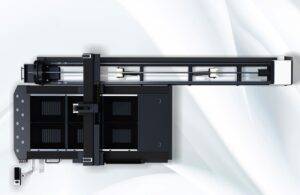
The Dawn of Shipyard 4.0 in Houston
Houston, Texas, stands as one of the world’s most critical maritime and energy hubs. For decades, the shipyards lining the Houston Ship Channel have relied on the rugged but imprecise methods of plasma cutting and manual fabrication to shape the massive I-beams, channels, and angles that form the skeleton of modern vessels. However, as global competition stiffens and the demand for faster delivery cycles increases, “good enough” precision is no longer viable.
The introduction of the 12kW Heavy-Duty I-Beam Laser Profiler marks the transition into “Shipyard 4.0.” Unlike traditional methods that require significant secondary processing—such as grinding, deburring, and manual drilling—the 12kW fiber laser delivers a finished part directly from the machine bed. In the context of a Houston shipyard, where labor costs are high and the environmental conditions are demanding, the ability to automate the processing of 40-foot structural members with surgical accuracy is a game-changer.
The Power of 12kW: Why Intensity Matters
In the realm of fiber lasers, 12kW is the “sweet spot” for structural steel. While lower-wattage lasers (3kW to 6kW) excel at thin sheet metal, they struggle with the thick-walled I-beams and H-sections required for maritime bulkheads and deck supports.
A 12kW source provides the photon density required to maintain high feed rates on carbon steel thicknesses up to 25mm (1 inch) and beyond. For a shipbuilding yard, this means the ability to slice through the web and flange of a heavy I-beam with a Heat-Affected Zone (HAZ) so minimal that the metallurgical integrity of the steel remains uncompromised. This is critical for American Bureau of Shipping (ABS) standards, where the structural strength of the weldment is non-negotiable. The high power also allows for the use of air-assist cutting in some applications, significantly reducing the cost per part compared to high-purity oxygen or nitrogen.
The Infinite Rotation 3D Head: Engineering Freedom
The most technologically advanced component of this system is the Infinite Rotation 3D Head. Traditional 5-axis laser heads are often limited by “cable wrap,” where the internal gas lines and fiber cables can only rotate 360 or 720 degrees before needing to be “unwound.” This creates downtime and limits the complexity of the cut.
An **Infinite Rotation** head utilizes advanced slip-ring technology and specialized fiber management to allow the cutting torch to rotate indefinitely around the C-axis. This is coupled with a high-degree A-axis tilt (often +/- 45 to 90 degrees).
For a Houston shipbuilder, this means:
1. **Complex Weld Preps:** The machine can cut V, X, Y, and K-bevels on all sides of an I-beam in a single continuous movement. This prepares the beam for immediate robotic or manual welding without the need for a secondary beveling station.
2. **Profiling Flanges:** The head can reach “inside” the profile of a channel or I-beam, cutting mounting holes or notches on the interior faces that were previously inaccessible to standard laser configurations.
3. **Contour Following:** Advanced capacitive sensors in the 3D head maintain a constant standoff distance even if the structural steel has slight deviations or “camber,” ensuring the focal point is always optimized.
Heavy-Duty Construction for the Gulf Coast Environment
Houston’s climate—characterized by high humidity and salt-laden air—is notoriously hard on precision machinery. A “Heavy-Duty” I-beam profiler is designed with these challenges in mind.
The machine bed is typically a stress-relieved, honeycomb-welded structure weighing tens of thousands of pounds to dampen the vibrations caused by moving heavy structural members. The rack-and-pinion systems are often enclosed or utilize specialized bellows to prevent the ingress of humidity and airborne particulates common in shipyards.
Furthermore, these systems feature automated loading and unloading racks capable of handling 12-meter (40-foot) beams weighing several tons. Using a “four-chuck” or “three-chuck” system, the machine can move the beam through the cutting zone with zero-tailing waste. In an industry where raw material costs for steel are volatile, the ability to nest parts across the entire length of a beam and minimize scrap provides a direct boost to the bottom line.
Bridging the Gap: From Tekla to Torch
The hardware is only as capable as the software that drives it. In modern shipbuilding, designers use sophisticated BIM (Building Information Modeling) and CAD software like Tekla Structures or ShipConstructor.
The 12kW Laser Profiler integrates directly with these platforms. The software takes the 3D model of the ship’s framework and automatically generates the G-code for the laser. It accounts for the thickness of the beam, the required bevel angles for the joints, and the nesting logic to maximize material yield.
In Houston’s fast-paced production environments, this eliminates the risk of human error during manual layout. When a beam is loaded onto the conveyor, the machine’s vision system or touch-probes verify the beam’s dimensions, adjust the cutting path in real-time to account for any physical warping, and execute the program. The result is a part that fits perfectly into the ship’s assembly, reducing “re-work” on the slipway—the most expensive place to fix a mistake.
Economic Impact and ROI for Houston Shipyards
The capital investment in a 12kW 3D laser profiler is significant, but the Return on Investment (ROI) in a shipbuilding context is often realized within 18 to 24 months.
Consider the traditional workflow: An I-beam is cut to length with a saw, moved to a drill line for bolt holes, moved again to a manual station where a worker with a torch cuts notches, and finally moved to a grinding station to clean the edges for welding.
With the 12kW Laser Profiler, these four steps are collapsed into one.
* **Labor Savings:** One operator manages the machine that replaces the output of four or five traditional workstations.
* **Consumable Savings:** Fiber lasers have a wall-plug efficiency of nearly 40%, far higher than CO2 lasers or plasma systems.
* **Assembly Speed:** Because the laser-cut parts are accurate to within +/- 0.1mm, the “fit-up” time during ship assembly is drastically reduced. No more “making it fit” with hammers and shims; the components slot together like a precision watch.
Local Support and the Houston Advantage
For a shipyard, machine downtime is a catastrophe. One of the primary reasons for the adoption of this technology in the Houston area is the robust local support ecosystem. As a hub for heavy machinery, Houston hosts the technical service teams and spare parts repositories necessary to keep a 12kW laser running 24/7.
Expertise in fiber optics, high-pressure gas systems, and CNC automation is concentrated in the Texas Gulf Coast, ensuring that shipyards aren’t just buying a machine, but are integrating into a support network that understands the specific pressures of the maritime and offshore industries.
Conclusion: Shaping the Future of the Seas
The 12kW Heavy-Duty I-Beam Laser Profiler with Infinite Rotation 3D Head is more than a tool; it is a competitive necessity. For Houston shipyards, it represents the ability to build larger, more complex, and more durable vessels at a lower cost and in less time.
By harnessing the power of a 12,000-watt beam of light and the dexterity of a 5-axis infinite rotation head, the maritime industry is no longer constrained by the limitations of mechanical tools. We are entering an era where the most massive structures on the ocean are built with the same precision as a microchip, ensuring that Houston remains at the forefront of global maritime engineering for decades to come.