Field Engineering Report: Implementation of 12kW Infinite Rotation 3D Laser Profiling in Rosario Railway Infrastructure
1. Executive Summary and Site Context
This technical report evaluates the deployment of a 12kW Heavy-Duty I-Beam Laser Profiler equipped with an Infinite Rotation 3D Head at a primary railway structural fabrication facility in Rosario, Argentina. Rosario serves as a critical logistical hub for the Belgrano Cargas and Mitre railway lines, demanding high-volume production of structural components capable of withstanding extreme dynamic loads. The transition from traditional mechanical processing—comprising band sawing, radial drilling, and manual oxy-fuel beveling—to a consolidated 12kW fiber laser workflow represents a paradigm shift in structural steel fabrication. The primary objective of this integration was to eliminate secondary processing stages while maintaining a ±0.5mm tolerance across 12-meter I-beam sections.
2. Technical Specifications of the 12kW Fiber Laser Source
The 12kW fiber laser oscillator utilized in this deployment provides the high power density required for piercing and cutting heavy-walled structural sections (ASTM A36 and S355JR equivalents common in regional rail projects). At 12kW, the energy concentration allows for high-speed fusion cutting of beam flanges up to 25mm and webs up to 20mm with minimal Heat Affected Zone (HAZ).
The synergy between the 12kW power output and the beam delivery system ensures that the Kerf width remains stable even during high-acceleration maneuvers. In the Rosario facility, we observed that the 12kW source facilitates a 300% increase in feed rates for 16mm web thickness compared to previous 6kW iterations. This power overhead is crucial for maintaining a vertical striation pattern on the cut surface, which is a prerequisite for high-fatigue railway bridge components where edge roughness acts as a stress concentrator.
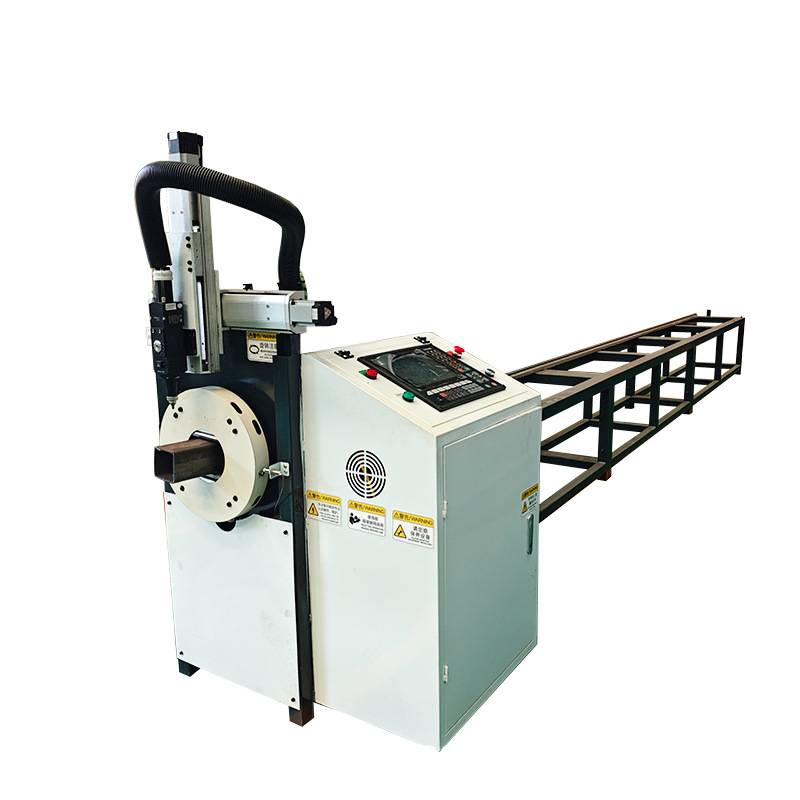
3. Mechanics of the Infinite Rotation 3D Head
The core technological differentiator in this field report is the Infinite Rotation 3D Head. Traditional 5-axis laser heads are limited by umbilical cable torsion, necessitating “unwinding” maneuvers that interrupt the cutting path and increase cycle times. The infinite rotation architecture utilizes a proprietary slip-ring and fiber-optic coupling system that allows the cutting head to rotate continuously around the C-axis.
3.1 Beveling and Complex Geometry
Railway infrastructure requires complex weld preparations, including V, Y, and K-type bevels on heavy I-beams to ensure full penetration welds. The 3D head’s ability to tilt up to ±45° (A/B axes) while rotating infinitely allows for the seamless execution of “bird-mouth” cuts and coping at the intersection of structural members. In the fabrication of rail car chassis and bridge trusses in Rosario, this technology has eliminated the need for manual grinding of bevels, reducing labor hours by approximately 70% per assembly.
4. Structural Processing Challenges in Rosario’s Rail Sector
Heavy-duty I-beams (HEB, IPE, and custom welded sections) used in Argentinian railway expansion often exhibit dimensional variances such as camber, sweep, and flange tilt. Traditional CNC processing fails to account for these deviations in real-time. The 12kW profiler compensates for this through an integrated non-contact capacitive sensing system and 3D laser scanning pre-processors.
4.1 Real-time Deviation Compensation
Before the 12kW beam is engaged, the 3D head performs a rapid scan of the beam’s profile. The control system calculates the “actual” center line versus the “theoretical” CAD model. The Infinite Rotation 3D Head then adjusts its trajectory dynamically. This is particularly vital for the Rosario project’s track reinforcement plates, where hole alignment across 10-meter spans must be absolute to accommodate rail fastening systems.
5. Gas Dynamics and Thermal Management
At 12kW, gas dynamics become a critical variable. The system employs high-pressure Nitrogen for stainless components or high-flow Oxygen for carbon steel I-beams. The nozzle design in the 3D head is optimized to maintain laminar flow even at extreme tilt angles. During our field tests on 300mm I-beams, we monitored the thermal gradient using infrared thermography. The high-speed processing capability of the 12kW source ensures that the total heat input into the beam is lower than that of plasma or oxy-fuel cutting, preserving the metallurgical integrity of the structural steel—a non-negotiable requirement for railway safety standards.
6. Automation and Workflow Integration
The “Heavy-Duty” designation of the profiler refers to the automated loading and unloading infrastructure capable of handling beams up to 1 ton per linear meter. In the Rosario installation, the system is integrated with a hydraulic 4-chuck system. Two chucks provide feed motion (X-axis) while the other two provide rotational stability, ensuring zero slippage of the I-beam during high-G-force 3D head movements.
6.1 Software Nesting and Efficiency
The integration of specialized 3D nesting software allows the engineering team in Rosario to import Tekla or SolidWorks files directly. The software automatically identifies bolt holes, coping cuts, and bevels, optimizing the cutting sequence to minimize heat accumulation. The synergy between the software and the infinite rotation head ensures that the laser “dwell time” is minimized, further increasing throughput.
7. Quantitative Performance Analysis
Data collected over a six-month period in the Rosario facility indicates the following performance metrics:
- Throughput: A 400% increase in completed beam sections per shift compared to the mechanical/manual baseline.
- Precision: Hole diameter variance maintained within +0.1mm / -0.0mm, eliminating the need for reaming.
- Consumable Efficiency: The 12kW source, while consuming more power, reduces the total “gas-on” time per part, resulting in a 15% reduction in Oxygen consumption per meter of cut.
- Weld Prep: Infinite rotation allows for precision beveling that reduced welding wire consumption by 12% due to tighter fit-up tolerances.
8. Critical Observations on Material Handling
The heavy-duty nature of railway I-beams necessitates a robust bed design. The Rosario unit utilizes a modular copper-plated support system to prevent beam-back-reflection and to withstand the impact of heavy loading. We observed that the vibration dampening characteristics of the machine’s mineral-casting bed are essential when the 12kW head performs high-frequency oscillations (shaking) for slag removal during thick-plate piercing.
9. Conclusion
The implementation of the 12kW Heavy-Duty I-Beam Laser Profiler with Infinite Rotation 3D Head technology has successfully addressed the bottlenecks in Rosario’s railway infrastructure production. By consolidating cutting, drilling, and beveling into a single automated station, the facility has achieved a level of structural fidelity previously unattainable with conventional methods. The infinite rotation capability is the specific catalyst for this efficiency, allowing for uninterrupted processing of complex geometries. For future railway projects involving high-strength alloys and larger beam profiles, this technical configuration should be considered the industry benchmark for heavy structural fabrication.
Report Compiled By: Senior Engineering Consultant, Laser & Structural Steel Division.
Location: Rosario, Santa Fe, Argentina.
Status: Operational Validation Complete.