Technical Field Report: Implementation of 12kW Heavy-Duty I-Beam Laser Profiling in the Monterrey Structural Racking Sector
1. Executive Summary and Scope of Deployment
This report details the technical deployment and operational integration of a 12kW Heavy-Duty I-Beam Laser Profiler, equipped with a ±45° 5-axis bevel cutting head, within the industrial corridor of Monterrey, Nuevo León. Monterrey serves as a critical nexus for North American logistics, necessitating the production of high-density storage racking systems capable of supporting extreme static and dynamic loads. The transition from traditional mechanical processing—comprising band sawing, radial drilling, and manual plasma gouging—to a unified 12kW fiber laser platform marks a significant shift in structural engineering precision. The primary objective of this deployment was to eliminate secondary finishing processes and solve the recurring issue of fit-up tolerances in heavy-gauge I-beam assemblies.
2. Structural Dynamics of Heavy-Duty Racking in Monterrey
In the Monterrey region, the demand for “High-Bay” warehouse solutions requires structural members (typically I-beams and wide-flange H-beams) that meet rigorous ASTM standards. For racking systems exceeding 15 meters in height, the structural integrity of the uprights and load beams is non-negotiable. Traditional manufacturing often suffers from “cumulative tolerance stack-up,” where slight inaccuracies in hole placement or beam length lead to eccentric loading. The 12kW I-beam profiler addresses this by consolidating all features—bolt holes, notches, and bevels—into a single CAD/CAM-driven operation, ensuring a dimensional accuracy of ±0.05mm over a 12-meter workpiece.
3. The 12kW Fiber Laser Source: Thermal Flux and Material Penetration
The integration of a 12kW fiber laser source is not merely for speed; it is a necessity for the material thicknesses encountered in heavy-duty racking (often 12mm to 20mm web and flange thicknesses).
- Power Density: At 12kW, the laser achieves a power density that allows for “high-speed nitrogen cutting” on mid-gauge sections, which prevents the formation of an oxide layer. This is critical for subsequent powder coating or galvanizing processes common in Monterrey’s industrial climate.
- Kerf Control: High wattage allows for a narrower kerf width even in thick sections. This minimizes the Heat Affected Zone (HAZ), preserving the metallurgical properties of the high-tensile steel used in racking uprights.
- Thick-Plate Piercing: The 12kW source utilizes multi-stage frequency-modulated piercing, reducing “splash” and ensuring that the entry point for internal cutouts (such as slotting for beam connectors) remains clean and structurally sound.
4. ±45° Bevel Cutting: Redefining Weld Preparation
The most significant technical advancement in this deployment is the 5-axis ±45° beveling capability. In traditional structural steel fabrication, creating a V-groove or J-groove for full-penetration welding requires a secondary pass with a handheld plasma torch or a milling machine. This is labor-intensive and introduces human error.
Kinematics of the Bevel Head: The profiler utilizes a specialized 3D cutting head with A and B axis rotation. When processing an I-beam, the software calculates the compensation required for the flange’s slope. The laser can execute a 45-degree chamfer on the edges of the flange in real-time. This creates a perfect “V” preparation when two beams are joined, allowing for 100% weld penetration. In the context of Monterrey’s racking industry, this ensures that seismic-rated joints meet the strict Mexican and International building codes without manual grinding.
5. Solving the “I-Beam Deformation” Challenge
Structural I-beams are rarely perfectly straight; they often possess “mill tolerances” including camber, sweep, and twist. A standard laser would lose focus or crash into the material. The heavy-duty profiler deployed here utilizes a sophisticated “touch-probe” sensing system and ultrasonic sensors to map the actual profile of the I-beam every 500mm.
- Active Compensation: The CNC control system dynamically adjusts the cutting path to account for the beam’s deviation from the theoretical CAD model.
- Chuck Centering: A four-chuck system (two fixed, two mobile) ensures that the beam is centered along the rotational axis, preventing “whip” during high-speed rotation and maintaining the focal point precisely at the material surface.
6. Efficiency Gains in Automated Structural Processing
Prior to the installation of the 12kW profiler, a typical I-beam for a heavy-duty rack required four separate stations:
1. Sawing: To cut to length.
2. Drilling: To create bolt patterns for cross-bracing.
3. Milling/Notching: To allow for interlocking beam-to-column connections.
4. Manual Beveling: For weld preparation.
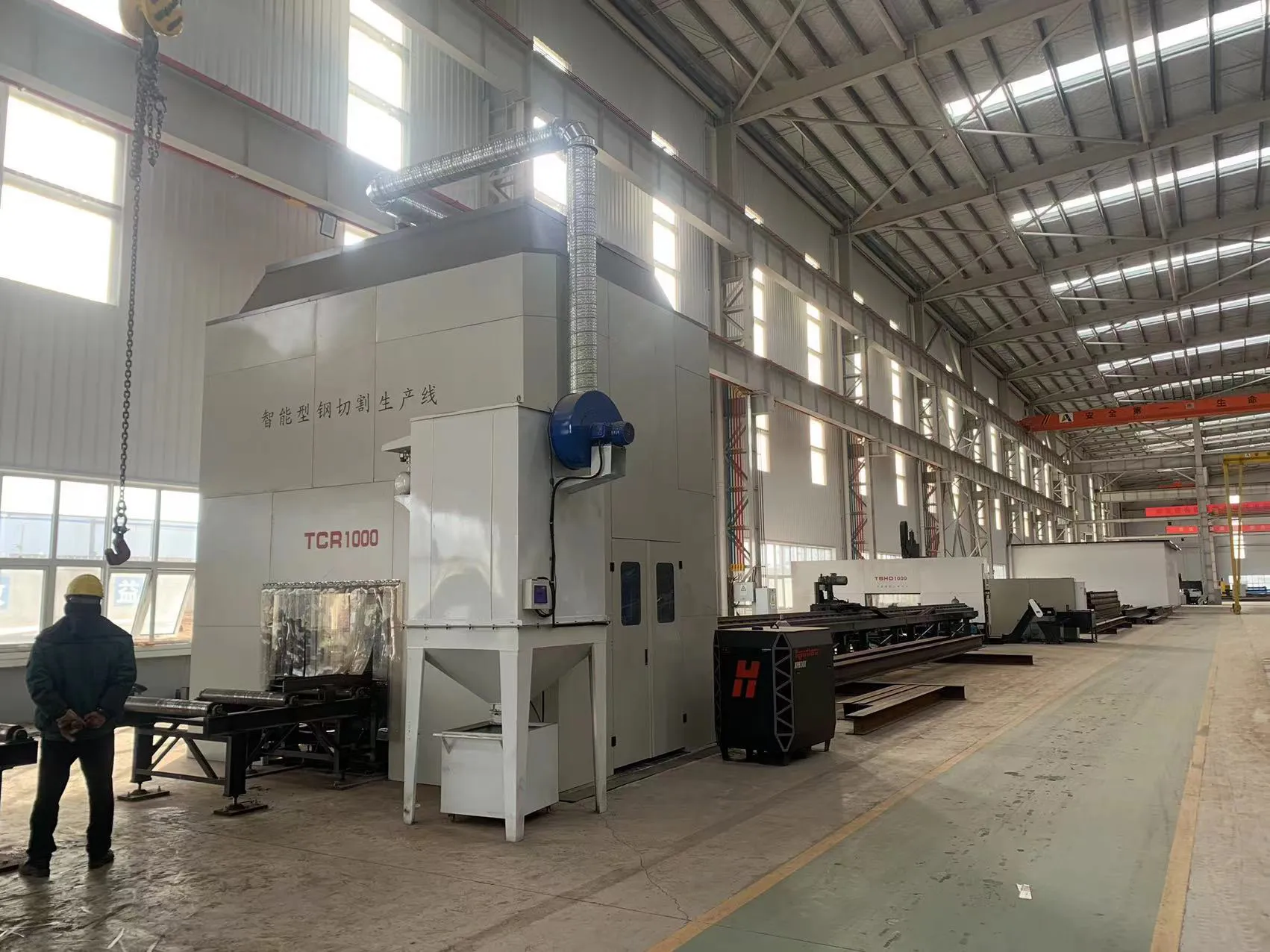
The 12kW profiler collapses these four stations into one. In our field observations at the Monterrey site, a 12-meter I-beam that previously took 45 minutes to move through the shop is now processed in under 8 minutes. This includes complex 3D notches and ±45° bevels on both ends. The elimination of “work-in-progress” (WIP) buffering between stations has increased the factory’s throughput by an estimated 300%.
7. Software Integration and Nesting Logic
The technical success of the profiler is heavily dependent on the “TubesT” or similar 3D nesting software. For racking systems, the software must manage “Common Line Cutting” for profiles to minimize scrap. More importantly, it handles the complex unfolding of I-beam geometries. When a bevel is applied to a flange, the software automatically calculates the “leading edge” and “trailing edge” of the laser path to ensure that the internal dimensions of the beam remain true to the engineering spec. This level of automation allows engineers in Monterrey to design more complex interlocking joints that were previously impossible to manufacture profitably.
8. Environmental and Metallurgical Considerations
Monterrey’s high ambient temperatures and humidity levels can affect fiber laser performance. The 12kW system is equipped with a dual-circuit high-capacity industrial chiller and a pressurized optical path to prevent dust contamination. From a metallurgical standpoint, the use of a 12kW laser reduces the time the beam is exposed to high temperatures. The rapid “cool-down” associated with high-speed laser cutting results in a much smaller HAZ compared to plasma cutting. This ensures that the high-strength low-alloy (HSLA) steels frequently used in racking do not lose their yield strength at the connection points.
9. Conclusion: The Future of Structural Steel in Mexico
The deployment of the 12kW Heavy-Duty I-Beam Laser Profiler in Monterrey represents a technological cornerstone for the region’s steel industry. By solving the precision issues associated with ±45° beveling and integrating high-power fiber laser sources into the structural workflow, manufacturers can now produce racking systems that are safer, faster to assemble, and more cost-effective. The synergy between 5-axis kinematics and 12kW power effectively bridges the gap between traditional heavy civil engineering and high-precision mechanical manufacturing. As Monterrey continues to expand its role as a global logistics hub, the adoption of such automated structural processing technologies will be the primary differentiator for Tier 1 suppliers.
End of Report.
Technical Assessment validated by Lead Systems Engineer.