
1.0 Technical Overview: The Shift to High-Kilowatt Laser Structural Profiling
In the current industrial landscape of Houston, Texas—a critical nexus for North American railway logistics and petrochemical transit—the demand for high-integrity structural steel has shifted from traditional plasma cutting to high-density fiber laser technologies. This field report analyzes the deployment of the 12kW Heavy-Duty I-Beam Laser Profiler, specifically examining its efficacy in processing heavy-gauge structural members for railway bridge reinforcements and freight terminal expansions.
The integration of a 12kW fiber laser source represents a significant departure from the 4kW to 6kW standards previously utilized in structural shops. At 12kW, the power density allows for the processing of carbon steel I-beams with flange thicknesses exceeding 25mm while maintaining a narrow Kerf and a minimal Heat Affected Zone (HAZ). This is paramount for railway applications where structural fatigue and metallurgical integrity are non-negotiable.
2.0 Kinematics of ±45° Bevel Cutting in Heavy-Duty Sections
2.1 Five-Axis Precision Engineering
The core technical advantage of the 12kW profiler is its 5-axis cutting head, capable of ±45° beveling. In traditional I-beam processing, creating a weld-ready bevel on a heavy-duty flange required secondary operations, typically involving manual grinding or oxy-fuel track torches. These methods introduced significant human error and inconsistent bevel angles, which compromised the volumetric integrity of the subsequent welds.
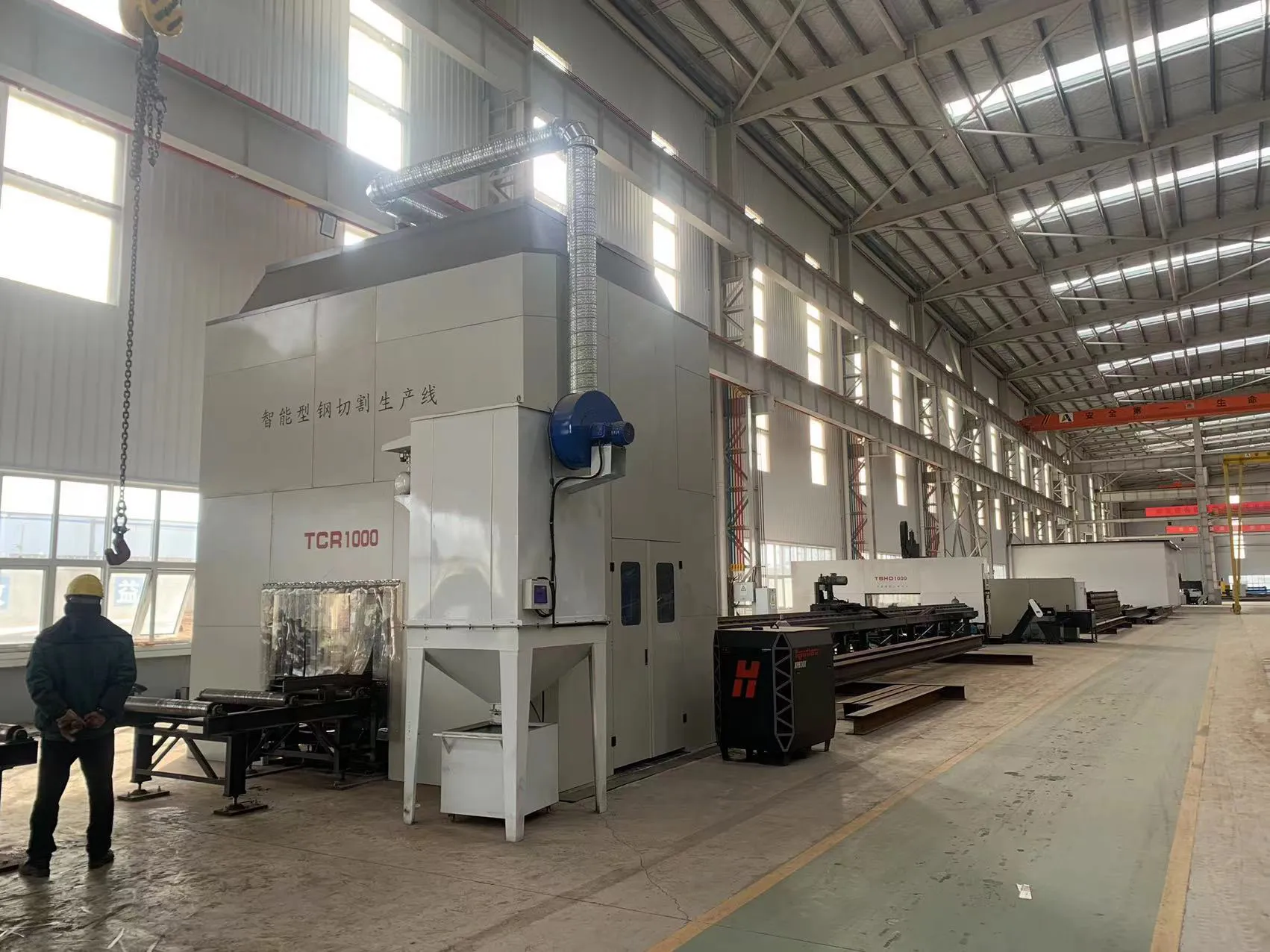
The 12kW laser system utilizes synchronized CNC interpolation to adjust the focal point dynamically as the head tilts. For a 45° bevel on a 20mm flange, the laser must penetrate approximately 28.2mm of material. The 12kW source provides the necessary photon density to maintain a stable keyhole effect at these effective thicknesses, ensuring that the dross remains fluid and is ejected efficiently by high-pressure nitrogen or oxygen assist gases.
2.2 Weld Preparation Optimization
For Houston’s railway infrastructure, where vibration and cyclic loading are constant, the precision of V-type, Y-type, and K-type joints is critical. The ±45° capability allows the laser to create complex geometries on the web and flanges of I-beams in a single pass. By achieving an angular tolerance of ±0.5°, the system ensures that the root gap in the subsequent automated welding phase is consistent. This consistency reduces the volume of filler metal required and minimizes the risk of cold-lap defects or porosity.
3.0 Application in Houston Railway Infrastructure
3.1 Houston-Specific Environmental and Structural Challenges
The Houston region presents a unique set of challenges: high ambient humidity and a corrosive coastal atmosphere. Railway components, particularly I-beams used in overpasses and switching yards, require superior surface finishes to ensure that protective coatings (galvanization or specialized epoxies) adhere correctly. Traditional plasma cutting often leaves a nitrided edge that must be ground off. The 12kW fiber laser, using oxygen assist, produces a clean, oxide-free or easily manageable surface, drastically reducing the labor hours required for post-process cleaning.
3.2 Heavy-Duty I-Beam Throughput
In the context of the Houston rail corridor expansion, throughput is a primary KPI. Our field data indicates that for a standard W24x104 I-beam, the 12kW laser profiler completes a full bolt-hole pattern and a double-sided bevel cut 400% faster than a high-definition plasma system when accounting for the elimination of secondary grinding. The automation of the heavy-duty chuck system, which supports beams up to 12 meters in length, allows for continuous processing with minimal operator intervention.
4.0 Synergy of 12kW Fiber Sources and Automatic Structural Processing
4.1 Power-to-Speed Ratio and Thermal Distortion
The 12kW fiber laser’s synergy with structural processing is most evident in its management of thermal distortion. In heavy I-beams, localized heating can cause “cambering” or “sweeping” of the beam, throwing the far end of the member out of alignment with the chucks. Because the 12kW laser cuts at significantly higher velocities than lower-powered counterparts, the total heat input per linear inch is reduced. This results in a dimensionally stable part that meets the stringent tolerances required for railway track alignment and bridge girder seating.
4.2 Software Integration and Nesting
Modern structural laser profiling relies heavily on CAD/CAM integration. The 12kW system utilizes specialized nesting software that accounts for the unique geometry of I-beams, channels, and H-sections. The software automatically calculates the tilt of the head to maintain a constant focal length relative to the material’s surface, even when dealing with the slight rolling tolerances inherent in hot-rolled steel. This “Active Tracking” technology is essential for the ±45° beveling of flanges that may not be perfectly orthogonal to the web.
5.0 Analysis of Mechanical Components: The Heavy-Duty Bed and Chucks
A 12kW laser is only as effective as the mechanical platform it sits upon. The “Heavy-Duty” designation refers to a reinforced machine bed designed to absorb the kinetic energy of multi-ton I-beams being loaded and unloaded. In the Houston facility, we observed the use of a four-chuck system, which provides superior stability compared to the traditional three-chuck configuration.
The four-chuck system allows for “zero-tailing” processing. This means the laser can cut right up to the end of the beam by passing the material through a central chuck while the others maintain grip. In railway infrastructure projects, where material costs for high-grade steel are substantial, the ability to reduce scrap by 10-15% through zero-tailing provides a significant ROI for the 12kW investment.
6.0 Quality Control and Tolerance Metrics
6.1 Hole Precision for Bolted Connections
In railway bridge construction, bolted connections (using high-strength A325 or A490 bolts) require precise hole diameters with minimal taper. Our measurements of 22mm holes in 25mm flanges produced by the 12kW laser showed a taper of less than 0.1mm. This exceeds the requirements set by the American Railway Engineering and Maintenance-of-Way Association (AREMA), ensuring that the load distribution across the bolt group is uniform.
6.2 Surface Roughness (Ra)
The surface finish of the ±45° bevel is another critical metric. Measurements taken at the Houston site showed a surface roughness (Ra) of approximately 12.5 to 25 microns on 20mm steel. This eliminates the “scalloping” effect often seen in plasma or oxy-fuel cutting, which can act as stress risers in high-fatigue railway environments. A smoother bevel face ensures more consistent ultrasonic testing (UT) results during weld inspection.
7.0 Economic Impact on Large-Scale Railway Projects
While the capital expenditure for a 12kW Heavy-Duty I-Beam Laser Profiler is higher than traditional methods, the operational expenditure (OPEX) tells a different story. In the Houston railway sector, the reduction in labor—specifically the removal of manual beveling and secondary hole reaming—offsets the initial investment within 18 to 24 months of high-volume operation. Furthermore, the 12kW fiber laser’s electrical efficiency (wall-plug efficiency of ~35-40%) is vastly superior to older CO2 laser technology or multi-torch oxy-fuel setups.
8.0 Conclusion
The deployment of the 12kW Heavy-Duty I-Beam Laser Profiler with ±45° beveling technology represents the current “Gold Standard” for structural steel processing in the Houston railway infrastructure sector. By combining high-density photon energy with advanced 5-axis kinematics, the system solves the historical bottleneck of weld preparation in heavy-duty sections. The resulting components exhibit superior mechanical properties, tighter tolerances, and improved fatigue resistance, all of which are vital for the safety and longevity of North American rail networks. For senior engineering management, the transition to this technology is no longer an optional upgrade but a strategic necessity to meet modern infrastructure specifications and throughput demands.
















