
Technical Field Report: Implementation of 12kW Heavy-Duty Laser Profiling in Dubai Aviation Structural Frameworks
1. Project Scope and Environmental Context
The expansion of aviation infrastructure in Dubai, specifically concerning the Al Maktoum International Airport and associated logistics mega-structures, demands a radical shift in structural steel fabrication. This report analyzes the deployment of the 12kW Heavy-Duty I-Beam Laser Profiler equipped with a 5-axis ±45° bevel cutting head. Unlike traditional commercial construction, airport hangars and terminal skeletons utilize heavy-gauge I-beams and H-sections that must withstand extreme thermomechanical stress and immense spans.
In the Dubai climate, where ambient temperatures often exceed 45°C, the thermal management of both the laser source and the structural material becomes critical. The 12kW fiber laser source was selected to maintain a high power-density-to-feed-rate ratio, ensuring that the Heat Affected Zone (HAZ) is minimized, thereby preserving the metallurgical integrity of the S355JR and S355J2+N grade steels commonly utilized in these high-load environments.
2. The Role of 12kW Fiber Laser Synergy in Heavy-Section Processing
The transition from 6kW to 12kW in structural profiling is not merely a matter of speed; it is a matter of “piercing capacity” and “melt-pool stability.” When processing I-beams with flange thicknesses exceeding 20mm, a 12kW source provides the necessary photon pressure to achieve a verticality tolerance of less than 0.3mm. In the context of Dubai’s airport construction, where beams often exceed 12 meters in length, any deviation in the cut front leads to cumulative errors during site assembly.
The 12kW source allows for high-pressure nitrogen or oxygen-assisted cutting through the web and flange of the beam without the “dross adhesion” typical of lower-powered units. This is vital for the “automatic structural processing” workflow. By integrating the laser with a synchronized 4-chuck or 3-chuck material handling system, the profiler handles beams weighing up to 1.5 tons per linear meter, ensuring that the heavy-duty nature of the machine matches the power output of the resonator.
3. ±45° Bevel Cutting: Solving the Weld Preparation Bottleneck
Historically, the fabrication of large-scale I-beam junctions required a three-stage process: mechanical sawing, secondary plasma bevelling, and manual grinding. The integration of a ±45° 3D beveling head on the 12kW profiler consolidates these into a single pass. In airport structural design—characterized by complex geometric nodes and cantilevered roof sections—weld preparation is the most labor-intensive phase.
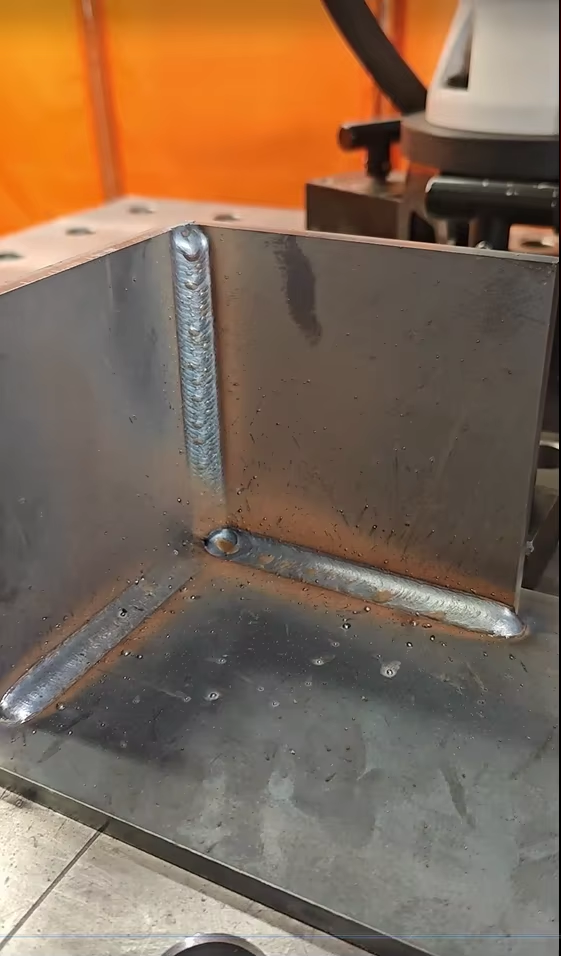
Precision Weld Prep: The ±45° bevel allows for the creation of V, Y, and X-type grooves directly on the beam ends or cut-outs. Because the laser maintains a consistent focal point via a 5-axis kinematic chain, the bevel angle remains accurate to within ±0.5°. This precision ensures that when the beams are presented for Submerged Arc Welding (SAW) or Flux-Cored Arc Welding (FCAW) on-site, the “fit-up” is perfect. In Dubai’s fast-track construction schedules, eliminating manual fit-up adjustments reduces the project timeline by an estimated 35%.
Complex Geometry: Airport terminals often feature “bird-beak” joints and complex intersections where I-beams meet at non-orthogonal angles. The ability to bevel the web and the flange simultaneously at varying angles allows for structural “interlocking” designs that were previously cost-prohibitive.
4. Automation and Structural Integrity Management
The 12kW I-beam profiler operates within a digital twin ecosystem. Utilizing TEKLA or Revit structures, the CAD/CAM interface translates structural BIM models directly into G-code. This eliminates human error in marking and measuring.
In the heavy-duty category, the machine utilizes “active sensing” technology. Since I-beams are rarely perfectly straight from the rolling mill, the profiler uses laser displacement sensors to map the actual deformation of the beam in real-time. The 12kW cutting head then adjusts its trajectory based on the actual centerline of the beam, rather than the theoretical model. This is critical for airport projects where the structural safety factor allows for zero tolerance in bolt-hole alignment and load-bearing surface contact.
5. Comparative Efficiency: Laser vs. Plasma in Heavy Steel
While plasma cutting has been the industry standard for thick-walled sections, its application in the Dubai aviation sector is being phased out in favor of 12kW laser profiling for several technical reasons:
- The Kerf Factor: A laser kerf is approximately 0.2mm to 0.5mm, whereas plasma exceeds 2.0mm. This precision allows for the direct cutting of bolt holes (1:1 ratio of hole diameter to thickness) which meet the stringent AISC (American Institute of Steel Construction) standards without secondary drilling.
- Heat Input: The 12kW laser moves at a velocity that results in a significantly narrower HAZ than plasma. This prevents the “brittleness” often found at the edge of plasma-cut heavy sections, which is a major concern in earthquake-resistant or high-vibration airport environments.
- Operating Cost: Despite higher initial capital expenditure, the 12kW laser eliminates the need for secondary processing gases and significantly reduces the “cost-per-part” when calculating the removal of secondary grinding and rework.
6. Thermal Dynamics and Gas Dynamics in the Dubai Environment
Operational stability in high-ambient temperatures requires the 12kW profiler to utilize a dual-circuit high-capacity chilling system. The field report indicates that maintaining the laser resonator at a constant 22°C while the factory floor is at 40°C requires a specialized HVAC interface for the power cabinets.
Furthermore, the gas dynamics at 12kW are optimized through “turbulent-flow” nozzles that ensure the molten steel is ejected cleanly during the beveling process. In the thick-section flange cutting (25mm+), the use of high-purity oxygen as an assist gas triggers an exothermic reaction that, when balanced with the 12kW fiber energy, produces a mirror-like finish on the bevel face. This surface quality is essential for non-destructive testing (NDT) compliance, such as Ultrasonic Testing (UT) of the welds.
7. Conclusion: The New Benchmark for Structural Engineering
The deployment of the 12kW Heavy-Duty I-Beam Laser Profiler with ±45° beveling technology represents the current zenith of structural steel fabrication. In the specific context of Dubai’s airport construction, the technology addresses the triple constraint of scale, speed, and precision. By integrating high-order laser power with multi-axis motion control, the industry is moving toward a “plug-and-play” structural assembly model.
As a senior expert in the field, it is my assessment that the 12kW threshold is the minimum requirement for modern heavy-duty profiling where beveling is involved. The synergy between the power source and the 5-axis head does more than cut steel; it engineers the reliability of the backbone of global aviation hubs. Future iterations should focus on real-time metallurgical monitoring during the cut, but the current 12kW platform has already redefined the throughput expectations for the Middle Eastern structural steel market.
















