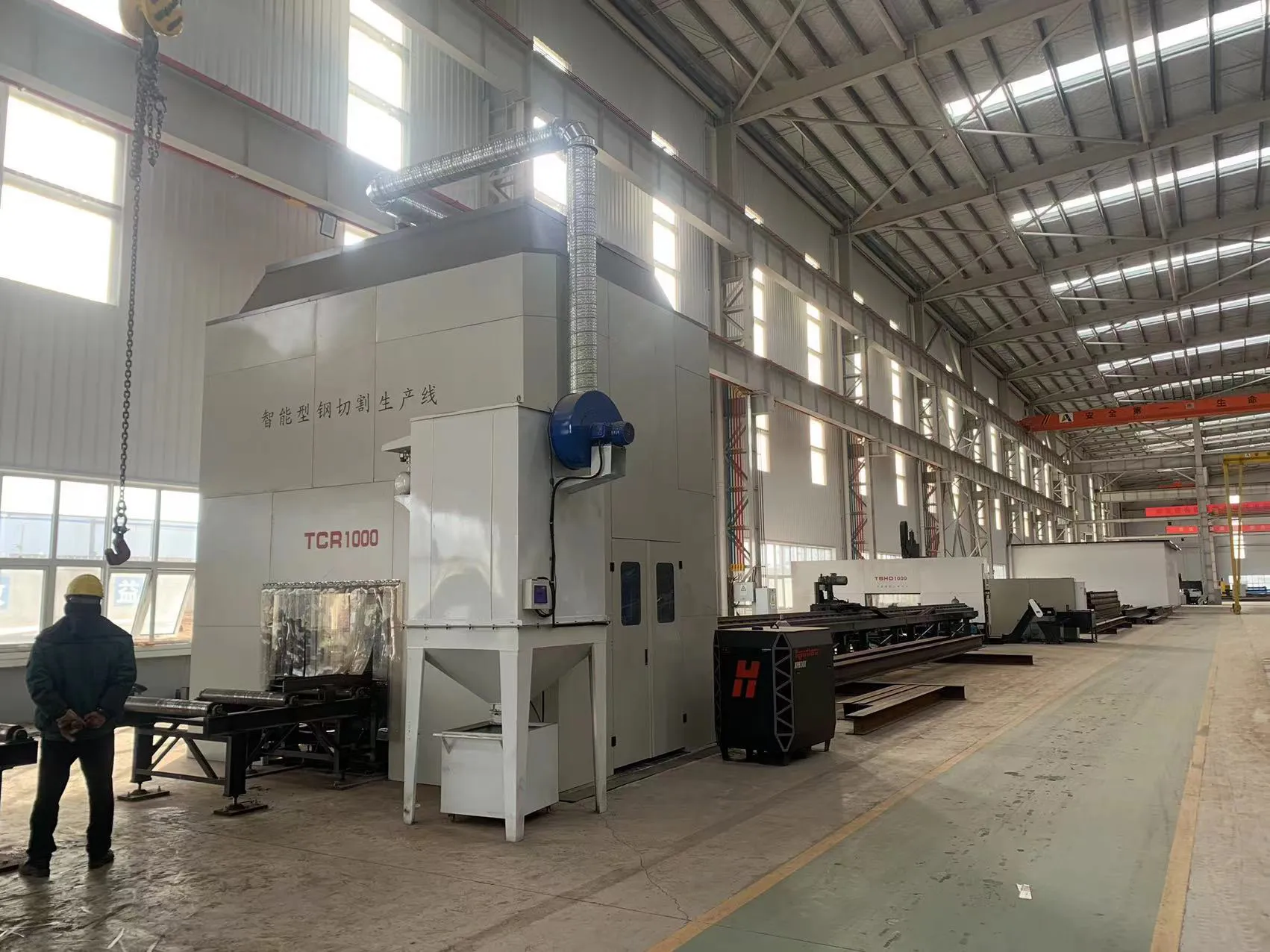
The Dawn of High-Power Structural Fabrication in Riyadh
Riyadh is currently the epicenter of a global construction boom. As the city prepares to host the World Expo 2030 and expands its footprint as a global logistics hub through the King Salman International Airport, the demand for structural steel has reached unprecedented levels. In this environment, the traditional methods of processing H-beams—manually marking, mechanical sawing, and drilling—are no longer sufficient. Enter the 12kW fiber laser cutting machine.
A 12kW fiber laser is not merely a “faster” tool; it represents a qualitative shift in how structural steel is handled. At 12,000 watts, the laser density is sufficient to pierce and cut through the thick flanges of structural H-beams with surgical precision. For Riyadh’s airport construction, where the skeletal structures must support massive cantilevered roofs and withstand significant thermal expansion cycles, the precision of a 12kW laser ensures that every joint fits perfectly, reducing the reliance on “gap-filling” welding techniques and significantly enhancing the overall safety of the structure.
Understanding the ±45° Bevel Cutting Edge
In structural engineering, the “fit-up” is the most critical stage of assembly. Traditionally, H-beams are cut square, and then workers use hand-held grinders or plasma torches to create bevels for weld penetration. This manual process is prone to human error and inconsistency.
The 12kW H-beam laser machine eliminates this secondary process through its integrated 5-axis or 6-axis cutting head, capable of ±45° beveling. This allows the machine to create V-type, Y-type, and X-type grooves directly during the initial cutting phase. In the context of Riyadh’s airport construction, this is a game-changer. When fabricating the heavy trusses required for terminal buildings, the ability to have a machine-cut 45-degree bevel means that the welding robots or manual welders can achieve full penetration welds with minimal preparation. This consistency is vital for meeting international building codes such as those set by the American Institute of Steel Construction (AISC) or Eurocode 3, which are frequently referenced in Saudi mega-projects.
The Physics of 12kW: Why Power Matters
As a fiber laser expert, I often explain to stakeholders that “power equals speed, but it also equals quality.” When cutting an H-beam with a thickness of 20mm or 30mm on the flange, a lower-power laser (like a 6kW) would struggle, resulting in a wider kerf and a larger Heat Affected Zone (HAZ).
The 12kW resonator provides a high-intensity beam that vaporizes the metal almost instantly. This high-speed vaporization results in a narrower HAZ. In the scorching heat of Riyadh, where ambient temperatures can fluctuate wildly, maintaining the metallurgical integrity of the steel is crucial. By minimizing the heat transferred to the beam during the cut, we ensure that the steel retains its design strength and ductility. Furthermore, the 12kW power allows for the use of compressed air or nitrogen as a shielding gas in thicker sections than previously possible, which provides a cleaner, oxide-free edge that is ready for immediate painting or coating without sandblasting.
Architectural Flexibility in Airport Design
Modern airports are characterized by sweeping curves, organic shapes, and massive open spans. These designs often require H-beams to be cut at complex angles where they intersect with other structural members.
The 12kW H-beam laser, equipped with advanced CAD/CAM software integration (such as TEKLA or Revit structures), can interpret complex 3D models and execute intricate “bird-mouth” cuts, miter joints, and circular penetrations for HVAC and electrical routing through the web of the beam. In Riyadh’s airport projects, where aesthetic elegance must meet rigorous engineering standards, this level of geometric freedom allows architects to push the boundaries of what is possible. The laser can cut holes for bolts with a tolerance of ±0.1mm, ensuring that when the steel arrives at the construction site in the desert, it bolts together like a Lego set, significantly reducing on-site labor and crane time.
Overcoming Riyadh’s Environmental Challenges
Operating high-precision 12kW fiber lasers in the Riyadh region presents unique environmental challenges. The primary enemies are extreme heat and airborne dust. As an expert in the field, I emphasize that the 12kW H-beam laser systems deployed here must be “tropicalized.”
First, the chiller system must be oversized. A 12kW laser generates significant internal heat; in a Riyadh summer where ambient temperatures exceed 45°C, the cooling system must be robust enough to maintain the laser source and the cutting head at a constant 22-25°C. Second, the machine must be fully enclosed or equipped with sophisticated dust extraction and pressurized bellows. The fine sand of the Arabian Peninsula can be abrasive to the precision rack-and-pinion systems and the optical lenses. Machines designed for this region often feature positive pressure in the optical path to prevent dust ingress, ensuring the 12kW beam remains focused and powerful over years of operation.
Economic Impact and Vision 2030
The deployment of this technology in Riyadh is a direct contribution to Saudi Arabia’s Vision 2030. By localizing the high-tech fabrication of structural steel, the Kingdom reduces its dependence on imported pre-fabricated components.
The efficiency of a 12kW laser is staggering. A single machine can replace several traditional sawing and drilling lines, occupying a smaller footprint in the factory while producing three to four times the output. This increased throughput is essential for meeting the aggressive timelines of the Riyadh airport expansion. Furthermore, the reduction in material waste—thanks to sophisticated nesting algorithms that optimize how parts are cut from a standard length of H-beam—lowers the overall carbon footprint of the construction project, aligning with the “Green Riyadh” initiatives.
The Future: Automation and Smart Manufacturing
The 12kW H-beam laser machines being installed today are often the first step toward a fully automated “Smart Factory.” These machines are equipped with sensors that monitor the health of the protective windows, the temperature of the cutting head, and the consistency of the gas pressure.
In a city as forward-thinking as Riyadh, these machines are often connected to the cloud, allowing for remote diagnostics. If a machine at a construction site near the airport experiences an issue, an expert can troubleshoot it from halfway across the world, or even from a central office in Riyadh’s King Abdullah Financial District (KAFD). This connectivity ensures maximum uptime, which is critical when project deadlines are measured in days rather than months.
Conclusion: Setting a New Standard for Infrastructure
The 12kW H-Beam Laser Cutting Machine with ±45° beveling is more than a piece of industrial equipment; it is a catalyst for Riyadh’s urban transformation. As the airport construction progresses, the precision and speed of these lasers will be visible in the soaring rafters and the robust skeletons of the new terminals.
By investing in high-power fiber laser technology, Saudi contractors are not just building an airport; they are establishing a new global standard for how infrastructure is conceived and realized. The combination of 12kW power, multi-axis beveling, and the ability to withstand the harsh Saudi climate makes this technology the backbone of 21st-century structural engineering in the heart of the Middle East. For the expert and the engineer alike, the message is clear: the future of Riyadh is being cut by light.