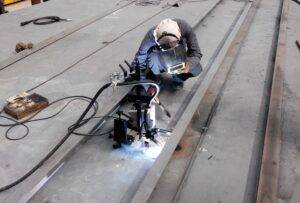
The Dawn of High-Power Fiber Lasers in Brazilian Infrastructure
Sao Paulo has long been the industrial engine of Brazil, a city where the demands of rapid urbanization meet the complexities of high-stakes architectural engineering. As the city continues to modernize its sports infrastructure—driven by the legacy of international tournaments and a growing demand for multi-use arenas—the methods of fabricating structural steel have undergone a radical transformation. The centerpiece of this evolution is the 12kW H-Beam Fiber laser cutting Machine.
For decades, the fabrication of H-beams, I-beams, and heavy channels relied on mechanical sawing, drilling, and plasma cutting. While functional, these methods were plagued by slow cycle times, high secondary finishing costs, and significant material waste. The introduction of 12kW fiber laser power changes the physics of the job site. At 12,000 watts, the laser doesn’t just cut; it vaporizes structural steel with a precision that was previously reserved for thin-sheet aerospace components. In the context of Sao Paulo’s stadium projects, where every millimeter of tolerance can impact the structural integrity of a cantilevered roof, this precision is not a luxury—it is a necessity.
Understanding the 12kW Power Threshold
In the world of fiber lasers, power is often misunderstood as merely “speed.” While a 12kW source is indeed significantly faster than its 6kW or 8kW predecessors, the real advantage lies in the “process window” and “piercing efficiency.” When dealing with the thick flanges of H-beams used in stadium supports—often exceeding 20mm or 25mm in thickness—the 12kW laser maintains a high energy density that ensures a clean, vertical cut with a minimal Heat Affected Zone (HAZ).
The high wattage allows for “flash piercing,” reducing the time the laser head spends over a single spot. This prevents the accumulation of heat that can lead to material deformation. In Sao Paulo’s humid climate, maintaining the metallurgical integrity of the steel is crucial to preventing long-term oxidation and stress fractures. The 12kW source provides enough “punch” to utilize nitrogen or air-assist cutting on thicker sections, resulting in an oxide-free edge that is immediately ready for welding without the need for grinding.
Engineering Precision: The H-Beam Challenge
Cutting a flat sheet of metal is a two-dimensional challenge. Cutting an H-beam is a three-dimensional exercise in spatial geometry. The 12kW H-beam machines deployed in Sao Paulo feature specialized 3D chuck systems and five-axis cutting heads. These machines must compensate for the natural deviations in structural steel—beams are rarely perfectly straight from the mill.
Advanced laser systems use touch-sensing or laser-scanning technology to map the actual profile of the H-beam before the first cut is made. The software then adjusts the cutting path in real-time to ensure that bolt holes, cope cuts, and weld preparations are perfectly aligned with the beam’s actual center line. This level of automation is vital for stadium construction, where complex “node” joints involve multiple beams intersecting at various angles. When these beams arrive at the construction site in the Barra Funda or Itaquera districts, they fit together like a Swiss watch, drastically reducing crane time and onsite labor costs.
The Economics of Zero-Waste Nesting
In the competitive Brazilian market, the cost of raw steel is a significant variable in project profitability. Traditional nesting—the arrangement of parts on a beam—often results in “drops” or remnants that are too short to be useful, effectively turning expensive structural steel into low-value scrap.
The “Zero-Waste Nesting” protocols integrated into these 12kW machines utilize sophisticated algorithms to bridge the gap between parts. By employing common-line cutting (where one cut serves as the edge for two different parts) and “end-to-end” processing, the software minimizes the “kerf” loss and utilizes the entire length of the raw beam. In a stadium project requiring thousands of tons of steel, a 5% to 8% increase in material utilization can translate to millions of Reais in savings. Furthermore, these machines can process the “tailings” of the beam, automatically nesting smaller connection plates or stiffeners into the sections of the beam that would otherwise be discarded.
Sao Paulo’s Strategic Advantage: Local Expertise and Support
The deployment of such high-tech machinery in Sao Paulo is supported by a growing ecosystem of local technicians and software engineers. The transition to 12kW systems requires a robust electrical infrastructure and a specialized cooling system, both of which are now standard in the industrial corridors of Greater Sao Paulo.
Local fabricators are no longer just “cutting metal”; they are operating data-driven centers. The 12kW H-beam machines are integrated into the factory’s BIM (Building Information Modeling) workflow. A structural engineer can design a complex truss for a stadium roof in a CAD environment, and the data can be sent directly to the laser machine in Sao Paulo. This “digital-to-physical” pipeline eliminates manual layout errors and ensures that the finished product is a perfect physical manifestation of the digital twin.
Sustainability and the Green Building Mandate
Modern stadium construction is increasingly scrutinized for its environmental impact. The 12kW fiber laser contributes to “Green Building” certifications in several ways. First, the energy efficiency of a fiber laser source is significantly higher than that of CO2 lasers or plasma systems, converting a higher percentage of wall-plug power into beam power.
Second, the “Zero-Waste” aspect aligns with circular economy principles. By reducing scrap, the carbon footprint associated with the production and transportation of “excess” steel is mitigated. For Sao Paulo, a city striving to lead in sustainable urban development, the adoption of clean, efficient laser technology represents a move away from the smoky, energy-intensive fabrication shops of the past toward a high-tech, low-impact future.
Safety and Structural Integrity in Public Arenas
When thousands of fans gather in a stadium, the structural integrity of the steel skeleton is paramount. Traditional cutting methods can introduce micro-cracks or heat-induced stresses into the steel. The 12kW fiber laser, with its localized heat input and high-speed processing, preserves the base material’s mechanical properties.
The precision of laser-cut bolt holes is also a critical safety factor. In traditional drilling or punching, holes can be slightly elliptical or misaligned, leading to uneven stress distribution across the bolts. A 12kW laser ensures perfectly cylindrical holes with a tolerance of ±0.1mm. This ensures that when the massive beams of a stadium’s upper tier are bolted together, the load distribution is exactly as the engineers calculated, providing long-term safety and peace of mind.
Conclusion: The Future of the Sao Paulo Skyline
The 12kW H-Beam Laser Cutting Machine is more than just a tool; it is a catalyst for architectural possibility. As Sao Paulo continues to host world-class events and build iconic structures, the ability to manipulate heavy steel with the grace and precision of a surgeon’s scalpel will redefine the city’s skyline.
By marrying the raw power of 12,000 watts with the intellectual power of zero-waste nesting software, Brazilian fabricators are setting a new standard for the global construction industry. The stadiums of tomorrow—lighter, stronger, and more efficiently built—are being born today in the laser shops of Sao Paulo, proving that when technology and infrastructure converge, the results are nothing short of monumental.