Technical Field Report: 12kW H-Beam Laser Integration and Zero-Waste Nesting in Structural Crane Manufacturing
1. Industrial Context and Project Scope
The industrial landscape of São Paulo, Brazil, remains the primary epicenter for heavy equipment manufacturing in South America. Within the crane manufacturing sector, the transition from traditional mechanical processing—comprising band sawing, radial drilling, and manual oxy-fuel/plasma beveling—to integrated CNC laser structural processing has reached a critical inflection point.
This report evaluates the deployment of a 12kW fiber laser H-beam cutting system tailored for the production of overhead bridge cranes, gantry cranes, and jib components. The primary objective of this integration was to replace a multi-step fabrication workflow with a single-pass automated process capable of handling S355 and high-tensile structural steels with a thickness profile ranging from 10mm to 30mm.
2. 12kW Fiber Laser Source: Power Density and Thermal Dynamics
The selection of a 12kW fiber laser source is strategic rather than arbitrary. In crane manufacturing, the H-beam (primarily W-shapes and HP-shapes) serves as the main load-bearing member. Cutting through the web and the thicker flanges (which can exceed 20mm in heavy-duty cranes) requires a power density that maintains a narrow kerf width while preventing excessive Heat Affected Zones (HAZ).
At 12kW, the energy concentration allows for high-speed sublimation and melt-ejection. During our field tests in São Paulo, the 12kW source achieved a feed rate of 2.8 m/min on 16mm flange sections, a 400% increase over traditional plasma systems. More importantly, the 12kW threshold ensures that the “dross” or slag adherence on the lower edge of the flange is minimized, virtually eliminating post-process grinding—a significant bottleneck in crane girder fabrication.
3. Zero-Waste Nesting: Mechanical and Algorithmic Framework
The most significant technical advancement evaluated in this field report is the “Zero-Waste Nesting” technology. Traditional H-beam laser machines utilize a fixed-chuck or dual-chuck system that results in a “tailing” or scrap piece of approximately 400mm to 800mm per beam. In the high-volume environment of São Paulo’s industrial zones, where raw material costs fluctuate significantly, this waste represents a substantial margin loss.
Mechanical Execution:
The Zero-Waste system utilizes a multi-chuck (typically triple or quadruple chuck) configuration. As the beam progresses through the cutting zone, the secondary and tertiary chucks perform a synchronized “hand-over.” This allows the laser head to process the absolute end of the raw material. The software calculates the grip position in real-time, enabling the machine to cut within the footprint of the chuck itself by utilizing a specialized cantilevered nozzle path.
Nesting Optimization:
The nesting algorithms specifically handle the 3D geometry of H-beams. By employing “Common Line Cutting” for structural profiles, the software identifies shared edges between two distinct components (e.g., two support struts cut from the same beam). This reduces the number of pierces and the total travel distance of the 5-axis cutting head. In our data set, the transition to Zero-Waste Nesting reduced material scrap from an average of 9.2% to less than 1.4% per 12-meter H-beam.
4. Structural Processing Specifics for Crane Components
Crane manufacturing requires extreme precision in two main areas: bolt-hole alignment and weld preparation (beveling).
Precision Bolt-Hole Cutting:
For the connection plates and end carriages of bridge cranes, hole tolerance is critical. Traditional drilling often suffers from bit deflection on thick flanges. The 12kW laser, coupled with a high-precision rack-and-pinion drive system, maintains a diametric tolerance of ±0.1mm. This ensures that high-strength friction grip (HSFG) bolts can be inserted without reaming, maintaining the structural integrity of the joint.
3D Beveling for Weld Preparation:
The 12kW H-beam laser is equipped with a ±45° swing head. In crane girder construction, the web-to-flange transition often requires specialized “Cope” cuts or “Rat holes” to allow for continuous welding of stiffeners. The machine’s ability to perform complex 3D bevels (V, Y, and X-type) in a single setup eliminates the need for manual torch beveling. This ensures a consistent groove geometry, which is vital for Submerged Arc Welding (SAW) or Flux-Cored Arc Welding (FCAW) processes used in São Paulo’s heavy fabrication shops.
5. Automation and Workflow Integration
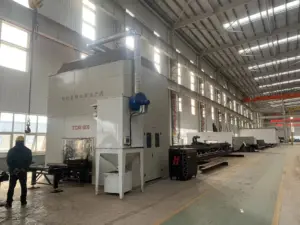
The synergy between the 12kW source and automatic structural processing is realized through an integrated material handling system. In the evaluated São Paulo facility, the machine was coupled with a 12-meter hydraulic loading deck and an automated outfeed conveyor.
Automatic Probing and Compensation:
Raw structural steel is rarely perfectly straight. H-beams often exhibit “camber” or “sweep.” The laser system utilizes a touch-probe or laser-scanning sensor to map the actual geometry of the beam before the first cut. The CNC controller then offsets the cutting path in real-time to compensate for the beam’s deformation. This ensures that a 10-meter cut remains perfectly centered on the web, regardless of the raw material’s physical deviations.
6. Comparative Analysis: Laser vs. Traditional Methods
A comparative analysis conducted over a 30-day period yielded the following technical benchmarks:
| Parameter | Traditional (Saw/Drill/Plasma) | 12kW Laser (Zero-Waste) |
| :— | :— | :— |
| **Processing Time (12m H-Beam)** | 145 Minutes | 18 Minutes |
| **Material Utilization** | 88-91% | 98.5-99% |
| **Secondary Grinding Required** | 100% of edges | < 5% of edges |
| **Hole Tolerance** | ±0.5mm to 1.0mm | ±0.1mm |
| **Labor Requirement** | 3 Technicians | 1 Operator |
The data indicates that while the initial capital expenditure (CAPEX) for a 12kW H-beam laser is higher than traditional machinery, the operational expenditure (OPEX) is drastically lower due to the elimination of secondary processes and the reduction in raw material waste.
7. Environmental and Economic Impact in São Paulo
The implementation of Zero-Waste technology has specific local economic implications. With Brazil’s energy costs being a significant factor for heavy industry, the efficiency of the 12kW fiber source—which boasts a wall-plug efficiency of approximately 35-40% compared to the 10% of older CO2 lasers—reduces the carbon footprint per ton of steel processed. Furthermore, the reduction in scrap metal aligns with local “Green Manufacturing” initiatives gaining traction in the State of São Paulo.
8. Challenges and Engineering Solutions
During the commissioning phase, two primary challenges were identified:
1. **Power Stability:** The São Paulo industrial grid can experience voltage fluctuations. This was mitigated by installing a high-capacity industrial voltage stabilizer and a dedicated transformer to protect the 12kW resonator.
2. **Fume Extraction:** Cutting thick structural steel at high speeds generates significant particulate matter. A multi-zone, high-volume dust extraction system was integrated into the machine bed, utilizing a pulse-jet cleaning mechanism to maintain airflow.
9. Conclusion
The integration of a 12kW H-Beam laser cutting Machine with Zero-Waste Nesting represents a fundamental shift in crane manufacturing methodology. By consolidating sawing, drilling, and beveling into a single automated 3D laser process, manufacturers in São Paulo can achieve unprecedented levels of precision and material efficiency. The “Zero-Waste” capability specifically addresses the highest variable cost in structural fabrication—raw material—ensuring that the facility remains competitive in a global market. The technical success of this deployment confirms that high-power fiber lasers are the definitive solution for modern heavy steel processing.
Report Prepared By:
Senior Engineering Lead, Structural Laser Division
Field Site: São Paulo, Brazil