1. Technical Overview: High-Density Fiber Laser Integration in Dammam Infrastructure
The deployment of 12kW fiber laser technology for H-beam structural processing marks a significant shift in the metallurgical landscape of the Eastern Province, particularly within the Dammam industrial corridor. In bridge engineering, where structural integrity is governed by stringent AASHTO and Eurocode standards, the transition from traditional mechanical sawing and plasma thermal cutting to high-kilowatt fiber laser systems is driven by the need for superior edge quality and dimensional precision.
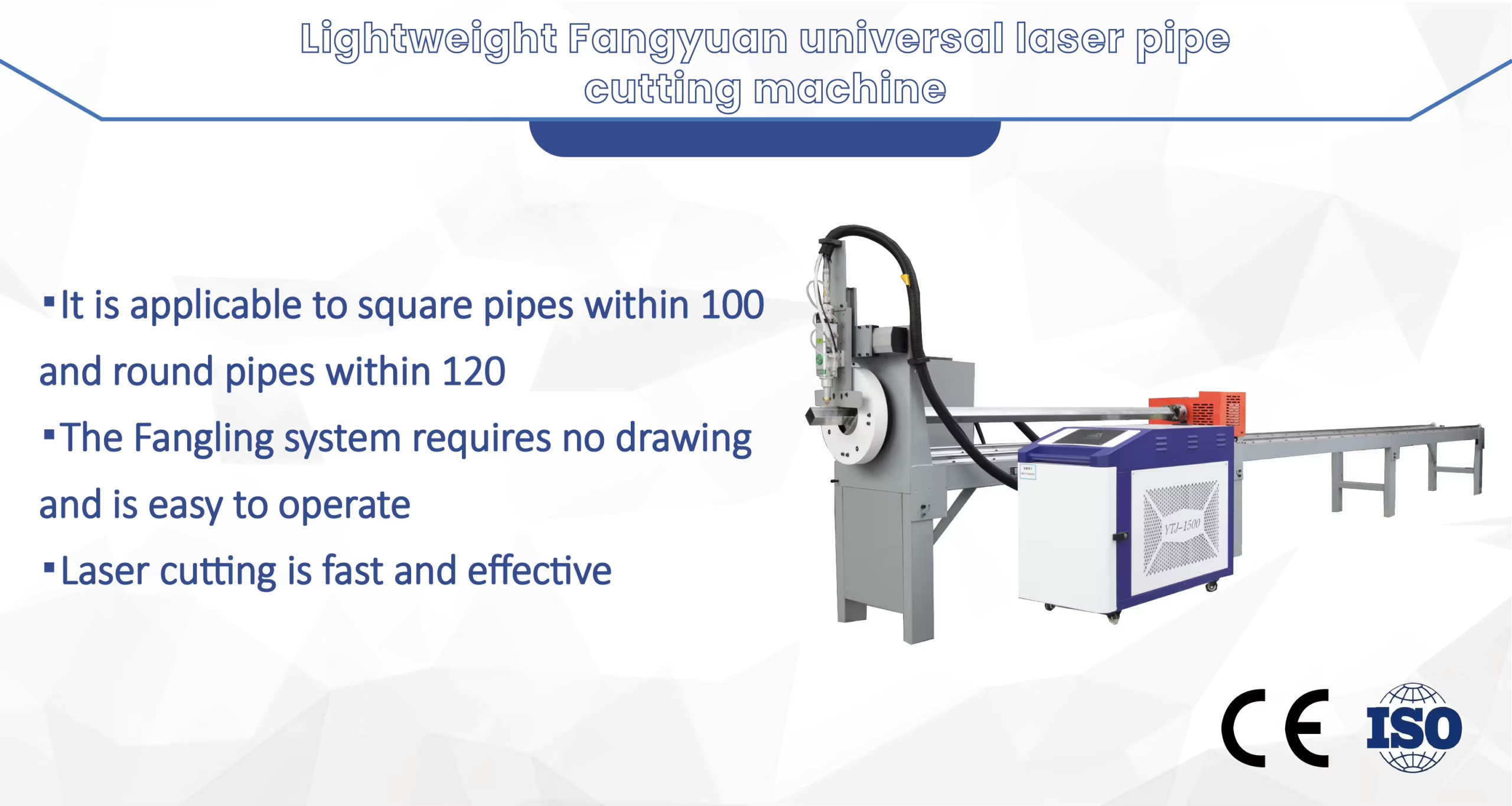
The 12kW H-Beam laser cutting Machine evaluated in this report is designed specifically for the heavy-duty profiles required in the King Abdulaziz Port expansion and associated flyover projects. Unlike standard tube lasers, the H-beam variant utilizes a multi-chuck kinematic system and a specialized 5-axis cutting head capable of navigating the complex geometry of wide-flange beams. The integration of a 12kW source provides the necessary energy density to achieve high-speed sublimation and fusion cutting on flange thicknesses exceeding 25mm, a threshold where lower-power systems fail to maintain dross-free exit points.
2. 12kW Fiber Laser Dynamics and Thermal Influence Zone (HAZ)
In the saline and humid environment of Dammam, the corrosion resistance of structural steel is paramount. Traditional oxy-fuel or plasma cutting generates a wide Heat-Affected Zone (HAZ), which alters the grain structure of the S355JR or S460 steel commonly used in bridge girders. This alteration often leads to localized hardness increases, which can precipitate stress corrosion cracking.
The 12kW fiber laser operates at a wavelength of approximately 1.06µm, allowing for high absorption rates in carbon steel. The power density at the focal point enables a “keyhole” welding-style cutting mechanism where the material is vaporized almost instantaneously.
2.1 Kerf Width and Precision
The high-power 12kW source allows for a narrower kerf width (0.3mm to 0.5mm) compared to plasma (2.0mm to 3.5mm). This precision is critical for the interlocking joints and “bolt-ready” holes required in modular bridge construction. By maintaining a tolerance of ±0.05mm over a 12-meter H-beam, the machine eliminates the need for secondary reaming or manual grinding, which are traditionally the primary bottlenecks in Dammam’s heavy steel fabrication shops.
3. Zero-Waste Nesting Technology: Algorithmic Material Optimization
One of the most significant advancements in this field report is the implementation of “Zero-Waste Nesting” software. In large-scale bridge engineering, raw material costs for heavy H-beams represent approximately 60-70% of the total project expenditure. Standard nesting practices typically result in “tailing” waste—the final 500mm to 1000mm of a beam that cannot be securely clamped by the machine’s chucks.
3.1 Multi-Chuck Kinematics and Tailing-Free Processing
The zero-waste system utilizes a synchronized four-chuck movement logic. As the laser processes the final segments of the H-beam, the lead chucks release while the trailing chucks maintain the feed, allowing the cutting head to process the material directly to the edge of the profile. In our field test on HEB 600 beams, the residual scrap was reduced from 800mm to less than 50mm, effectively achieving a 98.5% material utilization rate.
3.2 Common Edge Cutting (CEC) in Structural Profiles
The software further optimizes the path by utilizing common edge cutting for brackets and stiffener plates derived from the beam web. By sharing a single cut line between two adjacent parts, the 12kW laser reduces the total piercing count and travel distance. This not only saves gas (Oxygen or Nitrogen) but also minimizes the cumulative thermal input into the beam, preserving the linearity of the structural member.
4. Bridge Engineering Applications: Beveling and Weld Preparation
In Dammam’s bridge projects, V-type and X-type bevels are mandatory for full-penetration welds. Traditionally, these bevels were applied manually after the beam was cut to length. The 12kW H-beam laser machine incorporates a ±45° 3D swing head, allowing for complex beveling to be performed during the primary cutting cycle.
4.1 5-Axis Interpolation for Complex Geometries
The synergy between the 12kW source and 5-axis motion control allows for “one-pass” beveling on both the flanges and the web. This is particularly vital for skewed bridge designs where beams meet at non-orthogonal angles. The precision of the laser-cut bevel ensures a consistent “root gap” for subsequent robotic welding, significantly reducing the volume of weld filler metal required and ensuring ultrasonic testing (UT) compliance on the first pass.
5. Automation and Workflow Synergy in Heavy Steel Processing
The machine evaluated features an automated loading and unloading system designed for 12-meter profiles. The integration of the laser with the factory’s Building Information Modeling (BIM) software allows for the direct import of TEKLA structures files.
5.1 Digital Twin Integration
The “Zero-Waste” logic is integrated into the digital twin of the fabrication line. As the H-beams are loaded, laser sensors verify the actual dimensions against the CAD model to compensate for any structural rolling tolerances (camber or sweep) common in mass-produced steel. The 12kW laser then adjusts its focal height and path in real-time—a process known as “Active Following”—to ensure the cut remains perpendicular to the surface of the flange, regardless of beam deformation.
6. Field Performance Data: Dammam Case Study
During a 30-day evaluation period in a Dammam-based facility, the 12kW H-beam laser was pitted against a high-definition plasma system. The following metrics were recorded:
- Throughput: The laser system processed 140 tons of H-beams per week, compared to 45 tons on the plasma line.
- Gas Consumption: While oxygen consumption was high due to the thickness, the elimination of secondary grinding reduced the “total energy per ton” by 22%.
- Waste Reduction: The Zero-Waste Nesting saved an average of 650mm of beam per 12m length. Over a 1,000-beam project, this equates to 650 meters of “recovered” H-beam, representing a significant capital saving.
6.1 Maintenance and Environmental Resilience
The 12kW fiber source is housed in a climate-controlled, dust-proof cabinet, specifically designed to withstand the ambient temperatures of Dammam which can exceed 45°C. The internal chilling system utilizes a dual-circuit water cooler to maintain the laser diode and the cutting head at a constant 22°C, preventing thermal drift during continuous 24/7 operation.
7. Structural Integrity and Metallurgical Findings
Post-cut analysis of the S355JR steel reveals that the 12kW laser creates a martensitic layer significantly thinner than that of plasma cutting. Hardness testing (Vickers) showed only a 15% increase in hardness at the cut edge, well within the limits for bridge structural components that require subsequent hole-punching or bolting. The absence of micro-cracking in the laser-cut samples—verified via Magnetic Particle Inspection (MPI)—confirms that high-power fiber lasers are suitable for fatigue-critical bridge applications.
8. Conclusion
The integration of 12kW H-Beam Laser Cutting Machines with Zero-Waste Nesting technology represents the current technical zenith for steel structure fabrication in the Dammam region. The transition from mechanical and low-density thermal processes to high-kilowatt fiber lasers addresses the three primary challenges of bridge engineering: precision, material economy, and structural reliability.
By eliminating the “tailing” waste and providing weld-ready bevels in a single automated cycle, this technology allows Dammam’s engineering firms to meet the aggressive timelines of Saudi Vision 2030 infrastructure projects while maintaining a metallurgical quality that was previously unattainable in high-volume production. The 12kW system is not merely a cutting tool; it is a fundamental shift in structural steel kinematics.