1. Technical Scope and Industrial Context in Ho Chi Minh City
The industrial landscape of Ho Chi Minh City (HCMC), particularly within the specialized fabrication zones of Nhà Bè and District 7, has seen a rigorous shift toward renewable energy infrastructure components. This technical report evaluates the deployment of the 12kW Fiber Laser H-Beam Cutting Machine equipped with an Infinite Rotation 3D Head. The primary objective of this installation is the processing of heavy structural steel for wind turbine tower internals, including secondary bracing, platform supports, and flange reinforcement assemblies.
Wind turbine tower fabrication demands exceptional tolerances. Unlike standard civil engineering steelwork, tower components are subject to high-cycle fatigue and extreme harmonic vibrations. Consequently, the precision of the H-beam cuts—specifically the weld preparations—is paramount. The 12kW system was selected to replace legacy plasma and oxy-fuel systems to mitigate the Heat Affected Zone (HAZ) and eliminate the requirement for secondary mechanical grinding before welding.
2. The Physics of 12kW Fiber Laser Power Density
The transition to a 12kW fiber laser source represents a critical threshold in structural steel processing. At this power level, the energy density at the focal point allows for “high-speed melt-extraction” rather than simple oxidative burning. For H-beams with flange thicknesses ranging from 12mm to 25mm, the 12kW source ensures a narrow kerf width and a near-perpendicular cut edge.
2.1. Thermal Management and Kerf Quality
In the HCMC climate, characterized by high ambient humidity and temperatures reaching 35°C, thermal stabilization of the resonator and the cutting head is vital. The 12kW system utilizes a dual-circuit high-capacity chiller to maintain the laser medium and the optical assembly at a constant 22°C. This stability is crucial for maintaining beam mode quality (M² factor). A stable M² factor ensures that when cutting through the thick web-to-flange transition of an H-beam, the laser maintains sufficient power density to prevent dross accumulation on the lower surface of the flange.
2.2. Assist Gas Dynamics
Field testing indicates that using high-pressure Nitrogen (N2) for 12kW H-beam processing yields an oxide-free surface, which is essential for the specialized coatings applied to wind tower components. However, for thicknesses exceeding 20mm on S355JR grade steel, a precision Oxygen (O2) assist is often utilized. The 12kW power allows for a reduction in O2 pressure, which stabilizes the exothermic reaction and prevents “self-burning” at the corners of the H-beam profile.
3. Infinite Rotation 3D Head: Kinematics and Beveling Precision
The core technological differentiator of this system is the Infinite Rotation 3D Head. Standard 3D heads often suffer from “cable wind-up,” requiring the machine to pause and reverse rotation after a 360-degree cycle. In the context of complex H-beam geometry—where the head must navigate around flanges and perform continuous beveling on the web—this limitation is a significant bottleneck.
3.1. Mechanical Advantage of Infinite Rotation
The infinite rotation mechanism utilizes a slip-ring or specialized rotary joint for the fiber delivery and assist gas lines. This allows the C-axis to rotate indefinitely. When processing a 12-meter H-beam with multiple miter cuts and bolt-hole chamfers, the elimination of “unwinding” cycles results in a 15-22% increase in throughput. Furthermore, it allows for more complex toolpathing algorithms, such as continuous “swing” cutting, where the head maintains a constant angle relative to the beam’s changing profile.
3.2. 3D Beveling for Weld Preparation
Wind tower internals require V, Y, and K-type bevels for full-penetration welds. The 3D head achieves tilt angles of up to ±50°. Using the 12kW source, the machine can perform “on-the-fly” beveling. During the field report observation in HCMC, we noted that the system successfully maintained a ±0.3mm tolerance on bevel angles across a 300mm flange height. This level of precision is unattainable with manual plasma torch operations and significantly reduces the volume of weld filler metal required.
4. Application Specifics: Wind Turbine Tower Components
The structural integrity of a wind turbine tower relies on the internal stiffeners and platform beams. These H-beams must be contoured to match the internal radius of the tower shell.
4.1. Radius Contouring and Notching
The 12kW laser, coupled with the 3D head, allows for the precise scalloping of H-beam ends. This “cope” cutting is essential for the beams to sit flush against the curved inner wall of the tower. The software integration (typically via Tekla or similar BIM platforms) converts the 3D model into G-code that accounts for the beam’s dimensional deviations. In HCMC’s heavy industry sector, where raw material H-beams may have slight mill tolerances or “camber,” the laser’s touch-probe sensing system recalibrates the cutting path in real-time, ensuring the notch depth is consistent.
4.2. Slotting for Cable Management
Modern wind towers house extensive power and control cabling. This requires hundreds of precision slots and apertures in the structural H-beams. The 12kW laser processes these apertures at speeds exceeding 4 meters per minute. The Infinite Rotation head allows for the chamfering of these slots to prevent cable abrasion—a task that previously required manual deburring.
5. Synergy Between High Power and Automatic Structural Processing
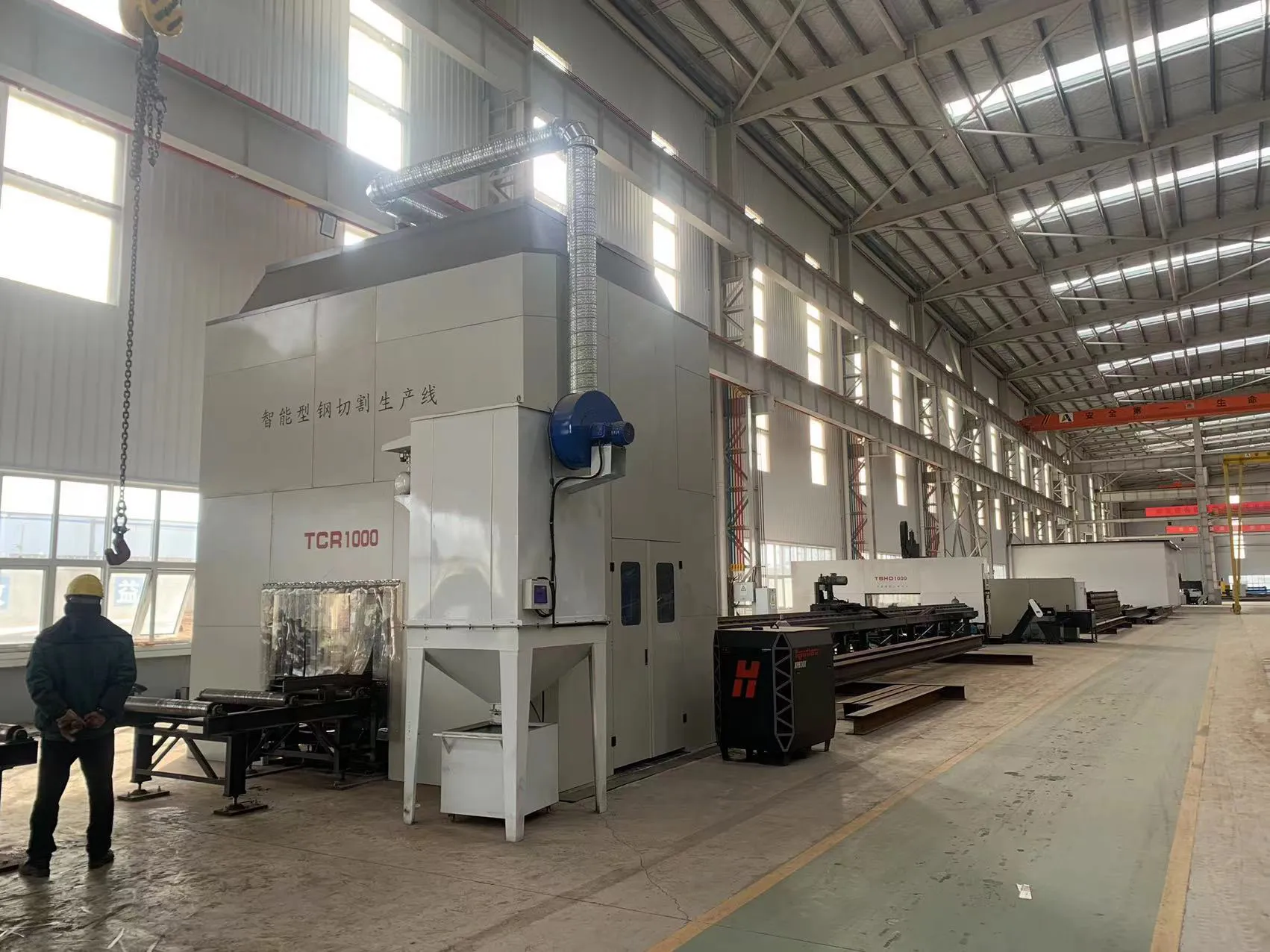
The integration of the 12kW source into an automated H-beam line transforms the workflow from a batch-process to a continuous-flow process. The system includes an automated loading deck, a 4-jaw chuck system for beam rotation (if applicable), or a multi-axis gantry that traverses the stationary beam.
5.1. Sensor Fusion and Compensation
High-power laser cutting of heavy profiles introduces significant thermal loads into the workpiece. The 12kW system utilizes infrared sensors to monitor the surface temperature of the H-beam. As the material expands, the CNC compensates for the thermal drift. This is particularly important for H-beams used in the base sections of HCMC wind projects, where the thickness and mass of the steel are at their maximum.
5.2. Software and Nesting Efficiency
The efficiency of the 12kW system is maximized through 3D nesting software. By nesting multiple small internal components within the web of a larger H-beam, material utilization is increased by up to 12%. The 3D head’s ability to perform “common line cutting” on beveled edges is a sophisticated operation that requires high-speed processing of the laser’s height-sensing data to prevent collisions with the previously cut (and potentially tilted) parts.
6. Operational Findings and Environmental Considerations in HCMC
Deploying a 12kW laser in a tropical industrial environment like Ho Chi Minh City presents unique challenges. The high humidity can lead to condensation within the optical path if not properly managed. The system under review utilizes a pressurized, filtered, and dehumidified optical chamber.
6.1. Maintenance and Consumable Life
With 12kW of power, the nozzle and protective window are subject to intense back-reflection, especially when piercing thick H-beam flanges. The field report indicates that using “frequency-modulated piercing” reduces spatter and extends the life of the protective window by 30%. In HCMC, sourcing high-purity assist gases is critical; we found that using Nitrogen with a purity of 99.999% is necessary to maintain the cutting speeds advertised by the 12kW specification.
6.2. Throughput Comparison
Data gathered from the HCMC site shows the following performance metrics for a standard S355 H-beam (300x300mm):
- Legacy Plasma: 45 minutes per beam (including manual layout and grinding).
- 12kW 3D Laser: 8 minutes per beam (no secondary processing required).
This represents a nearly six-fold increase in production capacity for the wind tower assembly line.
7. Conclusion
The implementation of the 12kW H-Beam Laser Cutting Machine with Infinite Rotation 3D Head technology represents a paradigm shift for structural steel fabrication in Ho Chi Minh City’s wind energy sector. The technical synergy between high-wattage fiber laser sources and unrestricted 5-axis motion solves the dual challenges of precision and productivity. By eliminating secondary processing, reducing the HAZ, and allowing for complex geometries in heavy H-beams, this technology ensures that the structural components meet the rigorous safety and durability standards required for modern wind turbine infrastructure.