
1.0 Technical Field Overview: The Industrial Transition in Querétaro
In the industrial corridors of Querétaro, the manufacturing of power transmission towers and heavy energy infrastructure has historically relied on a combination of mechanical sawing, radial drilling, and manual plasma torch operations. While functional, these legacy methods introduce significant cumulative tolerances and high labor overhead. This report details the field implementation and technical performance of a 12kW H-Beam laser cutting Machine equipped with an Infinite Rotation 3D Head, specifically calibrated for the fabrication of high-voltage transmission structures.
The energy sector in Mexico demands high-tensile structural integrity. Power towers, particularly those designed for 400kV lines, utilize heavy H-beams (IPE and HEB profiles) that must withstand extreme torsional and environmental loading. The shift to a 12kW fiber laser platform represents a fundamental change in the metallurgical approach to these structures, moving from mechanical stress-inducing processes to precision thermal profiling.
2.0 12kW Fiber Laser Source: Flux Dynamics and Material Interaction
The integration of a 12kW ytterbium fiber laser source is the cornerstone of this system’s efficiency. In structural steel processing, particularly with ASTM A36 or A572 Grade 50 commonly found in the Querétaro sector, power density is critical. At 12kW, the system achieves a power density that allows for high-speed sublimation and melt-ejection, minimizing the Heat-Affected Zone (HAZ).
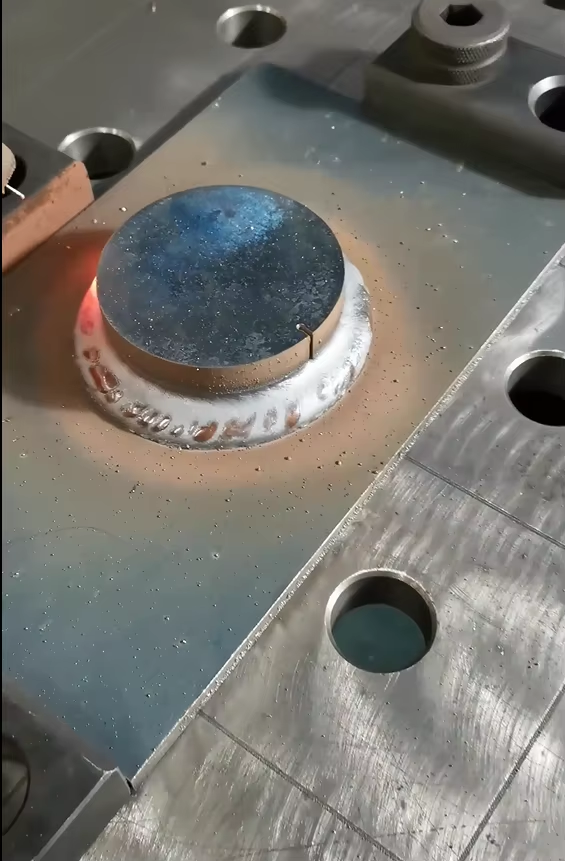
2.1 Kerf Consistency and Thermal Management
Unlike 6kW or 8kW systems, the 12kW source maintains a stable keyhole even through the thicker flanges of H-beams (up to 25mm-30mm). The increased wattage allows for a larger nozzle-to-workpiece standoff without sacrificing beam stability. This is vital for structural beams where minor surface deviations are common. By utilizing high-pressure Nitrogen (N2) or Oxygen (O2) assist gas dynamics, the 12kW system ensures that the dross adhesion on the lower flange is negligible, effectively eliminating secondary grinding operations—a major bottleneck in traditional power tower fabrication.
2.2 High-Speed Processing of Lattice Members
In the context of power towers, speed is not merely a production metric but a thermal management strategy. Rapid traverse and cutting speeds reduce the dwell time of the laser beam on any specific coordinate, thereby preventing local grain growth and maintaining the mechanical properties of the structural steel as specified by structural engineering codes.
3.0 Infinite Rotation 3D Head: Kinematics and Beveling Precision
The most significant leap in this technology is the Infinite Rotation 3D Head. Traditional 5-axis heads are often limited by cable-wrap constraints, requiring the head to “unwind” after a certain degree of rotation. In H-beam processing—where the torch must navigate the web, transition to the flange, and perform complex bevels on all four sides—infinite rotation is mandatory for continuous cycle times.
3.1 Solving the Beveling Dilemma
Transmission towers require complex joinery, often involving K-type, Y-type, or X-type joints where H-beams meet at acute angles. To ensure full-penetration welds, these beams must be beveled precisely. The Infinite Rotation 3D Head allows for ±45° (or higher in specialized configurations) tilting with continuous 360° rotation. This allows the machine to perform “One-Pass Beveling.”
Technically, the head utilizes a slip-ring or advanced fiber-delivery system that maintains the beam’s focal integrity while the head rotates around the A and C axes indefinitely. This eliminates the “dead time” seen in 3D plasma cutting and ensures that the bevel angle remains constant across the entire geometry of the beam web and flange interface.
3.2 Compensation for Beam Camber and Sweep
Structural H-beams are rarely perfectly straight. In a field environment like Querétaro, ambient temperatures and manufacturing tolerances in the raw steel lead to “camber” (vertical curve) and “sweep” (horizontal curve). The 3D head is integrated with high-speed capacitive sensors and 3D vision systems. Before the first pierce, the system maps the actual profile of the H-beam. The Infinite Rotation Head then adjusts its trajectory in real-time to maintain a constant focal point relative to the actual, rather than the theoretical, surface of the steel. This ensures that the bolt holes for the tower gusset plates are perfectly aligned across 12-meter sections.
4.0 Automated Structural Processing: The Synergy of Hardware and Software
The 12kW H-beam laser is not a standalone cutter; it is a robotic work cell. For the Querétaro power tower sector, the integration of automatic loading and unloading is what scales the 12kW power into actual throughput. The machine utilizes a heavy-duty conveyor system and a hydraulic clamping mechanism that can handle beams weighing several tons.
3.3 Nesting and Material Optimization
Advanced CAD/CAM software (such as Lantek or SigmaNEST, optimized for 3D structural steel) allows for the nesting of different tower components on a single 12-meter H-beam. The software accounts for the 3D head’s clearance requirements. Because the laser kerf is significantly narrower than a plasma arc (0.2mm vs 2.0mm), the nesting can be much tighter, leading to a 5-8% reduction in raw material waste—a significant cost saving given the current price of structural steel.
3.4 Hole Quality and Bolt-Ready Fabrication
One of the critical failure points in power towers is the integrity of the bolted joints. Traditional punching or plasma cutting can create micro-cracks or tapered holes. The 12kW laser, with its high-frequency pulsing and precision 3D motion control, produces holes with a taper of less than 0.1mm. These “bolt-ready” holes meet the most stringent AISC (American Institute of Steel Construction) standards without requiring reaming. This eliminates a secondary fabrication step and ensures that the structural load distribution is uniform across the tower assembly.
5.0 Comparative Efficiency: Laser vs. Traditional Methods
To quantify the impact of this technology in the field, we must look at the cycle time for a standard 400kV tower leg section.
- Traditional Method: Band saw cutting (15 mins) + Layout/Marking (10 mins) + Manual Drilling (30 mins) + Plasma Beveling (20 mins). Total: 75 minutes.
- 12kW Laser with 3D Head: Automated loading (2 mins) + Laser profiling/holes/beveling (8 mins) + Automated unloading (2 mins). Total: 12 minutes.
The 12kW laser achieves an 84% reduction in processing time. Furthermore, the accuracy is improved from ±2.0mm (manual/plasma) to ±0.2mm (laser). In the assembly phase in Querétaro, this means that site crews can bolt tower sections together without the need for on-site “forcing” or re-drilling, which drastically improves worker safety and structural reliability.
6.0 Metallurgical Considerations and Long-Term Reliability
A frequent concern in heavy structural fabrication is the “hardened edge” caused by thermal cutting. With 12kW power, the cutting speed is so high that the heat input into the base metal is significantly lower than that of plasma or oxy-fuel cutting. Field tests conducted on the cut edges of A572 steel show a negligible increase in Rockwell hardness. This ensures that the beams remain ductile and are not prone to brittle fracture under the cyclic wind loading typical of the Mexican highlands.
The 12kW fiber source also boasts a Mean Time Between Failure (MTBF) of over 100,000 hours, making it a robust solution for the 24/7 production schedules required by major energy infrastructure projects in the region.
7.0 Conclusion: The Future of Querétaro’s Steel Sector
The deployment of 12kW H-Beam Laser Cutting machines with Infinite Rotation 3D technology represents the pinnacle of current structural steel fabrication. For the Querétaro power tower sector, this technology solves the dual challenges of precision and volume. By automating the most complex aspects of H-beam processing—specifically the beveling and hole-drilling—manufacturers can guarantee a level of structural integrity that was previously unattainable at this scale.
As the regional grid expands and the demand for more complex, resilient towers grows, the synergy between high-wattage fiber lasers and 3D robotic motion will become the standard. The ability to move from raw beam to finished, bolt-ready component in a single automated cycle is not just an efficiency gain; it is a total reimagining of structural engineering possibilities.
















