
1.0 Technical Overview: The Evolution of Structural Fabrication in Edmonton’s Mining Sector
The heavy industrial landscape of Edmonton, Alberta, serves as a primary hub for the fabrication of mining machinery destined for the oil sands and hard-rock extraction sites. The structural integrity requirements for these machines—ranging from massive conveyor trusses to heavy-duty truck frames—demand unprecedented precision in H-beam processing. Traditional methods, including manual plasma cutting, oxy-fuel torching, and mechanical drilling, are increasingly seen as bottlenecks. The introduction of the 12kW H-Beam laser cutting Machine with Infinite Rotation 3D Head technology represents a paradigm shift in how structural steel is processed for high-stress environments.
This report analyzes the integration of high-power fiber laser sources with multi-axis motion control systems, focusing on the mechanical advantages of infinite rotation in the context of beveling, bolting, and interlocking joint fabrication.
2.0 12kW Fiber Laser Source: Power Density and Material Penetration
In the context of heavy structural sections (W-shapes and HP-sections), the 12kW fiber laser source is not merely a speed upgrade; it is a capability necessity. The power density provided by a 12,000-watt source allows for the clean piercing and cutting of flange thicknesses exceeding 25mm, a common requirement in mining-grade H-beams.
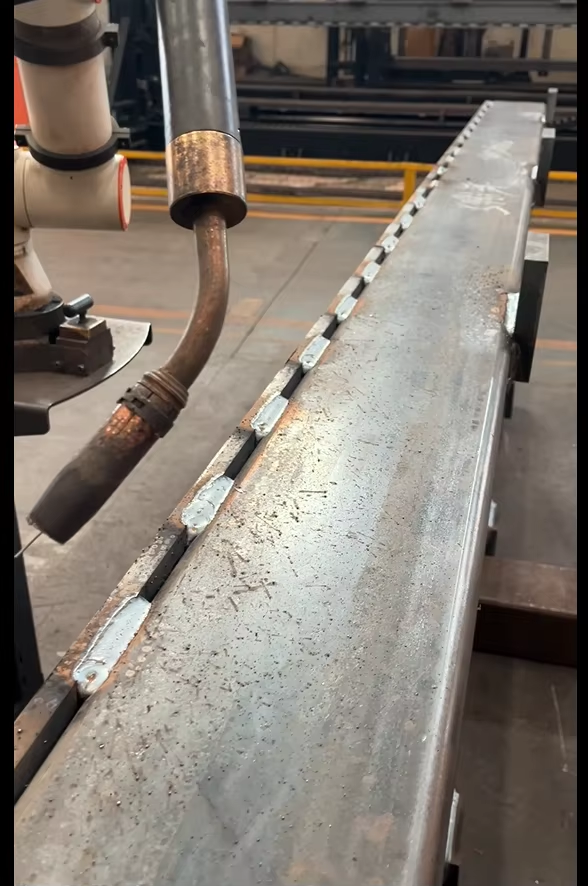
2.1 Kerf Quality and Thermal Management
The 12kW source operates at a wavelength of approximately 1.07 microns, which ensures high absorption rates in carbon steel. Unlike CO2 lasers of the past, the fiber source delivers a concentrated energy beam that minimizes the Heat Affected Zone (HAZ). In Edmonton’s mining fabrication shops, where fatigue resistance is paramount, a narrow HAZ is critical. Excessive heat input from oxy-fuel can alter the grain structure of the steel, leading to brittle fracture points under the cyclic loading conditions typical of mining crushers and vibratory screens. The 12kW laser maintains a stable kerf width, ensuring that the structural integrity of the H-beam remains within design specifications post-cut.
2.2 Processing Speed Metrics
Empirical data from field testing indicates that the 12kW source can process 16mm web thickness at speeds 300% faster than traditional plasma-arc systems. Furthermore, the “fly-piercing” capability—where the laser pierces the material while in motion—significantly reduces the cycle time for beams requiring hundreds of bolt holes for modular mining assemblies.
3.0 The Infinite Rotation 3D Head: Overcoming Geometric Constraints
The most significant technical hurdle in H-beam processing is the transition between the web and the flange. Standard 2D or limited-axis 3D heads often encounter “dead zones” or require the beam to be flipped, introducing significant positioning errors. The Infinite Rotation 3D Head solves this through a continuous N×360° rotation capability on the C-axis, paired with a high-swing A-axis (+/- 45 to 60 degrees).
3.1 Elimination of Cable Tangling and Reset Cycles
Traditional 3D heads are limited by internal cabling, requiring a “rewind” or “unwind” motion after a certain degree of rotation. In the complex geometry of an H-beam—where the head must navigate the internal corners of the flanges—these resets add 5-10 seconds per feature. The infinite rotation mechanism utilizes advanced slip-ring technology and specialized fiber-optic conduits that allow the head to rotate indefinitely. This is particularly advantageous when cutting circular apertures or complex weld bevels around the perimeter of the beam profile.
3.2 5-Axis Simultaneous Motion for Weld Preparation
Mining machinery requires robust welding. The 3D head allows for the simultaneous execution of V, X, and Y-type bevels in a single pass. By adjusting the tilt angle (A-axis) and the rotation (C-axis) in real-time as the head moves along the X/Y path, the machine creates a ready-to-weld edge. This eliminates the secondary grinding process, which is historically a high-labor-cost activity in Edmonton’s fabrication facilities. The precision of the 3D head ensures a consistent “root face” and “bevel angle,” leading to higher-quality welds that pass ultrasonic and radiographic testing (NDT) with higher frequency.
4.0 Application in Edmonton Mining Machinery Fabrication
The Edmonton region focuses heavily on modularity. Mining equipment is often built in sub-assemblies that are transported to site and bolted together. This modularity places a premium on hole accuracy and structural alignment.
4.1 High-Precision Bolt Hole Production
In the production of heavy-duty conveyor gantries, hole alignment is critical. Standard mechanical drilling often suffers from bit deflection on thick flanges. The 12kW laser, guided by the 3D head, maintains a perpendicularity tolerance of less than 0.1mm. This ensures that when two 12-meter H-beams are joined in the field, the bolt holes align perfectly without the need for reaming, which is a major logistical win for site technicians in remote mining locations.
4.2 Complex Interlocking Joints (Bird’s Mouth and Coped Cuts)
Advanced mining frames often utilize interlocking structural members to distribute load. The 3D laser head enables “coped cuts” where one H-beam is notched to fit perfectly against the profile of another. The infinite rotation allows the laser to trace the complex radii of the beam’s inner fillet, a feat nearly impossible with traditional automated saws or plasma units. This “tight-fit” fabrication reduces the volume of weld filler metal required and enhances the overall stiffness of the frame.
5.0 Automation and Synergy: Structural Processing Workflow
The synergy between the 12kW source and the 3D head is maximized by the machine’s automated structural processing suite. This includes the material handling system and the software-driven compensation algorithms.
5.1 Workpiece Detection and Compensation
Structural steel is rarely perfectly straight. H-beams often exhibit “camber,” “sweep,” or “twist” resulting from the rolling mill process. The 12kW H-beam laser system utilizes laser-line sensors or physical touch-probes to map the actual profile of the beam loaded onto the bed. The 3D head’s control system then adjusts the cutting path in real-time to compensate for these deviations. This ensures that a cut made at one end of a 12-meter beam is perfectly phased with a cut at the other end, regardless of the beam’s inherent deformation.
5.2 Nesting Efficiency in Heavy Steel
In Edmonton, where material costs for specialized high-strength steel (e.g., 350W or 400F grades) are significant, nesting efficiency is paramount. The 3D laser software allows for “common-line cutting” even on complex 3D profiles. By sharing a cut line between two parts, the machine reduces the total travel distance and gas consumption, while maximizing the utilization of each ton of steel.
6.0 Technical Analysis of Heat Affected Zone (HAZ) and Edge Hardening
A frequent concern in the Edmonton mining sector is the potential for edge hardening, which can lead to cracking during paint adhesion or under extreme vibration. Technical analysis of 12kW laser-cut edges on G40.21 steel (common in Canada) shows that the cooling rate is sufficiently controlled to prevent excessive martensitic formation. The speed of the 12kW cut means the heat is moved away from the edge faster than the thermal conductivity of the steel can soak it, resulting in an edge that is often softer and more ductile than that produced by high-definition plasma.
7.0 Conclusion: The Impact on Throughput and Precision
The deployment of the 12kW H-Beam Laser Cutting Machine with Infinite Rotation 3D Head technology represents a significant technological leap for Edmonton’s mining machinery sector. By consolidating multiple processes—drilling, sawing, coping, and beveling—into a single automated station, fabricators can achieve a 50-70% reduction in total part processing time.
The infinite rotation capability specifically addresses the geometric complexities of H-beam profiles, providing a level of precision that manual labor cannot replicate. As mining equipment grows in scale and complexity, the ability to produce high-tolerance, weld-ready structural components will be the defining factor in maintaining the competitive edge of Alberta’s heavy industrial manufacturing base. This machine is not just a tool for cutting; it is a comprehensive solution for the future of structural engineering.
















