
1. Technical Overview and Deployment Context
This report evaluates the operational integration of a 12kW High-Power H-Beam Fiber laser cutting Machine, equipped with an Infinite Rotation 3D Head, within the heavy-duty crane manufacturing sector in the Istanbul industrial corridor (Gebze-Dudullu axis). The transition from traditional mechanical processing—comprising band sawing, radial drilling, and manual oxy-fuel beveling—to a unified CNC laser structural processor represents a paradigm shift in steel fabrication kinetics.
Crane manufacturing demands extreme structural integrity. Gantry and overhead cranes produced in Istanbul’s industrial hubs must adhere to stringent EN 13001 and ISO 9001 standards. The primary challenge has historically been the “bottleneck of fit-up”: the time-consuming process of ensuring that H-beams, I-beams, and U-channels are cut and beveled with enough precision to minimize gap volume for submerged arc welding (SAW) and flux-cored arc welding (FCAW).
2. The Kinematics of the Infinite Rotation 3D Head
The core technological advantage of the subject machine is the Infinite Rotation 3D Head. Unlike standard 3D heads that utilize a limited “swing” or “tilt” mechanism (often restricted to +/- 360 degrees, requiring a “rewind” of the internal cabling), the infinite rotation mechanism utilizes a sophisticated slip-ring or advanced fiber-coupling assembly. This allows the cutting head to rotate continuously around the C-axis while maintaining a stable ±45° to ±60° A-axis tilt.
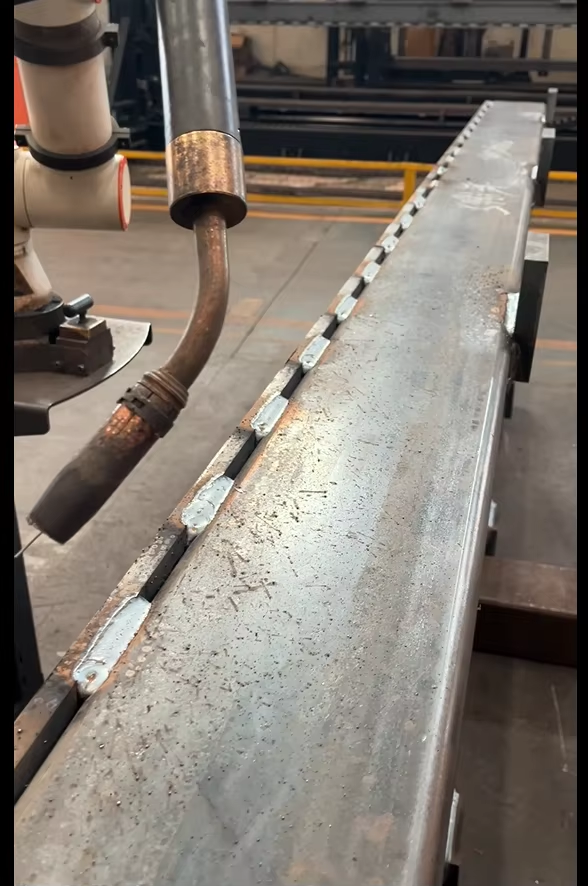
In the context of H-beam processing, this is critical. A standard H-beam requires cutting on three or four sides. When performing complex bevels (V, X, or K-cuts) for weld preparations, the head must transition from the flange to the web seamlessly. The infinite rotation capability eliminates the “non-productive cable-return time,” which, in a 12-meter beam processing cycle involving 20+ holes and 4 bevel cuts, saves approximately 15% in total cycle time. More importantly, it ensures a continuous kerf, reducing the heat-affected zone (HAZ) inconsistencies caused by stops and starts.
3. 12kW Fiber Laser Source Synergy
The selection of a 12kW fiber laser source is intentional for the Istanbul crane market, where beam web thicknesses typically range from 10mm to 25mm, and flanges can exceed 30mm. While a 6kW source can “sever” these thicknesses, the 12kW source provides the “power density” required for “high-speed vaporization cutting.”
3.1. Piercing Dynamics
In crane fabrication, bolt-hole precision for end-truck attachments is non-negotiable. The 12kW source allows for “flash piercing”—reducing the piercing time on a 20mm flange from seconds to milliseconds. This prevents “volcanoing” (excessive dross buildup at the entry point) and ensures that the hole diameter remains consistent through the entire thickness of the H-beam. The resulting holes meet the tolerances required for high-strength friction grip (HSFG) bolts without the need for secondary reaming.
3.2. Gas Dynamics and Edge Quality
The 12kW output allows the use of Oxygen (O2) at higher pressures for thick carbon steel (S235JR, S355J2+N) while maintaining a narrow kerf. In Istanbul’s crane facilities, where S355 structural steel is the standard, the 12kW laser achieves a surface roughness (Rz) that often negates the need for grinding before painting or galvanizing. This is a direct reduction in man-hours per ton of steel processed.
4. Application in Crane Manufacturing: Structural Logic
Crane girders are subject to massive dynamic loads. The structural integrity of the H-beam is compromised by manual thermal cutting, which introduces significant thermal stress and geometric distortion. The H-Beam Laser Cutting Machine addresses several specific crane-building pain points:
4.1. Complex Profile Intersections
Main girders often require “notching” or “coped cuts” to accommodate cross-beams or specialized end-carriage mounting. The Infinite Rotation 3D Head executes these 3D paths in a single pass. The software-driven approach (using files exported from Tekla Structures or SolidWorks) ensures that the geometry of the notch exactly matches the profile of the intersecting beam, resulting in a “zero-gap” fit-up.
4.2. Precision Beveling for Weld Efficiency
Manual beveling is the most labor-intensive part of crane assembly. By utilizing the 3D head to cut AWS-compliant bevels directly on the laser bed, the manufacturer eliminates the “bevel-grinding” station entirely. The 12kW laser maintains the feed rate even at a 45° angle (where the effective thickness increases by approximately 1.41x). This ensures that the root face and bevel angle are mathematically perfect, leading to a 30% reduction in weld wire consumption due to tighter tolerances.
5. Automation and Workflow Integration
In the Istanbul industrial environment, space and labor efficiency are at a premium. The H-beam laser replaces a suite of machines. The integrated system features an automatic loading rack, a 4-chuck (or 3-chuck) clamping system for stability, and an unloading conveyor.
5.1. The 4-Chuck Clamping Advantage
Processing long H-beams (up to 12 meters) introduces the risk of “beam sag” or “torsional twist.” The 4-chuck system provides continuous support, especially when the beam is being rotated for web cutting. By maintaining the centerline of the beam relative to the laser’s focal point, the system compensates for “mill-tolerance” deviations (bowing) inherent in raw steel. The machine’s touch-probe or laser-sensing system maps the actual profile of the H-beam before cutting, adjusting the NC code in real-time to ensure the 3D head maintains a constant stand-off distance.
6. Economic and Engineering Impact Analysis
The deployment of this technology in an Istanbul-based facility yields the following quantifiable improvements:
- Throughput: A 12-meter H-beam with 16 bolt holes and 4 bevelled ends is processed in under 12 minutes. Traditional methods (saw + drill + manual bevel) typically require 90 to 120 minutes of floor time.
- Accuracy: Linear tolerances are held to ±0.2mm per meter, and hole-to-hole centers are held to ±0.1mm. This eliminates “site-reaming” during crane assembly.
- Labor: The process is managed by a single technician rather than a team of four (sawyer, driller, burner, and grinder).
7. Conclusion: The Senior Expert’s Verdict
The 12kW H-Beam Laser Cutting Machine with Infinite Rotation 3D Head is no longer an “optional upgrade” for crane manufacturers in competitive markets like Istanbul; it is a fundamental requirement for Tier-1 status. The synergy between high-power fiber sources and unrestricted 3D kinematics solves the two greatest problems in heavy steel processing: thermal distortion and secondary operation bottlenecks.
From an engineering perspective, the ability to produce “weld-ready” components directly from the machine bed increases the safety factor of the final crane structure. By minimizing the heat-affected zone and maximizing fit-up precision, the structural fatigue life of the crane is inherently improved. This technology represents the peak of current structural steel fabrication, bridging the gap between digital design and heavy-duty physical execution.
Field Report End.
Authored by: Senior Laser & steel structures Consultant
















