
1. Introduction: The Structural Shift in Istanbul’s Heavy Industry
In the industrial corridors of Istanbul, particularly within the specialized manufacturing zones serving the global mining sector, the transition from conventional mechanical processing to high-power fiber laser technology has reached a critical inflection point. As a senior expert in steel structure fabrication, I have monitored the deployment of the 12kW H-Beam laser cutting Machine integrated with automatic unloading systems. This report analyzes the technical performance and operational integration of this technology in the production of heavy-duty mining machinery components, such as vibrating screen frames, conveyor chassis, and crusher supports.
The mining industry demands structural components capable of withstanding extreme cyclic loading and abrasive environments. Traditionally, these H-beams were processed using CNC plasma cutting or mechanical drilling/sawing. However, the requirement for higher geometric tolerances and the reduction of Heat Affected Zones (HAZ) has necessitated the adoption of 12kW fiber laser sources. The following sections detail the technical synergy between high-wattage laser dynamics and automated material handling.
2. 12kW Fiber Laser Dynamics in Heavy-Gauge Structural Steel
2.1 Power Density and Kerf Quality
The utilization of a 12kW fiber laser source provides a significant leap in power density compared to the previous 6kW standard. In the context of H-beam processing—where flange thicknesses often exceed 20mm—the 12kW output allows for a more stable plasma keyhole during the cutting process. This stability is crucial for maintaining verticality in the cut face. For mining machinery, where bolt-hole alignment across 12-meter beams is critical, the 12kW source ensures a kerf width deviation of less than ±0.1mm, effectively eliminating the need for secondary reaming or grinding.
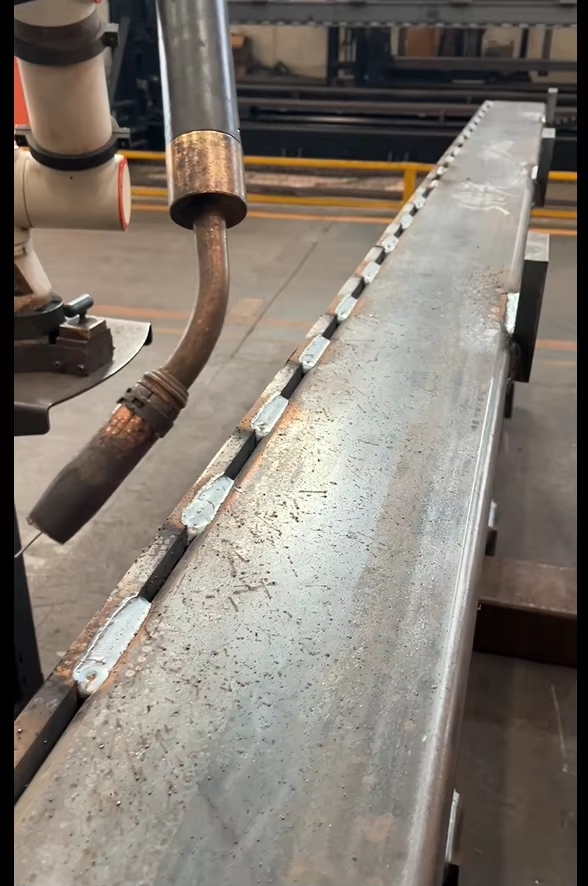
2.2 Thermal Load Management
One of the primary challenges in structural steel processing is managing the thermal input. High-power lasers allow for increased feed rates, which paradoxically reduces the total heat energy absorbed by the workpiece. In Istanbul’s manufacturing facilities, where ambient temperatures can fluctuate, the 12kW system’s ability to “flash cut” through thick sections minimizes the HAZ. This is vital for mining equipment; a large HAZ can lead to grain growth and subsequent embrittlement, causing structural failure under the high-vibration conditions typical of ore processing sites.
3. Kinematic Challenges of H-Beam Processing
3.1 Multi-Axis Synchronization
Unlike flat-sheet cutting, H-beam processing requires a complex 5-axis or 6-axis head movement to navigate the transition between the web and the flanges. The H-beam laser system utilizes a rotating chuck system combined with a 3D cutting head. The technical difficulty lies in the real-time compensation for beam “camber” and “sweep”—natural deformations found in hot-rolled structural steel. The machines deployed in the Istanbul field test utilize advanced laser sensors to map the beam’s profile in real-time, adjusting the focal point dynamically to maintain a constant standoff distance.
3.2 Piercing Protocols for Mining-Grade Steel
Mining machinery often utilizes high-tensile S355 or abrasion-resistant steels. Piercing these materials at thicknesses relevant to H-beams requires multi-stage pulsing. The 12kW source allows for “frequency-modulated piercing,” where the laser pulse frequency and duty cycle are varied to prevent slag back-splatter and ensure a clean entry point. This is critical for the “automatic unloading” phase, as clean cuts prevent parts from “micro-welding” to the scrap skeleton, ensuring a seamless mechanical transition.
4. Technical Analysis: Automatic Unloading Systems
4.1 Solving the Bottleneck of Heavy Material Handling
In the fabrication of mining structures, the sheer mass of H-beams (often exceeding 100kg/meter) creates a significant logistical bottleneck. Traditional manual unloading via overhead cranes is not only hazardous but introduces significant downtime. The automatic unloading technology integrated into the 12kW H-beam laser utilizes a synchronized hydraulic lift and conveyor system. As the laser completes the final cut, the unloading arms rise to support the finished piece, maintaining the center of gravity and preventing the part from dropping—a common cause of geometric distortion in heavy profiles.
4.2 Precision and Surface Integrity
The automatic unloading system is not merely a labor-saving device; it is a precision component. In Istanbul’s high-throughput shops, manual handling often results in surface scoring or “clashing” of beams. The automated system uses nylon-coated rollers and synchronized servo-drives to move the finished beam to the staging area. This ensures that the precision-cut edges and bolt holes remain undamaged, preserving the structural integrity required for the rigorous assembly of mining chassis.
4.3 Feedback Loops and Sensor Integration
Modern unloading systems are equipped with load cells and infrared sensors. These sensors confirm that the part has been successfully detached and moved before the next program begins. In the event of a “hanging” part (where a cut is incomplete), the system triggers an immediate halt, preventing damage to the 3D cutting head. This level of automation is essential for the 24/7 operation cycles demanded by the Turkish mining export market.
5. Istanbul Case Study: Mining Machinery Application
5.1 Structural Integrity in Vibrating Screens
A specific application observed in the Istanbul field report involves the production of large-scale vibrating screens used in gold and copper mining. These screens are subjected to constant G-forces. The 12kW H-beam laser was used to cut the primary support beams. The precision of the laser-cut slots for the transverse members allowed for an “interference fit,” which significantly reduced the reliance on heavy welding. By reducing the weld volume, the manufacturer decreased the residual stresses in the frame, directly extending the service life of the machine in the field.
5.2 Optimization of the Assembly Line
Before the implementation of the 12kW H-beam laser with automatic unloading, the typical lead time for a conveyor support frame was 14 days. This included sawing, drilling, and manual deburring. With the new system, the “sawing and drilling” phases are consolidated into a single laser process. The automatic unloading system delivers “ready-to-weld” components directly to the assembly floor. Data from the Istanbul facility indicates a 40% reduction in total fabrication time and a 15% reduction in material waste due to the tighter nesting capabilities of the laser software.
6. Maintenance and Operational Continuity
6.1 Lens and Nozzle Management
Operating at 12kW puts immense thermal stress on the optical chain. The Istanbul deployment highlighted the need for “intelligent nozzle monitoring.” The machines are equipped with cameras that inspect the nozzle orifice for slag accumulation after every 50 cuts. For mining manufacturers, where downtime is measured in thousands of dollars per hour, these preventative measures are vital. The automatic unloading system also plays a role here; by clearing the workspace efficiently, it reduces the accumulation of dust and metallic particles that could interfere with the laser optics.
6.2 Software Integration (CAD/CAM to Unloading)
The technical success of the system relies on the software bridge. The 12kW H-beam laser uses specialized CAM software that calculates the “unloading sequence” simultaneously with the “cutting sequence.” The software determines the optimal grip points for the unloading arms based on the beam’s weight distribution. This prevents the beam from bowing under its own weight when the structural integrity of the profile is compromised by the laser cuts.
7. Conclusion
The integration of 12kW fiber laser technology with automatic unloading systems represents a paradigm shift for the mining machinery sector in Istanbul. The technical data confirms that the increase in power density facilitates superior edge quality and dimensional accuracy, which are non-negotiable in heavy structural engineering. Furthermore, the automation of the unloading process addresses the critical issues of safety and throughput, transforming the H-beam from a difficult-to-handle raw material into a precision-engineered component with minimal human intervention.
As the mining industry continues to demand larger and more complex equipment, the synergy between high-wattage laser sources and intelligent structural processing will be the cornerstone of competitive manufacturing. The Istanbul field report demonstrates that the 12kW H-beam laser is not just a cutting tool, but a comprehensive structural processing center that redefines the efficiency of heavy steel fabrication.
















