
1.0 Field Report Overview: Structural Laser Integration
This technical report evaluates the deployment and operational performance of a 12kW high-power H-beam laser cutting system equipped with an integrated automatic unloading module. The field study was conducted at a heavy-duty crane manufacturing facility in Houston, Texas—a region characterized by rigorous structural standards and high-volume throughput requirements for the petrochemical and maritime logistics sectors. The primary objective of this installation was to transition from legacy plasma and mechanical processing to a fully automated fiber laser workflow to enhance dimensional tolerances and structural integrity in heavy-duty gantry and overhead crane components.
2.0 Site Context: Crane Manufacturing in the Houston Industrial Corridor
Crane manufacturing in Houston demands adherence to stringent AISC (American Institute of Steel Construction) standards. The structural members, primarily wide-flange H-beams (W-shapes), serve as the primary load-bearing elements for overhead bridge cranes and massive port-side gantry systems. Historically, these components were processed using CNC plasma stations or mechanical saw-and-drill lines. However, these methods introduce significant heat-affected zones (HAZ) or require secondary deburring and finishing operations.
The introduction of the 12kW H-beam laser provides a critical advantage in this environment. The higher power density allows for the processing of thick-walled flanges (up to 25mm-35mm) with minimal thermal distortion, which is vital for maintaining the camber and sweep tolerances required in long-span crane beams. The Houston facility’s specific requirement involved the processing of A572 Grade 50 steel, where maintaining the grain structure of the flange-to-web transition is paramount for fatigue resistance.
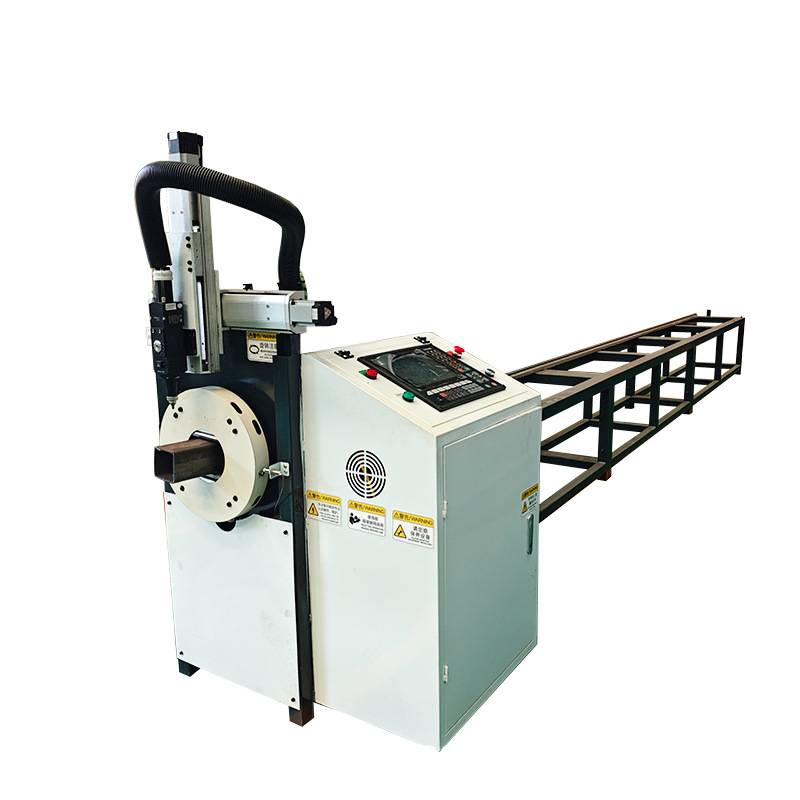
3.0 Technical Specifications of the 12kW Fiber Laser Source
3.1 Power Density and Kerf Dynamics
The 12kW fiber laser source provides a significant leap in cutting velocity compared to 6kW or 8kW alternatives. In the context of H-beams, the laser must penetrate not only the flat surfaces of the web and flanges but also navigate the radius (the fillet) where the two meet. The 12kW source ensures that the energy density remains sufficient to maintain a stable melt pool even when the beam incidence angle deviates from the perpendicular during complex 3D maneuvers.
3.2 Gas Dynamics and Cut Quality
For crane manufacturing, the edge quality of the cut determines the efficacy of subsequent welding processes. Using high-pressure oxygen (O2) as an assist gas for carbon steel processing at 12kW results in a narrow kerf and a smooth surface finish (Ra < 12.5 μm). This eliminates the need for edge grinding prior to submerged arc welding (SAW). The system’s ability to modulate gas pressure dynamically as the head transitions from the flange to the web is a critical factor in preventing dross accumulation at the beam’s internal corners.
4.0 3D Structural Processing and Multi-Axis Kinematics
The H-Beam Laser Cutting Machine utilizes a sophisticated 5-axis or 6-axis head configuration. Unlike flatbed lasers, structural lasers must account for the physical geometry of the H-beam, which involves complex shadowing and interference risks. The software must calculate the “true” position of the beam, accounting for mill tolerances (slight twists or uneven flange widths) common in structural steel.
4.1 Beveling for Weld Preparation
One of the most significant efficiency gains observed in the Houston facility is the ability to perform automated bevel cutting (V, X, and K-shaped joints). In crane girder fabrication, top flanges often require precise bevels for full-penetration welds. The 12kW system executes these bevels with a precision of ±0.5mm, a level of accuracy unattainable with manual plasma torches. This precision ensures tight fit-up, reducing the volume of filler metal required and minimizing the risk of weld defects.
5.0 Automatic Unloading: Solving the Heavy Steel Bottleneck
In heavy steel processing, the “cutting time” is often overshadowed by “material handling time.” For H-beams that can weigh several tons, the transition from the cutting zone to the staging area is a high-risk, low-efficiency phase. The integration of automatic unloading technology is the definitive solution to this bottleneck.
5.1 Kinematic Synchronization
The automatic unloading system consists of a synchronized conveyor bed integrated with hydraulic tilting or lateral transfer arms. As the 12kW head completes the final cut on a structural member, the unloading sensors detect the part’s center of gravity. The system then engages mechanical grippers or heavy-duty rollers to move the finished piece out of the work envelope while simultaneously feeding the next raw beam into the chuck. This “tandem” movement ensures that the laser source has a duty cycle exceeding 85%.
5.2 Precision Placement and Surface Protection
Manual unloading with overhead cranes often leads to “swing damage” or surface scarring on the processed H-beams. In crane manufacturing, surface integrity is vital for corrosion resistance and paint adhesion (essential in Houston’s humid, saline environment). The automated unloading system utilizes polyurethane-coated rollers and controlled deceleration, ensuring that the finished beam is placed on the outfeed racks without impact or abrasion. Furthermore, the system categorizes cut parts based on the nesting program, facilitating easier sorting for the assembly teams.
6.0 Synergistic Efficiency: Software and Sensing
The 12kW H-beam laser is not merely a mechanical tool but a data-driven platform. The synergy between the 12kW source and the unloading system is managed by a centralized CNC controller.
6.1 Real-Time Sensing and Compensation
H-beams are rarely perfectly straight. The machine employs laser-based profiling sensors to scan the beam’s actual geometry before the first cut. This “digital twin” of the physical beam allows the CNC to adjust the cutting path in real-time. If a flange is slightly bowed, the system compensates for the focal point, ensuring consistent penetration. This level of sensing is particularly critical when the automatic unloading system is in use, as it ensures that every part exiting the machine meets the same dimensional threshold without manual verification.
6.2 Nesting Optimization
Advanced CAD/CAM software for structural steel allows for “common line cutting” even on 3D shapes. By optimizing the nesting of stiffeners, brackets, and bolt holes on a single H-beam length, material waste is reduced by up to 15%. When paired with automatic unloading, the software can sequence cuts to ensure that the structural integrity of the beam is maintained until the final “part-off” cut, preventing the beam from sagging and binding the laser head.
7.0 Impact on Labor and Safety in Houston Heavy Industry
The Houston labor market for skilled welders and fabricators is highly competitive. By automating the H-beam processing and unloading, the facility reduces its reliance on manual labor for non-value-added tasks. Previously, a team of three was required to manage the unloading and deburring of a single gantry beam. With the 12kW automated system, a single operator monitors the entire process from a climate-controlled booth. This significantly reduces the risk of workplace injuries associated with moving heavy steel and exposure to Hexavalent Chromium fumes common in plasma cutting.
8.0 Conclusion: The New Benchmark for Structural Fabrication
The deployment of the 12kW H-beam laser cutting machine with automatic unloading represents a fundamental shift in crane manufacturing. For the Houston industrial sector, the benefits are three-fold:
- Precision: Achieving aerospace-grade tolerances on multi-ton structural members.
- Efficiency: Eliminating the handling bottlenecks that plague traditional steel service centers through automated material flow.
- Integrity: Reducing the heat-affected zone and improving weld fit-up, directly translating to safer, more durable crane structures.
The synergy of high-wattage fiber laser sources with automated mechanical handling is no longer an optional upgrade; it is the requisite standard for facilities aiming to remain competitive in the global heavy-lift infrastructure market. The technical data from this field report confirms that the integration of automatic unloading is the single most effective factor in maximizing the ROI of high-power laser investments.
















