The Dawn of High-Power Laser Processing in Istanbul’s Rail Sector
Istanbul stands at a unique geographical and logistical crossroads, serving as the literal bridge between Europe and Asia. As the city’s population swells, the demand for robust, high-capacity railway infrastructure has reached an all-time high. To meet these demands, Turkish engineering firms are moving away from traditional plasma and mechanical sawing methods toward high-power fiber laser solutions. The introduction of the 12kW H-Beam laser cutting Machine, equipped with a 5-axis ±45° beveling head, represents the pinnacle of this technological shift.
For decades, the fabrication of H-beams (or Universal Beams) for rail stations, elevated tracks, and bridge supports relied on a multi-step process: sawing to length, drilling holes for fasteners, and manual oxy-fuel torching for bevels. Each step introduced the potential for human error and material waste. The 12kW fiber laser consolidates these processes into a single automated workflow, offering a level of precision that was previously unattainable in heavy-duty structural steel.
The 12kW Fiber Advantage: Power and Throughput
In the realm of fiber lasers, 12kW is often considered the “sweet spot” for structural steel fabrication. While 20kW or 30kW machines exist, the 12kW source provides an optimal balance of energy density and operational cost for the thicknesses typically found in railway H-beams (ranging from 10mm to 30mm or more).
The 12kW laser source allows for incredibly high cutting speeds on the flanges and webs of H-beams. More importantly, the power allows for “clean cutting” with high-pressure air or nitrogen on thinner sections, and highly efficient oxygen cutting on the thickest structural members. This power level ensures that the laser can penetrate the material instantly, minimizing the Heat Affected Zone (HAZ). In railway applications, where fatigue resistance is critical, a smaller HAZ means the structural integrity of the steel is better preserved compared to the intense, prolonged heat of plasma or oxy-fuel cutting.
Mastering Complexity: The ±45° Bevel Cutting Head
Perhaps the most significant advancement in this machine is its 5-axis 3D cutting head, capable of ±45° beveling. In railway infrastructure, H-beams are rarely joined at simple 90-degree angles. They require complex weld preparations—specifically V, X, and Y-type joints—to ensure full-penetration welds that can withstand the dynamic loads of high-speed trains.
Traditionally, creating a 45-degree bevel on a heavy H-beam required a secondary operation using a handheld grinder or a dedicated beveling machine. This was slow, loud, and prone to inconsistency. The 12kW laser’s bevel head can tilt and rotate in real-time as it traverses the H-beam’s profile. It can cut a hole and bevel its edge in a single pass, or create a perfectly mitered end-cut that is ready for the welding robot immediately after leaving the laser bed.
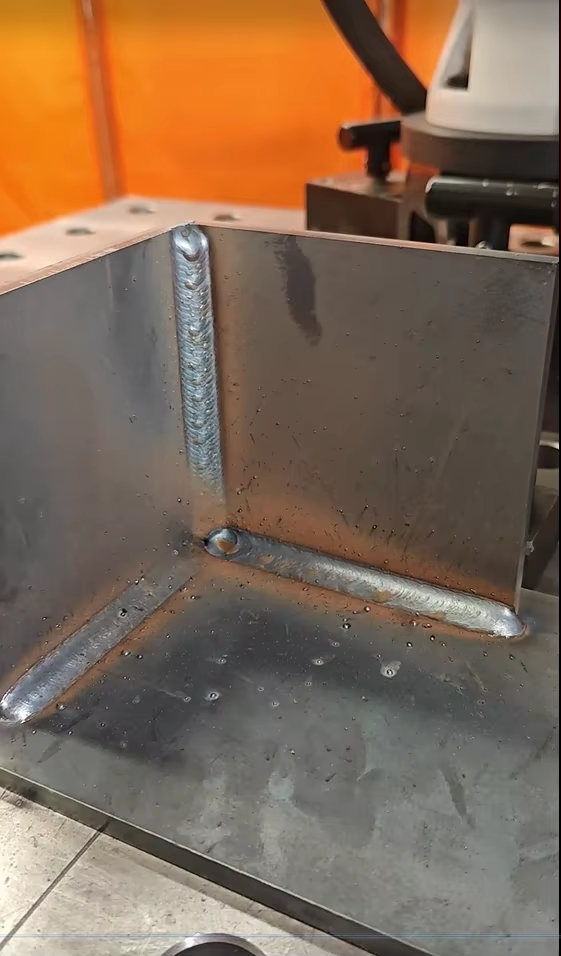
This precision is vital for Istanbul’s “mega-projects.” When building a station canopy or a complex rail junction, components must fit perfectly. A deviation of even a few millimeters can lead to massive delays on-site. The ±45° laser beveling ensures that the “fit-up” is airtight, reducing the amount of filler wire needed during welding and significantly speeding up the assembly of large-scale railway skeletons.
Specialized Challenges of H-Beam Geometry
Cutting an H-beam is significantly more complex than cutting a flat sheet of metal. An H-beam consists of two parallel flanges connected by a central web. This geometry creates “shadowing” issues and requires a sophisticated clamping and rotation system.
The 12kW H-beam machines deployed in Istanbul typically utilize a multi-chuck system—often three or four independent chucks—that can rotate the massive beam with sub-millimeter accuracy. This allows the laser head to access all four sides of the beam and the internal web. The software controlling these machines must be world-class, capable of calculating the “beam compensation” required when the laser hits the curved radius where the web meets the flange.
Furthermore, these machines are designed to handle the heavy weights associated with Istanbul’s rail infrastructure. We are talking about beams that can be 12 meters long and weigh several tons. The integration of automated loading and unloading conveyors ensures that the 12kW laser isn’t waiting for a crane, keeping the duty cycle high and the “green light” time maximized.
Impact on Istanbul’s Urban and Suburban Rail Projects
The application of this technology is visible across Istanbul’s landscape. The city is currently expanding its metro lines (such as the M7 and M11) and upgrading the suburban rail links that connect the European side to the Anatolian side.
1. **Station Frameworks:** The architectural designs for new Istanbul metro stations often feature exposed structural steel. These designs require clean, aesthetic cuts that only a laser can provide. The ±45° beveling allows for seamless “tree-column” structures where multiple H-beams converge at various angles.
2. **Overhead Line Equipment (OLE) Supports:** The masts that hold the electrical wires for the railways must be durable and standardized. The 12kW laser can churn out hundreds of these supports with identical precision, ensuring that the entire rail line is uniform.
3. **Bridge and Viaduct Reinforcements:** For the elevated sections of the railway, H-beams serve as critical bracing. The ability to laser-cut these with pre-beveled edges means the structural welding can be performed to the highest international safety standards (such as EN 1090), which is a requirement for modern Turkish infrastructure projects.
Economic Efficiency and Sustainability
From a fiber laser expert’s perspective, the move to 12kW H-beam cutting in Istanbul isn’t just about speed; it’s about the bottom line. Traditional methods are incredibly labor-intensive. By automating the beveling and cutting, a fabrication shop can reduce its labor costs by up to 60% for a given project.
Moreover, there is the factor of material utilization. High-end laser software includes “nesting” capabilities for 3D profiles. It can calculate how to get the most parts out of a single 12-meter H-beam, minimizing the “tailing” or scrap. In an era where steel prices are volatile, saving 5% of material on a massive railway project can equate to hundreds of thousands of dollars.
From a sustainability standpoint, fiber lasers are significantly more energy-efficient than older CO2 lasers or plasma systems. They convert more electricity into light, and because they cut so much faster, the total energy consumed per meter of cut is much lower. For Istanbul, a city aiming to modernize with an eye on environmental impact, this “green” efficiency is a significant secondary benefit.
Conclusion: The Future of Turkish Infrastructure
The 12kW H-Beam Laser Cutting Machine with ±45° beveling is more than just a tool; it is a catalyst for Istanbul’s industrial evolution. As the city continues to build deeper metros, longer bridges, and faster rail links, the reliance on high-precision fiber laser technology will only grow.
By eliminating the manual labor of the past and replacing it with the digital precision of the 12kW laser, Istanbul’s fabrication industry is setting a new standard for the Middle East and Europe. These machines ensure that the “Iron Silk Road” passing through Turkey is built on a foundation of perfect geometry, superior weld quality, and industrial efficiency. For the fiber laser expert, seeing these 5-axis heads dance around a heavy H-beam is a glimpse into the future of global construction—a future where Istanbul is leading the way.