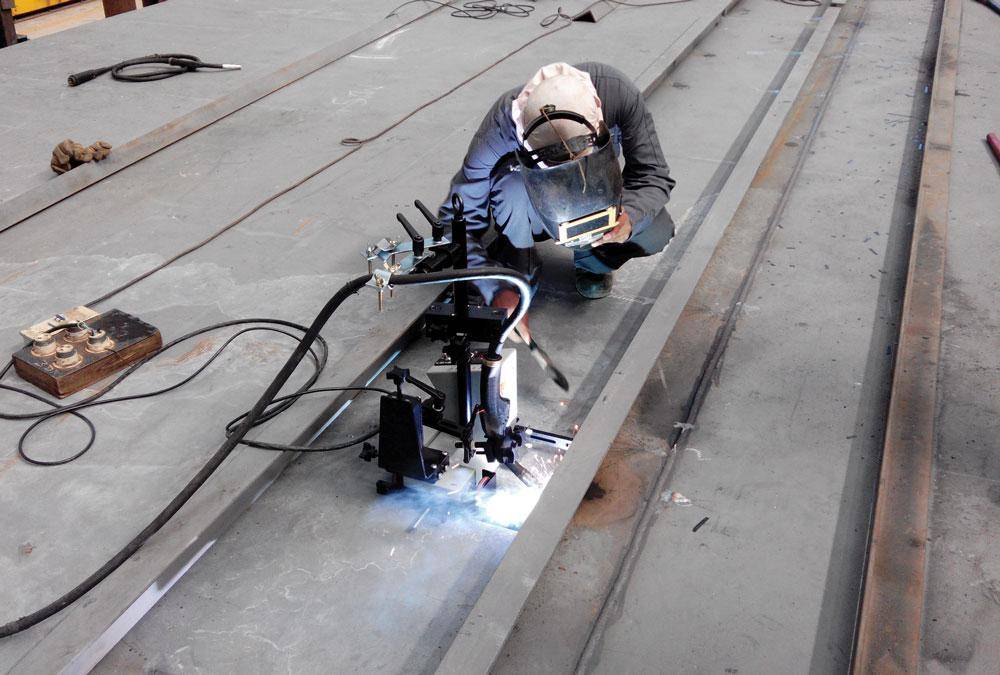
The Paradigm Shift: From Mechanical Sawing to 12kW Fiber Laser Precision
For decades, the fabrication of H-beams and structural profiles for storage racking relied on a sequence of mechanical sawing, radial drilling, and manual oxy-fuel or plasma beveling. This traditional workflow was not only labor-intensive but also prone to cumulative tolerances that complicated the assembly of high-bay racking systems. The arrival of the 12kW H-Beam Fiber Laser in the Katowice industrial corridor has condensed these multiple steps into a single, automated process.
At 12kW, the fiber laser operates in a power density bracket that allows for “high-speed fusion cutting.” Unlike lower-power alternatives, a 12kW source provides the necessary photon density to maintain a stable molten pool even when traversing the thick flanges of heavy-duty H-beams. This power level is the “sweet spot” for storage racking, where structural integrity is paramount. It allows for the rapid piercing of thick-walled sections (up to 20mm or more) with minimal Heat Affected Zones (HAZ), ensuring that the metallurgical properties of the S235 or S355 steel commonly used in racking remain uncompromised.
Mastering the Geometry: The Mechanics of ±45° Bevel Cutting
In the world of structural steel, a straight 90-degree cut is rarely sufficient. For storage racking—especially those designed for seismic zones or heavy-load industrial environments—welding preparation is a critical phase. This is where the ±45° bevel cutting capability becomes the most significant technological lever.
The machine utilizes a sophisticated 5-axis 3D cutting head. Unlike standard 2D lasers, this head can tilt and rotate with high dynamic precision. The ±45° range allows for the creation of V, Y, X, and K-shaped weld preparations directly on the H-beam. In Katowice’s fabrication shops, this eliminates the need for secondary grinding or plasma torching. By integrating the beveling into the laser cutting cycle, the part moves directly from the laser bed to the welding robot. The precision of a laser-cut bevel ensures a consistent “root gap” and “land face,” which are essential for high-quality automated welding, reducing the volume of filler wire needed and significantly lowering the risk of weld defects.
Specific Applications in Storage Racking Production
Storage racking is an industry of repetition and precision. Whether it is the upright frames, the horizontal load beams, or the bracing, every component must interlock with millimeter accuracy to ensure the safety of the entire structure.
1. **Upright Profiles:** The 12kW laser allows for the intricate “teardrop” or rectangular punching patterns to be cut into heavy H-beams used in high-density racking. The speed of the 12kW source means hundreds of these holes can be cut in minutes with no tool wear, unlike traditional mechanical punches.
2. **Interlocking Joints:** Modern racking often uses boltless or semi-boltless connections. The 3D laser head can cut complex tabs and slots into the H-beam ends, allowing for “jigsaw” style assembly that increases the structural rigidity of the rack.
3. **Cantilever Arms:** For racking designed to hold long loads (like timber or steel pipes), the 12kW laser can cut the tapered profiles and the mounting bevels of the cantilever arms in one pass, ensuring a perfect fit against the central column.
Why Katowice? The Strategic Industrial Context
Katowice and the wider Upper Silesian region represent the heart of Poland’s heavy industry. The region’s proximity to major steel mills and its role as a logistics hub for Central and Eastern Europe make it the ideal location for a storage racking manufacturing powerhouse.
By adopting 12kW technology, Katowice-based firms are moving up the value chain. They are no longer just “steel bashers” but high-tech engineering firms. The local labor market, rich in metallurgical expertise, has adapted quickly to the CNC programming requirements of 5-axis laser cutting. Furthermore, the ability to produce “Ready-to-Assemble” (RTA) structural components allows these companies to export racking systems across Europe with lower shipping costs, as the precision of the laser cuts allows for tighter nesting and more efficient transport of unassembled parts.
The Technical Edge: 4-Chuck Systems and Material Handling
A 12kW laser is only as good as its ability to hold and move the material. For H-beams, which are inherently heavy and sometimes exhibit slight “twist” or “bow” from the mill, a specialized chucking system is required.
The premier machines in this class often utilize a four-chuck system. This configuration provides “zero-tailing” waste, a critical factor when dealing with expensive structural steel. The four chucks work in tandem to support the H-beam throughout the entire cutting envelope, even during the ±45° beveling of the very end of the beam. This prevents “sag” which could ruin the precision of the bevel angle. For a manufacturer in Katowice, reducing material waste by even 5% through better nesting and zero-tailing can result in tens of thousands of Euros in annual savings, effectively paying for the machine’s footprint over time.
Software Integration: From BIM to the Factory Floor
In the modern construction and warehousing era, Building Information Modeling (BIM) is the standard. The 12kW H-Beam Laser is fully integrated into this digital ecosystem. Software such as Tekla Structures or SolidWorks can export files directly to the laser’s CAM (Computer-Aided Manufacturing) system.
The software automatically calculates the complex kinematics required for the ±45° bevel. For example, when cutting a bevel on the flange of an H-beam, the software adjusts the laser’s focal point and gas pressure in real-time to account for the changing thickness of the material as the head tilts. This “intelligent cutting” ensures that the quality of the cut at a 45-degree angle is just as clean as a 90-degree cut, with no dross or slag accumulation on the underside of the beam.
Energy Efficiency and Sustainability in Polish Manufacturing
The transition to 12kW fiber lasers also aligns with the European Green Deal and the push for more sustainable manufacturing in Poland. Fiber lasers are significantly more energy-efficient than the older CO2 laser technology or plasma cutting.
The “wall-plug efficiency” of a fiber laser is roughly 30-40%, compared to 10% for CO2. Furthermore, the precision of the laser reduces the need for secondary processes, which in turn reduces the total energy consumption per ton of steel processed. In Katowice, where energy costs are a significant factor in industrial overhead, the high throughput of a 12kW machine means that the energy cost per part is lower than that of a less powerful, slower machine.
The Expert Verdict: A New Standard for Structural Steel
As a fiber laser expert, it is clear that the 12kW H-Beam Laser with ±45° beveling is not just an incremental upgrade; it is a fundamental shift in how structural steel for storage racking is conceived and executed. For the factories in Katowice, this technology solves the “Iron Triangle” of manufacturing: it increases speed, improves quality, and reduces cost simultaneously.
The ability to handle H-beams with such dexterity allows for more creative and safer racking designs. Engineers can now specify complex joint geometries and precise weld preps that were previously too expensive to produce. As the Katowice region continues to cement its status as a European manufacturing leader, the 12kW fiber laser will be the cornerstone of its structural steel industry, providing the precision needed to build the massive, automated warehouses of the future.
In conclusion, the integration of 12kW power and 5-axis beveling represents the pinnacle of current laser application. For storage racking manufacturers, it is the difference between being a local supplier and a global industry leader. The machines operating in Katowice today are not just cutting steel; they are cutting the path for the next generation of industrial infrastructure.