Introduction to High-Power laser cutting in Monterrey’s Industrial Sector
Monterrey, Nuevo León, has long been recognized as the industrial capital of Mexico. With its strategic proximity to the United States and a robust infrastructure supporting the automotive, aerospace, and home appliance industries, the demand for precision metal fabrication has reached unprecedented levels. At the center of this manufacturing evolution is the 12kW fiber laser cutting machine. As industries shift toward “nearshoring,” Monterrey-based fabricators are increasingly adopting high-wattage fiber lasers to maintain a competitive edge in speed, precision, and cost-effectiveness.
The 12kW fiber laser represents a significant technological leap from the 4kW and 6kW systems that were industry standards just a few years ago. For stainless steel applications—a material prized for its corrosion resistance and aesthetic appeal—the 12kW power level offers a unique balance. It provides enough energy to maintain high feed rates on medium-thickness plates while ensuring a clean, oxide-free edge that meets the rigorous standards of the medical, food processing, and petrochemical sectors prevalent in the Santa Catarina and Apodaca industrial parks.
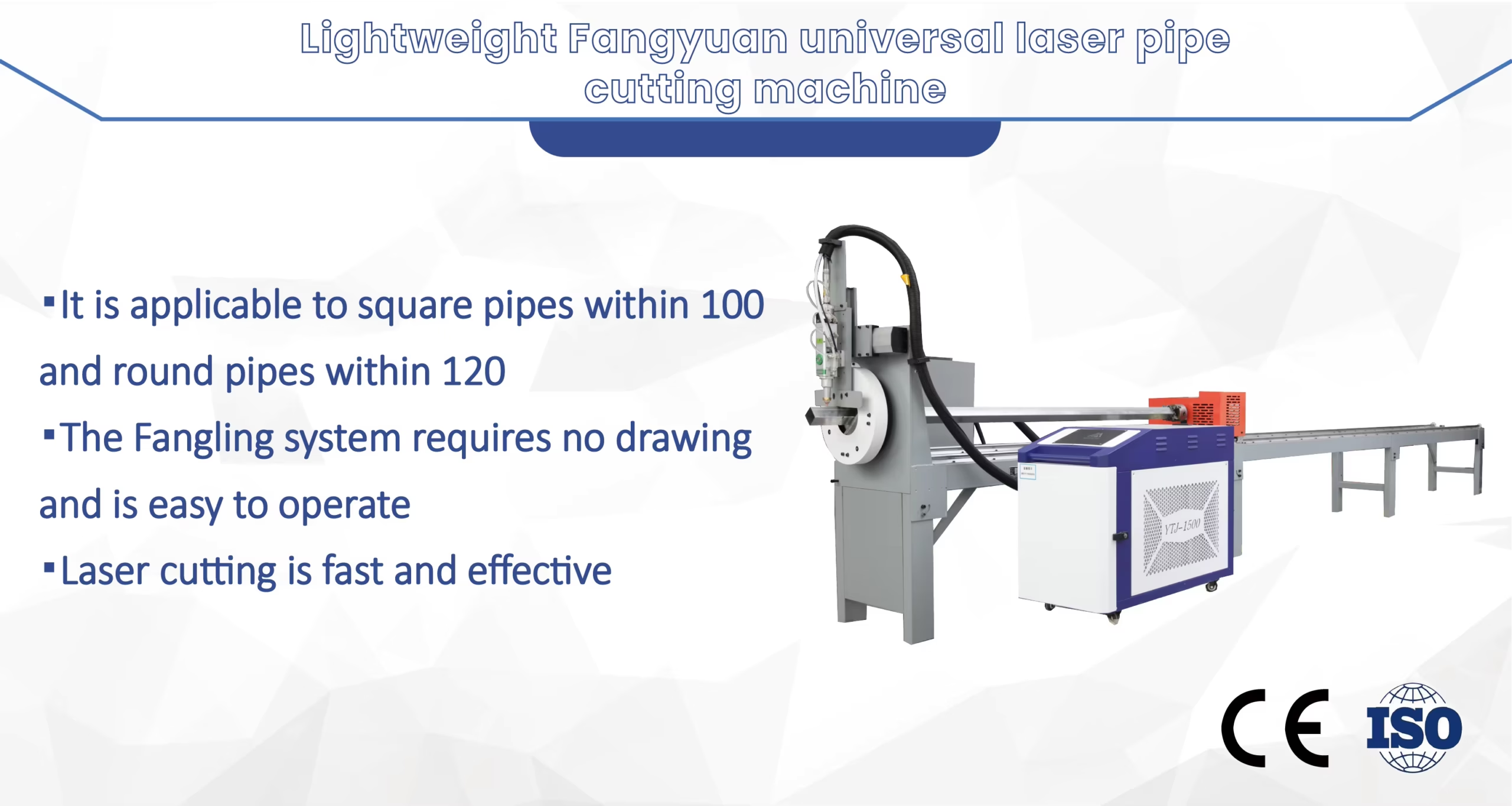
The Technical Superiority of 12kW Fiber Laser Technology
The core of a 12kW fiber laser cutting machine lies in its ability to concentrate a massive amount of energy into a microscopic focal point. Unlike traditional CO2 lasers, fiber lasers use a solid-state gain medium, typically ytterbium-doped optical fibers. This results in a beam with a shorter wavelength (approximately 1.064 micrometers), which is more readily absorbed by metals, particularly stainless steel. This absorption efficiency is the primary driver behind the machine’s high cutting speeds.
When operating at 12,000 watts, the laser cutting process undergoes a transition in physics. For thinner stainless steel sheets (1mm to 3mm), the speed is limited more by the machine’s motion system (acceleration and jerk) than by the laser power itself. However, as we move into the 6mm to 20mm range, the 12kW power becomes the defining factor. It allows for “high-speed nitrogen cutting,” where the high-pressure gas expels the molten metal so quickly that the heat-affected zone (HAZ) remains negligible, preventing warping and preserving the material’s structural integrity.
Stainless Steel Fabrication Challenges and Solutions
Stainless steel, specifically grades 304 and 316L, is a staple in Monterrey’s manufacturing output. However, it presents specific challenges for laser cutting. Its lower thermal conductivity compared to carbon steel means heat tends to stay localized, which can lead to “self-burning” or dross accumulation if the parameters are not perfectly tuned. Furthermore, the reflective nature of stainless steel can potentially damage the laser source if back-reflections are not managed by advanced optical isolators.
Optimizing Edge Quality with Assist Gases
In the context of 12kW laser cutting, the choice of assist gas is critical. For stainless steel, Nitrogen is the gold standard. Since Nitrogen is an inert gas, it prevents oxidation at the cut edge. This is vital for Monterrey manufacturers who supply the food and beverage industry, where any oxidation or “charring” on a cut edge could lead to bacterial growth or corrosion over time. A 12kW system provides the necessary energy to maintain a high-pressure nitrogen flow (often exceeding 20 bar) to ensure a “silver” or “bright” finish on the cut surface, eliminating the need for secondary polishing or cleaning operations.
For thicker sections of stainless steel (above 25mm), some operators may experiment with Oxygen-assisted cutting to utilize the exothermic reaction for extra piercing power. However, this results in a black, oxidized edge. With 12kW of power, the necessity for Oxygen is greatly reduced, allowing fabricators to cut thicker plates with Nitrogen than was previously possible with lower-power machines, thus maintaining the aesthetic and chemical properties of the stainless steel throughout the entire thickness range.

Piercing Technology and Speed Advancements
One of the most significant bottlenecks in laser cutting is the piercing time—the moment the laser takes to break through the material before starting the cut. A 12kW fiber laser utilizes “Flash Piercing” or “Multi-stage Piercing” techniques. Because of the high power density, a 12kW machine can pierce a 12mm stainless steel plate in a fraction of a second, whereas a 6kW machine might take several seconds. Over a complex nest of hundreds of parts, these saved seconds translate into hours of increased productivity per shift, a critical factor for Monterrey’s high-volume production environments.
Economic Impact on the Monterrey Manufacturing Hub
The investment in a 12kW fiber laser cutting machine in Monterrey is often justified by the “cost per part” metric rather than the initial capital expenditure. As the local market becomes more competitive due to the influx of international Tier 1 and Tier 2 suppliers, the ability to produce more parts in less time is the primary driver of profitability. A 12kW system can often replace two or three older 4kW machines, reducing the footprint required in expensive industrial real estate and lowering labor costs.
Energy Efficiency and Operational Costs
While 12,000 watts sounds like a high energy requirement, fiber laser technology is remarkably efficient. The wall-plug efficiency of a fiber laser (the ratio of optical output power to electrical input power) is typically around 30% to 35%, compared to the 8% to 10% efficiency of older CO2 lasers. In Monterrey, where industrial electricity rates are a significant operational consideration, the lower power consumption per cut—combined with the elimination of laser gases like Helium and CO2—results in a significantly lower overhead.
Integration with Industry 4.0
Modern 12kW laser cutting systems are rarely standalone units. In Monterrey’s advanced factories, these machines are integrated into Industry 4.0 workflows. They feature real-time monitoring of nozzle condition, protective window temperature, and gas pressure. Through IoT connectivity, production managers in Monterrey can monitor the machine’s performance from their mobile devices, receiving alerts if the cutting speed drops or if there is a deviation in the beam quality. This level of data-driven manufacturing ensures that the stainless steel components produced meet the exact tolerances required by the automotive and aerospace export markets.
Maintenance and Safety Protocols for High-Power Lasers
Operating a 12kW laser requires a higher level of technical expertise and stricter safety protocols. The intensity of the 1.064μm beam is invisible to the human eye and can cause permanent damage instantaneously. Therefore, these machines must be operated within a fully enclosed Class 1 laser safety housing. In Monterrey, where labor safety regulations (NOM standards) are strictly enforced, ensuring that all safety interlocks and filtration systems are functional is paramount.
The Importance of Optical Maintenance
For a 12kW system, the “health” of the cutting head is the most critical maintenance factor. The high power levels mean that even a microscopic speck of dust on the protective window can absorb enough energy to shatter the lens or damage the internal optics. Monterrey shops must implement “clean room” protocols when changing consumables. Furthermore, the cooling system (chiller) must be meticulously maintained. A 12kW laser generates significant heat within the laser source and the cutting head; any fluctuation in the deionized water temperature can lead to beam instability and poor cut quality on stainless steel.
Nozzle Calibration and Beam Alignment
To achieve the “perfect cut” on stainless steel, the nozzle must be perfectly centered with the laser beam. High-power machines often feature automated nozzle changers and automated centering systems. In a 24/7 production environment like those found in Monterrey’s Guadalupe or Escobedo districts, automation reduces human error and ensures that the 12kW of power is directed exactly where it is needed, preventing wasted material and reducing the amount of scrap generated during the laser cutting process.
Conclusion: The Future of Metalworking in Monterrey
The 12kW fiber laser cutting machine is no longer a luxury for Monterrey’s metalworking industry; it is a necessity for those looking to compete on a global scale. By mastering the nuances of stainless steel fabrication—from gas selection to high-speed piercing—local manufacturers can provide world-class components to the international market. As fiber laser technology continues to evolve, with even higher wattages becoming available, the 12kW remains the “sweet spot” for versatility, offering the perfect combination of speed for thin materials and raw power for thick plates.
For engineers and business owners in Monterrey, the transition to high-power laser cutting represents an investment in the future. It is a commitment to precision, efficiency, and the continued growth of Mexico’s industrial heartland. By leveraging the capabilities of a 12kW system, Monterrey continues to prove that it is not just a hub for assembly, but a center for advanced, high-tech manufacturing excellence.