Technical Field Report: High-Power Structural Laser Integration in Hamburg Maritime Fabrication
1.0 Introduction and Site Context
This report evaluates the deployment and operational performance of a 12kW CNC Beam and Channel Laser Cutter equipped with a 5-axis ±45° beveling head within the maritime manufacturing sector of Hamburg, Germany. The Hamburg shipyards represent one of the most demanding environments for structural steel, requiring strict adherence to DIN EN 1090-2 standards and DNV-GL certification requirements. The transition from traditional plasma arc cutting and mechanical milling to high-brightness 12kW fiber laser technology marks a critical shift in the processing of H-beams, U-channels, and heavy-walled hollow sections (RHS/SHS).
2.0 Kinematic Architecture and Multi-Axis Synchronization
The system under review utilizes a sophisticated kinematic chain designed to handle the mass and inertia of structural members up to 12,000mm in length. Unlike flat-sheet lasers, the beam and channel cutter operates on a Chuck-Rotation-Feed (CRF) logic or a moving-bridge architecture. In the Hamburg facility, the 12kW system employs a triple-chuck synchronized drive to maintain axial alignment of heavy beams during high-speed rotation.
The CNC controller manages a minimum of seven simultaneous axes (X, Y, Z, A, B, C, and W) to facilitate the movement of the laser head around the static or rotating profile. For the ±45° beveling capability, the B and C axes (tilt and rotation) are critical. The integration of high-resolution absolute encoders ensures that the “pivot point” of the laser focus remains constant relative to the material surface, even when transitioning between the flange and the web of an H-beam.
3.0 The ±45° Beveling Mechanism: Weld Preparation Precision
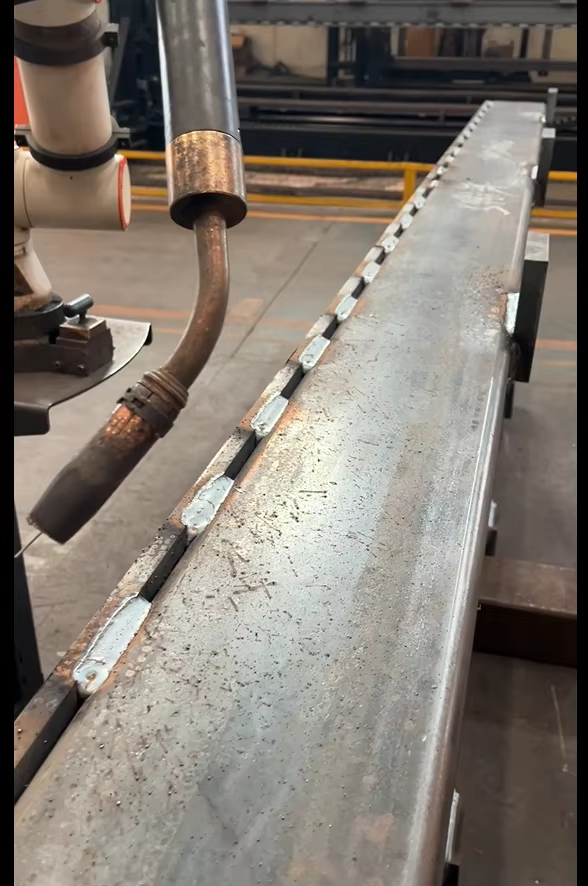
In shipbuilding, the integrity of the weld joint is paramount. Traditionally, V, Y, and K-type bevels were achieved via manual oxy-fuel cutting or secondary CNC milling—both of which introduce significant thermal stress or excessive labor costs. The ±45° 3D laser head eliminates these secondary processes by performing the cut and the bevel in a single pass.
3.1 Geometric Tolerance and Kerf Control
The 12kW source allows for a narrower kerf compared to plasma, typically ranging from 0.3mm to 0.8mm depending on material thickness. When executing a 45° bevel, the “effective thickness” of the material increases (e.g., a 20mm flange cut at 45° presents a 28.28mm path to the laser). The CNC must dynamically adjust the feed rate and gas pressure to maintain a stable molten pool. In Hamburg’s testing phase, the system achieved a surface roughness (Rz) of less than 40μm on S355J2+N steel, significantly reducing the post-cut grinding required for ultrasonic weld testing compliance.
3.2 Thermal Input Management
The 12kW fiber laser delivers a high energy density that results in a minimal Heat Affected Zone (HAZ). This is particularly vital for the high-strength steels used in hull reinforcements. By maintaining a high processing speed (often 3-4x faster than plasma for 15mm sections), the total heat input per millimeter is reduced, preventing grain growth and brittleness in the base metal—a critical factor for ships navigating high-stress maritime environments.
4.0 Synergy of 12kW Fiber Sources and Heavy Structural Processing
The leap to 12kW is not merely about speed; it is about “piercing stability” and “edge perpendicularity” in thick-walled members. In the Hamburg shipyard application, the 12kW source is optimized for processing beams with flange thicknesses up to 35mm.
4.1 Piercing Protocols
Using frequency-modulated piercing (burst piercing), the 12kW system penetrates 25mm structural steel in under 1.5 seconds with minimal spatter. This protects the laser optics and ensures that the subsequent beveling path starts from a clean datum point. In the context of “Channel” profiles (U-sections), where the internal radius often presents a varying thickness, the 12kW reserve power allows the CNC to maintain a constant cutting speed without the risk of “drossing” at the transition points.
4.2 Assist Gas Optimization
For maritime applications, the choice between Oxygen (O2) and Nitrogen (N2) is dictated by the coating requirements of the shipyard. The 12kW system in Hamburg utilizes High-Pressure Nitrogen for sections up to 12mm to ensure an oxide-free surface, allowing for immediate primer application without acid pickling. For heavier sections (15mm+), high-purity Oxygen is used with a focused beam diameter of 200μm, balancing speed and edge quality.
5.0 Automatic Structural Processing and Workflow Integration
The Hamburg facility integrates the laser cutter directly with TEKLA and SDS/2 BIM software. The “Automatic Structural Processing” workflow involves several automated subsystems:
- Mechanical Probing and Centering: Structural beams often possess inherent “bow” or “twist” from the rolling mill. The system utilizes laser line sensors to map the actual geometry of the beam before cutting. The CNC then offsets the programmed path in real-time to ensure the bevel is relative to the actual face of the material.
- Automatic Loading/Unloading: Given the weight of ship-building profiles (up to 200kg/m), hydraulic drag-chain loading systems are synchronized with the laser’s CNC to ensure continuous operation, minimizing “beam-to-beam” cycle times.
- Nesting Efficiency: Advanced nesting algorithms for 3D profiles allow for “common line cutting” even with bevels, which has resulted in a measured 12% reduction in scrap material at the Hamburg site compared to traditional saw-and-drill lines.
6.0 Field Observations: Solving Efficiency Bottlenecks
Prior to the implementation of the 12kW CNC laser, the shipyard faced a bottleneck in the “Fit-up and Tack” stage. Traditional cutting methods resulted in gaps of 2-4mm in complex joints, necessitating heavy weld fill and increasing the risk of distortion.
With the 12kW ±45° laser, the fit-up precision has improved to ±0.5mm. This high-fidelity fit-up is a prerequisite for the transition to robotic welding cells. The laser-cut bevels provide a consistent root face and land, allowing for “Single-Pass” welding on sections that previously required three or four passes. In the Hamburg sector, this has translated to a 30% increase in throughput for modular deck sections.
7.0 Maintenance and Operational Longevity
Operating in a coastal environment like Hamburg introduces the challenge of salinity and humidity. The 12kW system is housed in a pressurized, climate-controlled enclosure for the power source and the beam delivery path. The use of “Focus Monitor” technology allows the engineering team to track the health of the protective windows and the BPP (Beam Parameter Product) degradation in real-time, ensuring that the 12kW output remains consistent through long-duration cuts (exceeding 60 minutes for complex nested beams).
8.0 Conclusion
The integration of a 12kW CNC Beam and Channel Laser with ±45° beveling technology represents a paradigm shift for Hamburg’s heavy steel and shipbuilding industry. By merging high-power fiber laser density with multi-axis kinematic precision, the technology solves the dual challenges of geometric accuracy and production speed. The ability to produce “weld-ready” structural members directly from raw stock significantly reduces the total cost of ownership and the carbon footprint of the fabrication process. Future developments should focus on the further integration of AI-driven vision systems to detect mill-scale inconsistencies, further refining the automated processing of heterogeneous steel batches.
Report End.
Technical Assessment Validated by: Senior Engineering Lead, Structural Steel Division.













