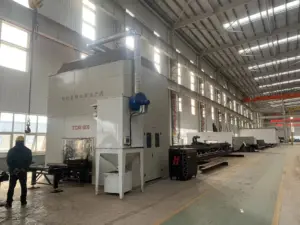
The Dawn of 12kW Power in Structural Fabrication
For decades, the structural steel industry relied on oxy-fuel and plasma arc cutting to manage the thick-walled beams and channels required for heavy machinery. While functional, these methods brought significant drawbacks: large heat-affected zones (HAZ), dross accumulation, and lower dimensional accuracy. The introduction of the 12kW fiber laser has fundamentally altered this landscape.
As a fiber laser expert, I have seen the transition from 4kW and 6kW systems to the now-standard “high-power” 12kW threshold. At 12,000 watts, the laser density is sufficient to pierce through thick-gauge structural carbon steel and abrasion-resistant (AR) alloys—common in mining—with a narrow kerf and minimal thermal distortion. The increased power doesn’t just mean thicker cutting; it means exponentially faster feed rates on mid-range thicknesses. For a Houston-based fab shop, this translates to a massive increase in throughput, allowing for the rapid prototyping and mass production of mining chassis and support structures that previously bottlenecked at the cutting station.
The Geometry of Success: ±45° Bevel Cutting
The most significant hurdle in structural fabrication for mining machinery is not the straight cut, but the weld preparation. Mining equipment is subject to extreme cyclic loading, vibration, and impact. Consequently, every joint must be perfectly prepared for full-penetration welds. Traditional beam lines could cut a channel to length, but a technician would then have to manually grind a bevel into the edge to create a V-groove or J-groove for the welder.
The 12kW CNC Beam and Channel Laser Cutter equipped with a 5-axis 3D head changes the game. By articulating the cutting head up to ±45°, the machine can perform complex beveling directly on the flanges and webs of a beam. This capability allows for the creation of intricate interlocking joints and precision weld preps in a single setup. When the laser creates a bevel, the edge is mathematically precise and chemically clean. There is no carbonization or slag to remove, meaning the beam can go straight from the laser bed to the welding robot, saving hours of labor per component.
Processing Channels and Beams: The 3D Challenge
Unlike flat-sheet lasers, a beam and channel cutter must manage the “shadowing” and physical interference of the structural shape itself. A 12kW system designed for Houston’s heavy industry typically utilizes a specialized rotary chuck system and a series of supportive conveyors.
When processing an I-beam or a C-channel, the CNC must account for the radius of the inner corners and the varying thickness between the web and the flange. The 12kW power source is critical here because it provides the “headroom” necessary to maintain a constant cutting speed even as the laser transitions through the thicker root of a structural member. The software integration—often utilizing advanced CAD/CAM plugins—allows the laser to “wrap” its path around the 3D object, ensuring that holes, slots, and bevels are perfectly aligned across all planes of the steel profile.
Mining Machinery: Built for the World’s Harshest Environments
The mining industry requires machinery that can withstand the abrasive nature of ore processing and the structural demands of deep-earth extraction. Components such as vibratory screens, conveyor frames, crushers, and underground roof supports are the backbone of this sector. Houston, being a central hub for equipment exporters, services both domestic Appalachian mining and international projects in Australia and South America.
Using a 12kW laser to fabricate these parts offers a distinct metallurgical advantage. High-strength, low-alloy (HSLA) steels and AR plates (like Hardox or Weldox) are notoriously difficult to cut without affecting their tempered properties. The high speed of a 12kW fiber laser ensures that the heat input into the material is kept to an absolute minimum. This preserves the hardness and integrity of the steel right up to the cut edge, which is vital for parts that will face constant friction and impact in a mine.
Houston’s Strategic Edge in Industrial Laser Adoption
Houston is uniquely positioned to leverage this technology. With its proximity to the Port of Houston and a massive infrastructure of steel service centers, the city acts as a funnel for raw materials. A 12kW CNC beam laser in a Houston facility can take raw stock directly from the mill and transform it into a high-value, precision-engineered component for a mining OEM (Original Equipment Manufacturer) within the same zip code.
Furthermore, the concentration of technical expertise in Houston means that maintenance and gas supply—critical for 12kW operations—are readily available. High-power lasers require high-purity nitrogen or oxygen as assist gases. Houston’s established energy infrastructure ensures that these consumables are cost-effective, allowing local shops to maintain a lower cost-per-part than competitors in less industrialized regions.
ROI and Operational Efficiency: Beyond the Initial Investment
A 12kW CNC laser with beveling capability represents a significant capital expenditure. However, from an expert’s perspective, the Return on Investment (ROI) is found in the “hidden” savings.
1. **Labor Reduction:** By eliminating manual beveling and secondary grinding, you reduce the man-hours required for every ton of steel processed.
2. **Consumable Savings:** Fiber lasers are significantly more energy-efficient than older CO2 models, and modern nozzles reduce gas consumption.
3. **Material Yield:** Advanced nesting software for beams and channels minimizes “drop” (waste material), which is crucial when working with expensive, high-grade mining steels.
4. **Accuracy:** The ±0.05mm accuracy of a laser ensures that large-scale mining assemblies fit together perfectly the first time, preventing costly field rework.
The Future: Automation and the Digital Twin
Looking forward, the 12kW CNC beam cutters arriving in Houston are increasingly integrated into the “Industry 4.0” ecosystem. These machines can feed data back to the cloud, monitoring lens temperature, gas pressure, and cutting speed in real-time. For mining machinery manufacturers, this means every beam can be tracked with a digital twin, ensuring that the structural integrity of a massive excavator or a longwall miner is documented from the very first cut.
The ±45° beveling head is also becoming more intelligent. Modern sensors can detect the slight deviations in a structural beam—which are never perfectly straight from the mill—and adjust the laser’s path in real-time to compensate. This “active sensing” ensures that even on a 40-foot I-beam, every bevel is consistent.
Conclusion
The 12kW CNC Beam and Channel Laser Cutter is more than just a cutting tool; it is a specialized manufacturing platform that addresses the specific pain points of the mining machinery industry. In the competitive industrial landscape of Houston, the ability to produce weld-ready, high-precision structural components at 12kW speeds is a game-changer. By embracing the power of fiber optics and the versatility of multi-axis beveling, Houston fabricators are not just cutting steel—they are engineering the future of global heavy industry. The precision of the ±45° cut today ensures the durability of the mining infrastructure that will fuel the world tomorrow.