
The Dawn of High-Power Structural Fabrication in Riyadh
As Saudi Arabia continues to diversify its economy under the mandate of Vision 2030, the industrial landscape of Riyadh has transformed into a high-tech hub for manufacturing. One of the most significant advancements in this transformation is the deployment of 12kW CNC fiber laser systems designed specifically for structural profiles such as I-beams, H-beams, and C-channels. Traditionally, the fabrication of these components for offshore platforms—rigs, jackets, and subsea structures—relied on mechanical sawing, drilling, and manual oxy-fuel or plasma cutting. However, the 12kW fiber laser represents a quantum leap in capability.
In the context of Riyadh’s industrial zones, where temperatures can soar and dust mitigation is critical, these machines are engineered for resilience. A 12kW system provides the necessary photon density to slice through thick-walled carbon steel and specialized alloys used in marine environments with a “cold” heat-affected zone (HAZ) compared to plasma. This precision is not just about aesthetics; it is a fundamental requirement for the structural integrity of offshore platforms that must withstand the corrosive and high-pressure environments of the Arabian Gulf and the Red Sea.
The Technical Edge: Why 12kW is the Sweet Spot
For structural steel processing, power is the primary driver of throughput. A 12kW fiber laser offers a unique balance between capital investment and operational efficiency. At this power level, the laser can achieve “high-speed” cutting on beam webs and flanges up to 25mm thick, and “clean-cut” finishes on even thicker sections. The 1.06-micron wavelength of the fiber laser is absorbed rapidly by structural steel, allowing for a concentrated energy delivery that melts and vaporizes the material almost instantaneously.
Furthermore, the 12kW source enables the use of nitrogen or high-pressure air as a shielding gas for thinner sections of offshore modules, resulting in an oxide-free edge. This is critical for offshore applications where paint adhesion and coating integrity are paramount to preventing salt-water corrosion. By eliminating the need for post-cut grinding or cleaning, Riyadh-based fabricators can cut their production cycles by 40-60%, moving components from the laser bed to the welding station in record time.
Advanced CNC Kinematics for Beams and Channels
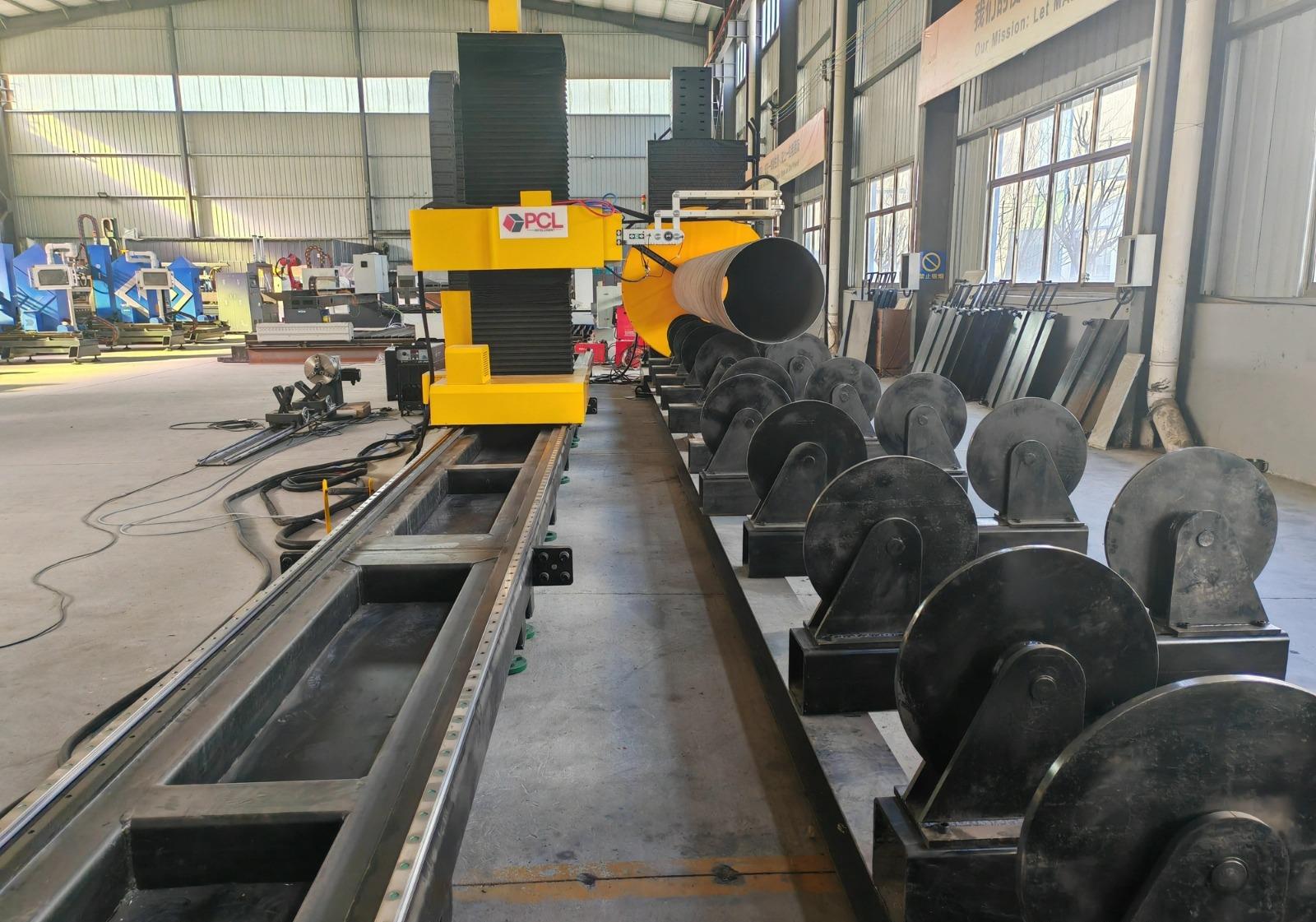
Cutting a flat sheet of metal is two-dimensional; cutting a 12-meter H-beam for an offshore platform requires a multi-axis approach. The 12kW CNC systems deployed in Riyadh feature specialized 3D cutting heads mounted on 5-axis or 6-axis robotic gantries. This allows the laser to move around the profile, cutting bolt holes, coping joints, and complex bevels for weld preparations (such as V, Y, and K-cuts) in a single pass.
For offshore platforms, where modularity and fit-up precision are the difference between a successful installation and a multi-million dollar delay at sea, this accuracy is vital. The CNC control system synchronizes the rotation of the beam with the movement of the laser head, ensuring that every cut is indexed to the beam’s center of gravity. This compensates for the natural “twists” and “camber” often found in raw structural steel, ensuring that the finished part meets the stringent tolerances required by international maritime engineering standards.
Zero-Waste Nesting: The Economic and Environmental Revolution
In the fabrication of offshore platforms, material costs—specifically for high-grade structural steel—represent a massive portion of the budget. Traditional nesting for beams often leaves significant “drops” or “skeletons” that are sold as scrap at a fraction of their original cost. The “Zero-Waste” nesting technology integrated into modern 12kW lasers in Riyadh changes this dynamic entirely.
Zero-Waste nesting uses sophisticated algorithms to analyze the entire production queue. Instead of treating each beam as a single job, the software identifies “common-line” cutting opportunities where one cut serves as the edge for two different parts. More importantly, it features “end-to-end” nesting, where the tail end of one project’s beam is automatically utilized for the start of the next, regardless of the part’s geometry. In a 12kW system, where the kerf (the width of the cut) is incredibly narrow, the software can nest parts with millimeter-level gaps. For a large-scale offshore project, this can improve material utilization by up to 15%, saving hundreds of tons of steel annually and directly contributing to the sustainability goals of the Kingdom.
Meeting the Demands of Offshore Platforms
Offshore platforms are among the most demanding environments for structural engineering. They must endure constant vibration, thermal expansion, and the relentless corrosive force of the sea. The 12kW laser addresses these challenges through the sheer quality of the cut. Smooth, laser-cut edges significantly reduce the risk of stress fractures which can initiate from the micro-cracks often left by mechanical shearing or lower-quality plasma cuts.
In Riyadh’s fabrication centers, these lasers are being used to create “Lego-like” assembly systems for offshore jackets. By laser-cutting interlocking tabs and slots into the beams and channels, fabricators can ensure that the massive structures are self-aligning during the welding process. This reduces the reliance on complex jigs and fixtures and minimizes human error, ensuring that when the modules are transported from the desert to the coast, they fit together with sub-millimeter precision.
Localization and the IKTVA Program
The deployment of these 12kW machines in Riyadh is a strategic move aligned with the In-Kingdom Total Value Add (IKTVA) program. By localizing high-tech fabrication, Saudi Arabia reduces its reliance on imported pre-fabricated steel. Establishing these capabilities in Riyadh allows for a centralized logistics hub that serves both the Eastern Province’s oil fields and the Red Sea’s emerging “giga-projects.”
As a laser expert, I have observed that the success of these installations in the Riyadh climate depends on robust secondary systems. The 12kW resonators require advanced chilling units capable of maintaining a delta-T of less than 1 degree Celsius, even when ambient temperatures exceed 45 degrees. Furthermore, the high-volume dust collection systems are essential for capturing the fine particulate matter generated by high-power cutting, ensuring a clean working environment that meets Saudi environmental regulations.
The Future: AI and Real-Time Monitoring
The next step for 12kW laser cutting in Riyadh is the integration of Artificial Intelligence and real-time sensor feedback. Modern heads are equipped with sensors that monitor the “back-reflection” of the laser beam. If the laser encounters a hard spot or an impurity in the steel beam that could cause a “lost cut,” the CNC system adjusts the power, frequency, and gas pressure in milliseconds to compensate. This level of autonomy is crucial for 24/7 operations, allowing Riyadh’s factories to run “lights-out” shifts to meet the aggressive timelines of offshore energy projects.
Additionally, the data generated by the Zero-Waste software is being integrated into Building Information Modeling (BIM) systems. This allows engineers to track a specific beam from the moment it is cut in Riyadh to its final position on a platform in the Safaniya oil field, providing a digital twin of the entire structural lifecycle.
Conclusion
The 12kW CNC Beam and Channel Laser Cutter is more than just a tool; it is a catalyst for industrial maturity in Saudi Arabia. By combining the raw power required for offshore structural steel with the sophisticated “Zero-Waste” logic needed for modern economic efficiency, Riyadh is positioning itself as a global leader in maritime fabrication. For the engineers and developers building the next generation of offshore platforms, this technology offers the ultimate trifecta: speed, precision, and sustainability. As the Kingdom moves toward a future beyond oil, the very infrastructure that supports the energy sector is being built with the most advanced light-based technology available today.
















