1.0 Introduction: The Structural Mandate for High-Power 3D Laser Processing
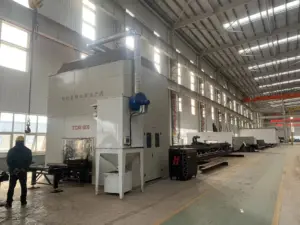
In the current industrial landscape of Riyadh, particularly within the localized crane manufacturing sector supporting Vision 2030 infrastructure projects, the transition from traditional mechanical fabrication to high-power CNC laser processing has become a technical necessity. This report evaluates the deployment of 12kW CNC Beam and Channel Laser Cutters equipped with Infinite Rotation 3D Heads. The primary objective is to assess how this specific configuration addresses the geometric complexities and load-bearing requirements of overhead gantry cranes, tower crane sections, and jib assemblies.
Traditional methods—consisting of band sawing, mechanical drilling, and manual plasma beveling—introduce cumulative tolerances that often exceed the stringent ISO 9001 standards required for heavy-lift equipment. The integration of 12kW fiber laser resonators coupled with 5-axis kinematic heads allows for the consolidation of these multi-stage processes into a single automated cycle, significantly reducing the Heat Affected Zone (HAZ) and improving structural integrity.
2.0 Technical Specifications of the 12kW Fiber Source in Heavy Section Steel
The 12kW fiber laser source represents a critical threshold for crane manufacturing. At this power level, the photon density is sufficient to maintain high feed rates on heavy-walled H-beams (HEA/HEB) and U-channels (UPN) typically used in crane runways and bridge girders.
2.1 Kerf Quality and Thickness Management
In the Riyadh sector, the predominant material is S355JR or S355J2 structural steel. A 12kW source enables high-speed nitrogen or oxygen-assisted cutting of flanges up to 25mm-30mm with minimal striation. For crane booms, where weight reduction is balanced against tensile strength, the ability to cut thinner, high-tensile alloys without introducing micro-fractures is paramount. The 12kW density ensures that the transition between the flange and the web of a beam is handled with localized heat control, preventing the thermal warping common in lower-power plasma systems.
2.2 Energy Efficiency and Piercing Dynamics
The 12kW system utilizes advanced piercing sensors (frequency-based) to penetrate thick-walled structural sections in under 0.5 seconds. This is critical when processing long-span beams that require hundreds of bolt holes for splice plates. The reduction in piercing time directly correlates to a decrease in total cycle time per metric ton of processed steel.
3.0 Infinite Rotation 3D Head: Kinematic Analysis
The “Infinite Rotation” capability of the 3D head is the technological centerpiece of this system. Unlike standard 3D heads that are limited by cable winding and require “unwinding” rotations, the infinite C-axis allows for continuous contouring around the complex profiles of I-beams and channels.
3.1 5-Axis Geometric Flexibility
Crane manufacturing requires complex miter cuts for lattice structures and precise beveling for weld preparation. The 3D head provides ±45° (and in some high-end configurations up to ±60°) of tilt. This allow for the execution of V, Y, K, and X-type bevels directly on the laser bed. For the Riyadh crane industry, where AWS D1.1 structural welding codes are frequently applied, the precision of these bevels ensures full-penetration welds with minimal filler material, reducing post-cut grinding by an estimated 85%.
3.2 Compensation for Structural Deviations
Large-scale beams from steel mills often possess inherent deviations—twists or bows—over their 12-meter lengths. The 3D head, integrated with capacitive height sensing and 3D vision mapping, dynamically adjusts the focal point in real-time. As the head rotates around the radius of a U-channel, it maintains a constant standoff distance, ensuring that the kerf width remains uniform even if the structural section is slightly out of tolerance.
4.0 Application in Crane Manufacturing: Case Analysis in Riyadh
Riyadh’s industrial zones have seen a shift toward modular crane assembly. This requires extremely high precision in the fabrication of end carriages and main girders to ensure perfect alignment of the wheel blocks and drive motors.
4.1 End Carriage Fabrication
The end carriage of an overhead crane is usually a box section or a large U-channel. By using the 12kW laser, manufacturers can cut the wheel block apertures and the motor mounting holes in a single setup. The infinite rotation head allows for the chamfering of the edges to facilitate the welding of internal diaphragms. The accuracy of the hole diameters—held within ±0.1mm—eliminates the need for secondary reaming, which was previously a bottleneck in the Riyadh workshops.
4.2 Lattice Boom and Jib Processing
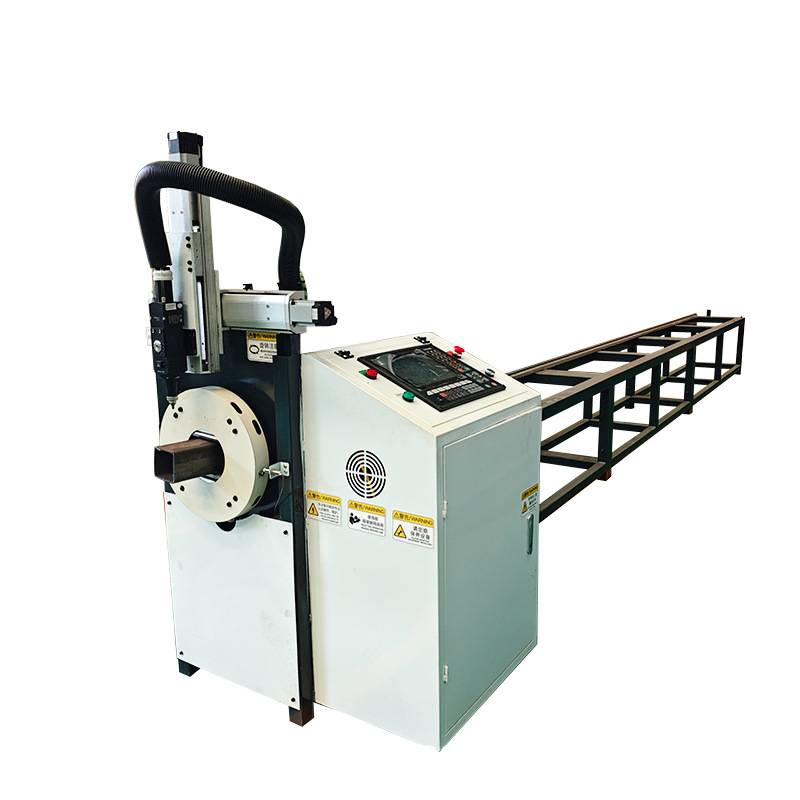
For tower cranes manufactured locally, the lattice members consist of various diameters of circular hollow sections (CHS) and square hollow sections (SHS). The 12kW cutter, equipped with a 4-chuck rotation system, allows the 3D head to perform complex “fish-mouth” cuts. These saddle cuts are essential for the interlocking of tubular members. The infinite rotation ensures that the transition between the top and bottom of the tube is seamless, providing a tight fit-up that is critical for fatigue resistance in high-altitude crane components.
5.0 Synergies with Automatic Structural Processing
The transition from a “cutter” to a “processing center” is achieved through the synergy of the 12kW source and automated material handling. In many Riyadh facilities, these machines are integrated into a digital twin workflow using TEKLA or SDS/2 software.
5.1 Automated Nesting and Loading
The software calculates the optimal nesting of various beam lengths to minimize scrap. Given the high cost of imported structural steel in Saudi Arabia, reducing waste by even 5% provides a significant ROI. The 12kW system’s controller handles the heavy-duty hydraulic chucks that move the beam through the cutting envelope, ensuring that long-span girders (up to 12 or 16 meters) are processed with consistent longitudinal accuracy.
5.2 Elimination of Secondary Operations
The primary advantage observed in field reports is the elimination of the “layout” phase. Traditionally, engineers in Riyadh workshops would manually mark beams using templates. The CNC laser reads the STEP or IGES files directly, executing cuts, holes, and markings for assembly instructions (inkjet or etching) automatically. This reduces human error, which is the leading cause of rework in structural steel fabrication.
6.0 Environmental and Operational Considerations in Riyadh
Operating a high-power 12kW laser in the Riyadh climate presents specific engineering challenges that must be addressed to maintain the 3D head’s precision.
6.1 Thermal Stability and Cooling
The ambient temperatures in Riyadh can exceed 45°C. For a 12kW fiber laser, the chiller capacity must be oversized to maintain the resonator and the 3D cutting head at a stable 22-25°C. Any thermal expansion in the 3D head’s internal optics or the C-axis gears would result in “beam wander,” compromising the accuracy of the bevel. Dual-circuit cooling systems are mandatory for continuous 24/7 operation in these conditions.
6.2 Dust Mitigation and Filtration
Crane manufacturing produces significant particulate matter. The 12kW laser requires a high-volume localized extraction system. In the arid environment of Riyadh, fine sand can also infiltrate the bellows and linear guides. The technical report recommends pressurized bellows and HEPA-grade filtration for the electrical cabinets to protect the CNC controllers and the laser source’s sensitive fiber-to-head coupling.
7.0 Throughput and Economic Impact Assessment
Data collected from Riyadh-based crane fabricators indicates that a 12kW CNC beam laser with a 3D head can replace approximately three conventional processing lines (one saw/drill line and two manual plasma stations).
- Processing Speed: For a standard 400mm I-beam, a 12kW laser can execute a 45-degree miter cut with bolt holes in approximately 90 seconds, compared to 15-20 minutes for manual methods.
- Weld Volume: Precise 3D beveling reduces the volume of weld metal required by up to 30%, as the “root gap” is consistently maintained across the entire profile.
- Labor Allocation: The requirement shifts from manual layout specialists and grinders to CNC technicians and CAD/CAM programmers, elevating the technical capability of the local workforce.
8.0 Conclusion: The Future of Riyadh’s Structural Steel Fabrication
The deployment of 12kW CNC Beam and Channel Laser Cutters with Infinite Rotation 3D Heads represents the pinnacle of current structural steel technology. For the Riyadh crane manufacturing sector, this is not merely an incremental improvement but a fundamental shift in production philosophy. By solving the dual challenges of precision beveling and high-speed processing of thick-walled sections, the technology ensures that the cranes built for the Kingdom’s future meet the highest global standards of safety and efficiency.
As the industry moves toward more complex architectural and industrial designs, the 5-axis capability of these machines will be the deciding factor in a manufacturer’s ability to compete in the high-spec infrastructure market. Continued investment in 12kW+ fiber technology and advanced 3D kinematics is recommended for all Tier-1 structural fabricators in the region.