The Power of 12kW: Redefining Structural Throughput
In the realm of fiber lasers, the jump to 12kW is more than just a numerical upgrade; it is a transition into a new class of industrial capability. For airport construction, where structural members like I-beams, H-beams, and C-channels form the skeletal framework of massive terminal buildings and hangars, the 12kW power source offers the ability to penetrate thick-walled sections with unprecedented speed.
At 12kW, the laser density allows for high-speed nitrogen or oxygen-assisted cutting of carbon steel up to 30mm or 40mm in thickness, which is common in the heavy-duty flanges of structural beams. Unlike plasma cutting, which can leave a wider kerf and a significant heat-affected zone (HAZ), the 12kW fiber laser maintains a narrow, concentrated beam. This results in minimal thermal distortion, ensuring that 12-meter long beams remain perfectly straight after the cutting process—a critical factor when these components must be bolted or welded together with sub-millimeter precision on a job site in Queretaro.
Mastering the Geometry: Beams, Channels, and Profiles
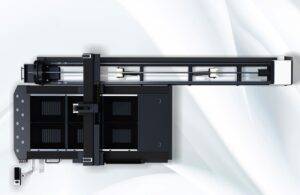
Traditional structural fabrication involves a disjointed workflow: sawing to length, drilling holes on a separate line, and manual torching for notches or coping. A CNC Beam and Channel Laser Cutter consolidates these operations into a single workstation.
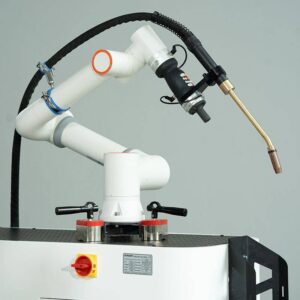
The machine utilizes a sophisticated “through-hole” chuck system or a series of robotic supports that rotate the beam as the laser head moves along the X, Y, and Z axes. This allows for the intricate cutting of holes, slots, and complex “bird-mouth” joints on all sides of a channel or beam in one continuous program. In airport construction, where aesthetics often meet engineering (such as exposed structural steel in terminal ceilings), the clean, burr-free edges produced by the 12kW laser eliminate the need for secondary grinding, saving thousands of man-hours.
±45° Bevel Cutting: The Secret to Rapid Assembly
Perhaps the most significant advancement in this specific machine configuration is the ±45° bevel cutting head. In structural engineering, particularly for seismic-resistant zones like parts of central Mexico, the quality of a weld is paramount. Most structural joints require specific preparations—V-grooves, Y-grooves, or K-cuts—to allow for full-penetration welding.
In conventional shops, these bevels are created by hand using a plasma torch or a mechanical beveller, both of which are slow and prone to human error. The 12kW CNC laser’s 5-axis head can tilt up to 45 degrees in any direction, allowing it to cut the bevel simultaneously with the profile of the beam. This means that as an I-beam is being cut to length, the laser is also carving the exact weld prep angle required for the joint. When these parts arrive at the airport construction site in Queretaro, they fit together like pieces of a puzzle, with the bevels already perfectly aligned for the welding robots or manual welders.
Strategic Implementation in Queretaro’s Industrial Hub
Queretaro has emerged as Mexico’s premier aerospace and logistics hub. The expansion of its airport infrastructure is not merely a local project but a strategic national interest. The region’s climate—marked by moderate temperatures but high industrial dust levels—requires machines that are robust and hermetically sealed.
The deployment of a 12kW fiber laser in this region leverages Queretaro’s skilled labor force, which is already accustomed to high-tech manufacturing in the automotive and aerospace sectors. For local contractors, the ability to produce “ready-to-erect” steel locally reduces the reliance on imported pre-fabricated components from the US or Asia. This “just-in-time” fabrication capability is essential for managing the complex logistics of airport expansion, where space for on-site material storage is often limited.
Engineering Precision for Aviation Safety
Airport structures face unique stresses, including the vibration from aircraft, high wind loads on large-span roofs, and the weight of massive glass facades. The precision afforded by CNC laser cutting ensures that every bolt hole is positioned with a tolerance of ±0.1mm.
When dealing with large channels or heavy-duty square tubing used in airport gantries or support columns, the 12kW laser ensures that there is no “taper” in the cut, even in thick materials. This level of accuracy is vital for the structural calculations performed by engineers. If a hole is slightly off-center or a notch is too deep, it can create a stress concentrator that compromises the entire member. The CNC control system, typically powered by advanced software like Lantek or SigmaNEST, integrates directly with BIM (Building Information Modeling) software used by architects, ensuring that the physical steel is a perfect mirror of the digital twin.
Efficiency and Environmental Impact
Beyond speed and precision, the 12kW fiber laser is an environmentally conscious choice compared to older technologies. Fiber lasers boast an electrical wall-plug efficiency of roughly 35-40%, which is significantly higher than CO2 lasers (approx. 10%). This translates to lower energy consumption for the Queretaro facility.
Furthermore, because the laser is so precise, nesting algorithms can be used to minimize the “scrap” or “drop” from each beam. In a project as massive as an airport terminal, saving even 3% of the total steel tonnage through smarter nesting and tighter kerf widths can result in hundreds of thousands of dollars in material savings. Additionally, the elimination of chemical cleaning and the reduction in grinding dust contribute to a safer, cleaner working environment for the technicians.
Software Integration: From CAD to Construction
The brain of the 12kW CNC cutter is its control software. For complex 3D profiles like beams and channels, the software must account for the “true shape” of the material, including any slight manufacturing deviations in the steel itself (such as web off-center or flange tilt). High-end laser systems use touch-probes or laser sensors to “map” the actual beam before cutting begins.
The software then adjusts the cutting path in real-time to compensate for any twists in the channel. This “auto-compensation” is vital for airport construction where long-span trusses are common. If the laser were to cut based on a theoretical model rather than the physical reality of the steel, the resulting parts would not align correctly over 30 or 40 meters. In Queretaro, where the aerospace influence demands high traceability, these machines can also laser-etch serial numbers, heat codes, and assembly instructions directly onto the steel, ensuring every piece is tracked from the mill to the terminal rafters.
Conclusion: The Future of Infrastructure Fabrication
The 12kW CNC Beam and Channel Laser Cutter with ±45° beveling is more than a tool; it is a catalyst for modernizing the construction industry in Mexico. As Queretaro continues to grow as a global logistics player, the ability to build sophisticated, safe, and cost-effective airport infrastructure is essential.
By merging the raw power of a 12kW source with the finesse of 5-axis motion control, fabricators can now produce structural components that were previously thought too complex or expensive to automate. The result is a faster construction cycle for the Queretaro airport, superior weld quality for long-term safety, and a new standard of excellence for structural steel fabrication across Latin America. As we look toward the future, the “laser-first” approach to construction will undoubtedly become the benchmark for all major civil engineering projects worldwide.