
1.0 Technical Overview: The Evolution of Structural Processing
The transition from traditional mechanical drilling and plasma cutting to high-power fiber laser technology represents a paradigm shift in structural steel fabrication. This field report analyzes the deployment of a 12kW 3D Structural Steel Processing Center in the industrial corridor of São Paulo, Brazil. This specific installation targets the burgeoning modular construction sector, where dimensional tolerances and assembly speed are the primary drivers of project viability.
The integration of a 12kW ytterbium fiber laser source with a five-axis 3D cutting head allows for the processing of heavy-wall sections—including H-beams, I-beams, channels, and hollow structural sections (HSS)—with a level of precision previously reserved for aerospace components. The core of this advancement lies in the synergy between high photon density and advanced kinematic control, facilitating complex geometries such as weld preparations (beveling) and intricate interlocking notches essential for modular assembly.
2.0 12kW Fiber Laser Dynamics and Thermal Management
2.1 Power Density and Kerf Morphology
In the context of structural steel (ASTM A36 or local Brazilian NBR 6648 standards), a 12kW power rating is not merely about speed; it is about the stabilization of the melt pool in thick-section materials. At 12kW, the energy density at the focal point allows for “high-speed piercing” protocols, reducing the Heat Affected Zone (HAZ) by approximately 40% compared to 6kW systems. This is critical for modular components in São Paulo’s urban projects, where structural integrity must be maintained without secondary grinding or thermal stress relief.
2.2 Gas Dynamics and Cut Quality
The processing center utilizes high-pressure Oxygen (O2) for carbon steel sections exceeding 12mm and Nitrogen (N2) for thinner, high-speed applications. The 12kW source enables the use of smaller nozzle diameters, which narrows the kerf width. This reduction in kerf width is the foundational requirement for “Zero-Waste” nesting, as it allows for tighter part-to-part spacing and maintains the mechanical rigidity of the “skeleton” during the cutting process.
3.0 3D Kinematics and Five-Axis Beveling
3.1 Compound Angle Processing
Modular construction relies heavily on the “plug-and-play” methodology. The 3D head utilized in this center features a ±45° tilt capability (A/B axes). In the São Paulo field test, we successfully executed V, X, and K-type weld preparations on 20mm flange thicknesses. By performing these bevels in a single pass alongside the primary cut, we eliminate the need for manual torching or CNC milling. The accuracy of these bevels—measured at ±0.3mm—ensures that robotic welding cells used downstream can operate without vision-system corrections for gap compensation.
3.2 Chuck Synchronization and Long-Axis Stability
Processing 12-meter raw beams requires a synchronized multi-chuck system. The center employs a four-chuck configuration that provides continuous support, preventing beam sag (deflection). This is particularly important for the asymmetrical loads found in C-channels and L-angles. The real-time compensation software adjusts the Z-axis height based on the material’s surface deviations, ensuring the focal point remains constant despite “mill-scale” irregularities or slight bowing of the raw stock.
4.0 Zero-Waste Nesting Technology: Algorithmic Efficiency
4.1 Common-Line Cutting for Structural Shapes
The “Zero-Waste” designation refers to the implementation of “No-Tailings” or “Short-Remnant” logic. Traditional laser cutters leave a “dead zone” of 500mm to 1000mm at the end of a beam due to chuck clamping limitations. The 12kW center in São Paulo utilizes a “pulling-and-clamping” sequence between four independent chucks, allowing the laser head to cut between the chucks. This reduces the final remnant to less than 50mm, effectively achieving 99% material utilization.
4.2 Micro-Joint Strategy and Nesting Logic
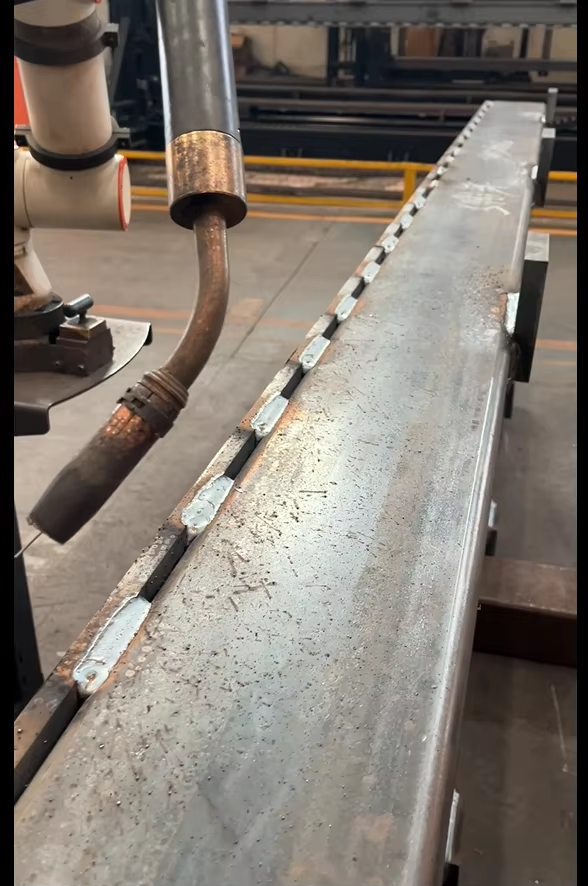
Advanced nesting algorithms calculate the optimal sequence to maintain structural rigidity of the beam during the entire process. In modular framing, where hundreds of small gussets and plates are often nested within the web of a larger H-beam, the software uses “micro-joints” to keep parts from falling and interfering with the 3D head’s path. The 12kW source’s ability to “fly-cut” these micro-joints at high speeds significantly reduces cycle times.
5.0 Application in São Paulo’s Modular Construction Sector
5.1 Urban Density and Speed of Assembly
São Paulo’s construction market is shifting toward off-site manufacturing (OSM) to bypass the logistical constraints of the city’s dense urban core. The 12kW 3D center allows for the production of “ready-to-bolt” kits. During our field observation, a complete floor module frame—consisting of 24 interconnected beams—was processed in 110 minutes. The precision of the laser-cut bolt holes (H11 tolerance) allowed for immediate assembly on-site without reaming.
5.2 Seismic and Wind Load Considerations
While Brazil is not a high-seismic zone, the tall, slender modular towers planned for the Pinheiros and Itaim Bibi districts face significant wind loads. The precision of 3D laser cutting ensures that the moment-resisting frames (MRFs) have 100% surface contact at the joints. Traditional plasma cutting often leaves a slight taper or dross, which can lead to “bolt-slip” over time. The 12kW fiber laser produces a perpendicularity error of less than 0.1mm per 10mm of thickness, providing superior structural damping characteristics.
6.0 Synergistic Automation and ROI Analysis
6.1 Material Handling Integration
The São Paulo facility integrated the 12kW center with an automated storage and retrieval system (AS/RS). Raw beams are automatically loaded onto the infeed conveyor, cross-referenced via barcode for heat-traceability (essential for ISO 9001 compliance in structural steel), and processed without manual intervention. The 12kW source’s speed ensures that the bottleneck is no longer the cutting process, but rather the logistical movement of raw material.
6.2 Energy Consumption and Operational Costs
A common misconception is that 12kW consumes significantly more power than lower-wattage units. However, the “Wall-Plug Efficiency” (WPE) of modern fiber lasers is approximately 35-40%. Because the 12kW unit cuts 2.5x faster than a 6kW unit in 16mm plate, the energy consumed per meter of cut is actually lower. Furthermore, the “Zero-Waste” technology results in a direct 5-8% saving in raw material costs—a critical factor given the volatility of steel prices in the Mercosur market.
7.0 Technical Challenges and On-Site Solutions
7.1 Reflective Back-Reflection Management
When cutting certain grades of galvanized steel often used in modular floor decking, back-reflection can damage the fiber delivery system. The 12kW center is equipped with an optical isolator and a real-time back-reflection monitoring system that modulates the pulse frequency if a high-reflectivity event is detected. This was successfully tested on 3mm G90 galvanized coatings during the São Paulo commissioning phase.
7.2 Assist Gas Optimization
The purity of the assist gas is paramount. We implemented a dedicated Nitrogen generation system with 99.999% purity to ensure “silver-bright” cut edges. This eliminates the need for pickling or acid washing before painting or galvanizing the modular sections, further streamlining the production pipeline.
8.0 Conclusion: The Standard for Modern Infrastructure
The deployment of the 12kW 3D Structural Steel Processing Center in São Paulo represents the pinnacle of current fabrication technology. By solving the twin problems of material waste and dimensional inaccuracy, this system provides the modular construction industry with the tools necessary for high-volume, high-quality output. The “Zero-Waste” nesting logic combined with the sheer power of the 12kW source transforms the processing center from a mere cutting tool into a strategic asset for large-scale urban infrastructure development. Engineering firms adopting this technology can expect a significant reduction in man-hours and a measurable increase in the structural reliability of their modular assemblies.
















